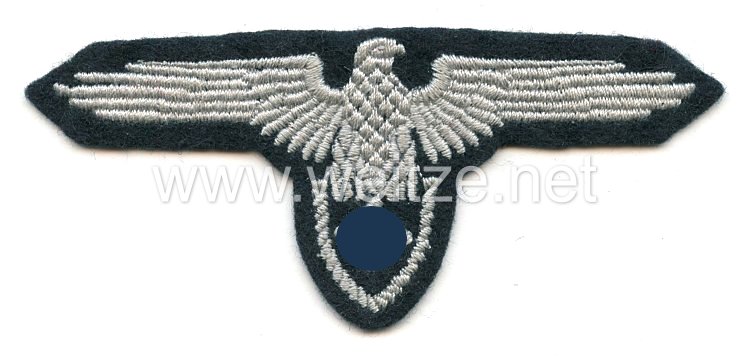
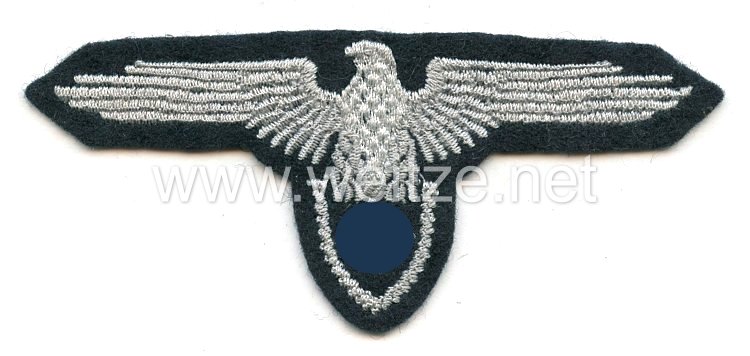
Freiwillige Schutzstaffel der Deutschen Volksgruppe der Slowakei Sleeve Eagle for Enlisted Men
The arm eagle of the Freiwillige Schutzstaffel (Voluntary Protection Squadron) of the German Ethnic Group in Slovakia represents an exceptionally rare piece of equipment from the Second World War era. This machine-embroidered badge for enlisted men on black fabric documents a largely unknown chapter in the history of German minorities in Eastern Europe during the Nazi period.
The German Ethnic Group in Slovakia (Deutsche Volksgruppe in der Slowakei, DVS) formed a significant German minority, primarily residing in the Spiš region, Pressburg (Bratislava), and other areas of Slovakia. Following the establishment of the first Slovak state in March 1939 under the leadership of Jozef Tiso, the German minority received special status. The DVS was established as the official representative organization of the German-speaking population and organized according to the Führer principle.
In the context of increasing societal militarization and close cooperation between Slovakia and the German Reich, the Freiwillige Schutzstaffel (FS) was founded in 1938/39. This paramilitary formation served multiple purposes: it was meant to protect the interests of the German minority, functioned as an internal police force within the ethnic group, and served as a reservoir for future recruitment. The organization was strongly modeled after the SS in the German Reich, though it formally remained an institution of the German ethnic group in Slovakia.
The sleeve insignia described here was worn by enlisted men, meaning regular members without leadership rank, on their uniforms. The machine-embroidered version on black background typically displays a stylized eagle, establishing a connection to the German Reich symbol. The black background color corresponded with the formation's uniform colors and symbolized ideological alignment with the SS.
The technical execution as machine embroidery was standard for enlisted ranks' badges and differed from the more elaborate, often hand-embroidered versions for leaders and higher ranks. Machine production enabled more cost-effective manufacturing while maintaining sufficient quality for daily wear. The embroidery was typically executed on black cloth backing, which was then sewn onto the uniform.
The historical significance of these badges lies in their extreme rarity. Unlike the mass-produced badges of the Wehrmacht or SS in the German Reich, the insignia of the Freiwillige Schutzstaffel of the DVS were intended only for a small group. The German minority in Slovakia comprised approximately 130,000 to 150,000 persons, and only a fraction were organized in the FS. Many members of the formation were later conscripted into the Wehrmacht or Waffen-SS, particularly after 1942.
After the Slovak National Uprising in August 1944, the situation of the German minority deteriorated dramatically. The Freiwillige Schutzstaffel became involved in the fighting, and many of its members fled with the retreating German troops. After the war's end in 1945, the entire German population of Slovakia was expropriated under the Beneš Decrees and largely expelled. This led to the widespread destruction of all material testimonies of the German ethnic group, including uniform equipment.
The preservation of such badges is therefore extraordinarily rare. Most uniform parts and insignia were destroyed or lost during flight, prisoner-of-war captivity, or expulsion. Surviving pieces are found today almost exclusively in specialized collections or were rescued into exile by members of the ethnic group.
From a military-historical perspective, such badges document the complex history of German minorities in East Central Europe during World War II. They illustrate the organization of paramilitary structures outside the Reich territory and the integration of ethnic Germans into National Socialist ideology and power structure. Simultaneously, they shed light on the often tragic fate of these populations, caught between different political fronts.
The condition rating of “2” indicates a well-preserved specimen with minimal signs of use, which is remarkable for a piece over 80 years old. This underscores the special care with which this historical document was preserved.