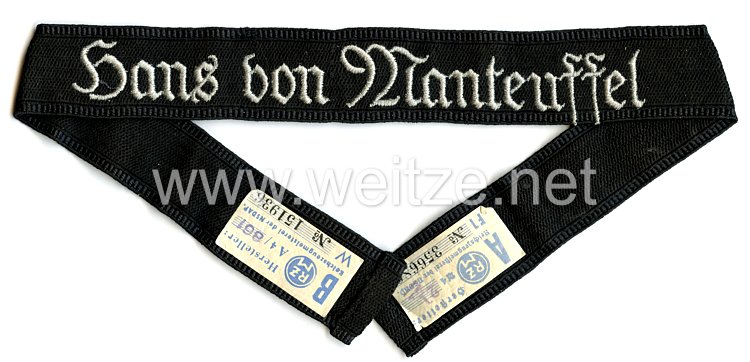
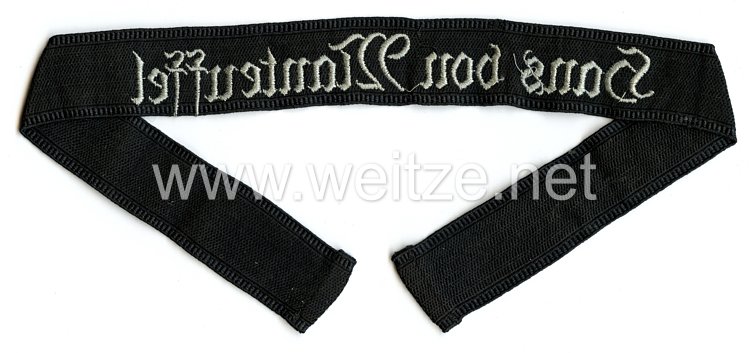
Sturmabteilung (SA) Armband “Hans von Manteuffel”, of SA-Standarte Posen, SA-Gruppe Wartheland

Black woven band with embroidered name inscription. Full length with hemmed ends, reverse with 2 RZM paper labels. Condition 2, very rare.
441345
650,00

Sturmabteilung (SA) Armband “Hans von Manteuffel”, of SA-Standarte Posen, SA-Gruppe Wartheland

This SA armband "Hans von Manteuffel" represents a significant testament to the organizational structure of the Sturmabteilung (SA) during the Nazi period, particularly in the newly organized eastern territories after 1939. This armband belonged to the SA-Standarte Posen, which was subordinate to the SA-Gruppe Wartheland.

The Sturmabteilung was founded in 1920/21 as a paramilitary combat organization of the NSDAP and developed into a mass organization with several million members by 1934. After the so-called "Röhm Affair" in June 1934, the SA largely lost its political significance but remained as an organization, primarily used for pre-military training and representative purposes.

The Wartheland (also called Reichsgau Wartheland or Warthegau) was created on October 26, 1939, by a decree from Adolf Hitler as an administrative unit in occupied Poland. It comprised parts of the former Polish voivodeships of Poznań, Łódź, and Pomerelia, covering an area of approximately 43,900 square kilometers. The city of Posen (Poznań) was designated as the Gau capital. Arthur Greiser was appointed Gauleiter and Reichsstatthalter.

The SA-Gruppe Wartheland was established in the course of the German Reich's expansion and the reorganization of SA structures in the occupied territories. It belonged to the eastern SA groups that were established after the outbreak of war in 1939. SA groups formed the highest regional organizational level of the Sturmabteilung, beneath which SA brigades and SA regiments were organized.

Hans von Manteuffel was a historical figure whose name was used to honor an SA regiment. The naming of SA units after historical personalities or fallen "movement fighters" was common practice within the SA organization. This naming convention was intended to create tradition and strengthen the ideological commitment of members.

SA armbands were essential components of the SA uniform and served multiple purposes: they identified the wearer's affiliation with a specific regiment or unit and were expressions of pride and sense of belonging. The Reichszeugmeisterei (RZM), from 1929 onwards, was responsible for controlling and certifying uniform parts and equipment of the NSDAP and its branches. RZM labeling guaranteed official approval and was meant to ensure quality standards.

The technical execution of this armband corresponds to usual standards: black woven fabric as base material, embroidered name inscription in white lettering. The black coloring of the band was characteristic of SA armbands and corresponded with the black base color of many SA uniform elements. The band was manufactured in full length with the ends hemmed to prevent fraying. The RZM paper labels on the reverse document the official origin and approval of the piece.

The production of such armbands was carried out by authorized manufacturers licensed by the RZM. Manufacturing techniques included weaving and embroidery work executed by specialized textile companies. Quality varied depending on the manufacturer and production period, with earlier pieces often showing higher craftsmanship quality than later wartime productions.

The historical context of the Wartheland was characterized by brutal German occupation policy. The region was subjected to intensive "Germanization," Polish and Jewish residents were expelled or murdered, and German settlers were relocated there. The SA played a subordinate role in this area compared to the SS, police, and civil administration, but was nevertheless integrated into the structures of the Nazi regime.

After the end of World War II, the SA, along with all other Nazi organizations, was banned by the Allies and classified as a criminal organization. Objects like this armband are today historical witnesses of a criminal dictatorship and serve scholarly examination and museum documentation of this era.