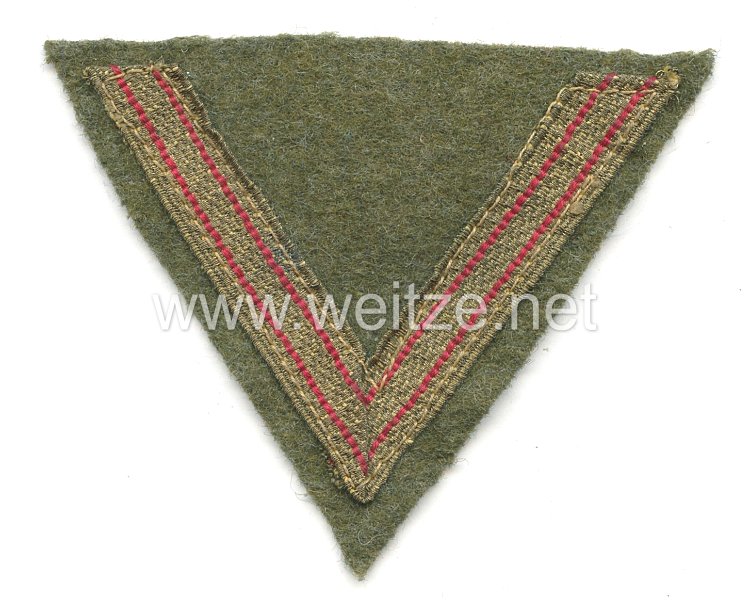
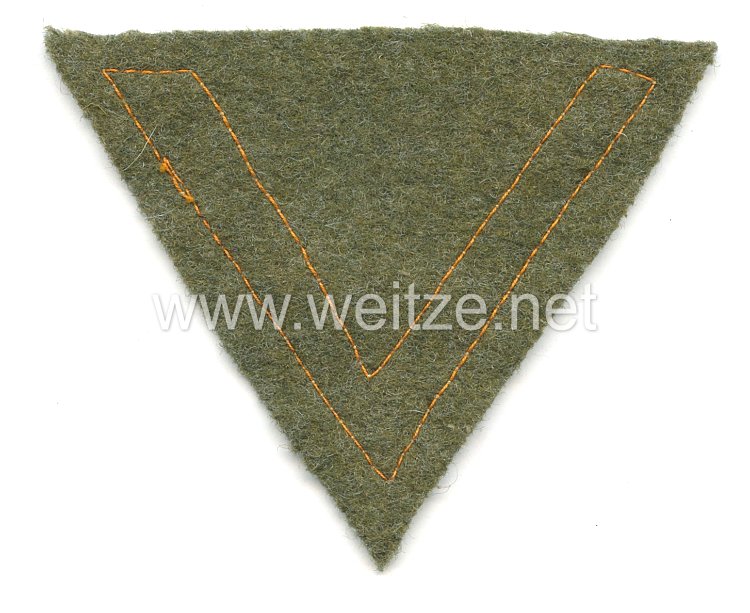
SA Sleeve Chevron for “Alte Kämpfer”

Metal thread woven on brown wool for service tunic. Condition 2.
340845
200,00

SA Sleeve Chevron for “Alte Kämpfer”

The SA sleeve chevron for “Alte Kämpfer” (Old Fighters) represents a significant decorative element within the uniform history of the National Socialist Sturmabteilung (Storm Detachment). This special badge was introduced to identify those SA members who had belonged to the movement before the seizure of power on January 30, 1933, and were thus counted among the so-called “Old Fighters” of the NSDAP.

The Sturmabteilung, officially founded in August 1921, evolved from a paramilitary protection formation into a mass organization with several million members. After 1933, the SA experienced enormous membership growth, creating the need to distinguish early supporters of the movement from later joiners. The sleeve chevron for Old Fighters fulfilled precisely this function of visual differentiation within the SA hierarchy.

The specimen described here shows the typical execution of this badge: woven in metal thread, it was manufactured on brown cloth and worn on the SA uniform's service tunic. The use of metal thread gave the badge a special luster and emphasized the status character of this decoration. The brown cloth corresponded with the characteristic brown SA uniform, which gave the organization its popular nickname “Brownshirts.”

The wearing of the sleeve chevron was precisely regulated by SA clothing regulations. It was attached to the left upper arm of the service tunic and positioned above any rank insignia. This placement made the badge immediately visible to superiors and comrades, identifying the wearer as a member of the early movement.

The term “Alter Kämpfer” itself was precisely defined in National Socialist parlance. Old Fighters were considered to be party members who had joined the NSDAP before January 30, 1933, as well as members of the SA, SS, and other party formations who had been engaged during the “Time of Struggle.” This membership in the early movement brought certain privileges and was regarded as special merit. After 1933, various medals and badges were introduced to document this early membership.

The craftsmanship of such sleeve chevrons varied depending on the manufacturer and production period. Early specimens were often manufactured in higher quality, while later productions were simplified due to wartime conditions. Metal thread weaving required specialized craftsmanship and was performed by various textile manufacturers specialized in military and paramilitary effects.

After the “Night of the Long Knives” from June 30 to July 2, 1934, during which the SA leadership was largely eliminated on Hitler's orders, the organization lost its supremacy within the NS system. The SS under Heinrich Himmler increasingly took over security police functions. Nevertheless, the SA remained as an organization, and its uniform components, including the sleeve chevrons for Old Fighters, continued to be worn.

The significance of such badges in the context of NS rule lay in creating an internal hierarchy and establishing a “movement aristocracy.” Old Fighters enjoyed higher prestige and often had better advancement opportunities in party and state. The visible wearing of corresponding badges publicly emphasized this status.

From a collecting history perspective, such SA sleeve chevrons are today documents of a dark epoch in German history. They serve in museums and scholarly collections for historical documentation and research. The indicated condition 2 suggests a well-preserved specimen that still clearly shows the original design and craftsmanship.

Engagement with such objects requires a responsible historical-scientific approach. They are testimonies of a totalitarian system and its symbolism, whose critical examination contributes to understanding this epoch. The material culture of National Socialism, which includes uniform parts and badges, provides insights into the self-representation and internal organization of the NS movement.

r