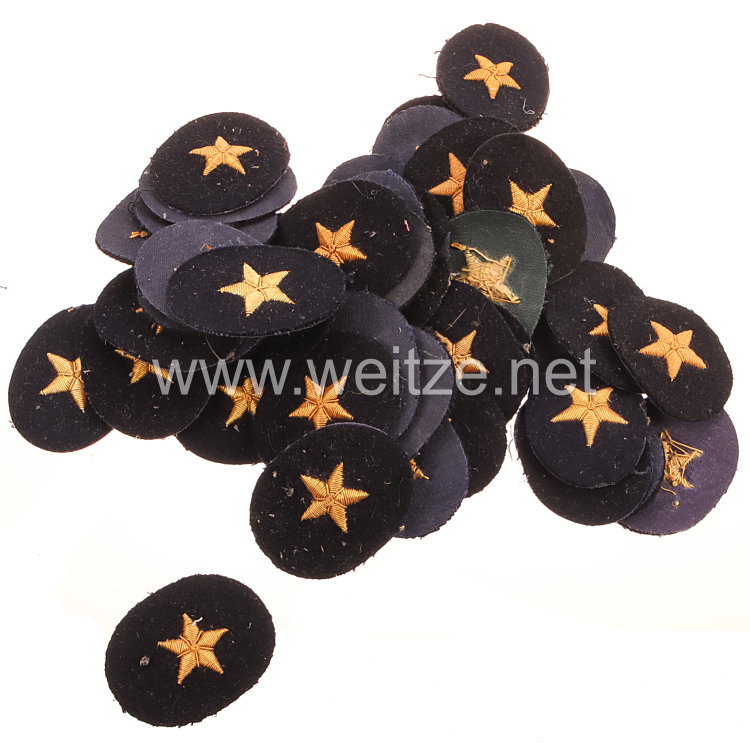
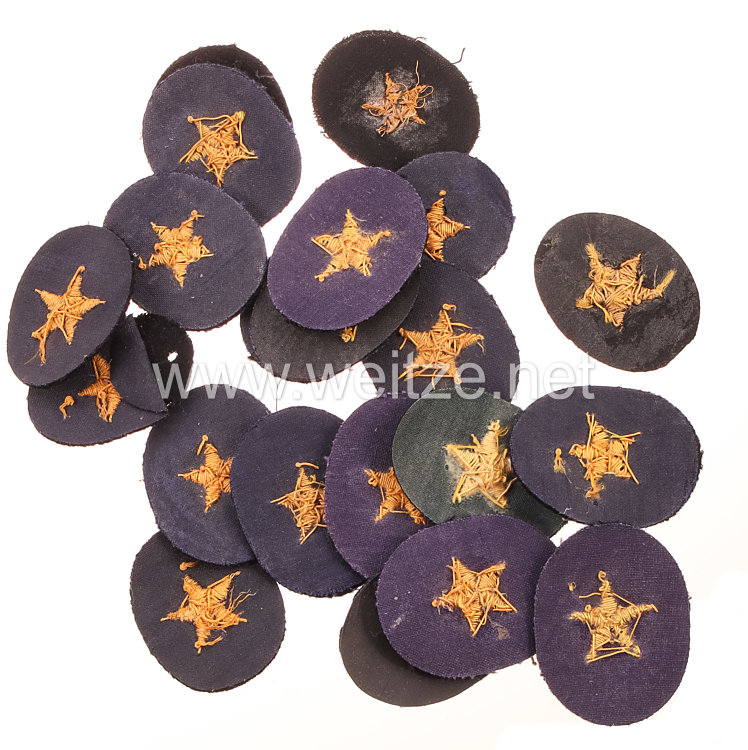
Kriegsmarine Single Sleeve Insignia for a Naval Officer
Price per piece: 12 Euro.
Condition may vary.
The Kriegsmarine Single Sleeve Badge for Naval Officers represents a significant example of maritime uniform studies from the German Reich during the period from 1935 to 1945. These sleeve badges formed an essential component of rank identification in the German Navy and followed a long tradition of naval rank insignia dating back to the 19th century.
The introduction of new Kriegsmarine uniforms occurred following the official reconstitution of the German Navy in 1935, after the provisions of the Treaty of Versailles were gradually set aside. The Dress Regulations for the Kriegsmarine (Anzugsordnung für die Kriegsmarine - A.O.K.) of September 1, 1935, regulated in detail the wearing and execution of all uniform components, including sleeve badges for officers. These regulations were supplemented and refined several times in subsequent years to meet the practical requirements of service.
The Cellon construction described here represents a special variant of sleeve badges. Cellon was a cellulose-based, plastic-like material that found increasing use during the 1930s and 1940s. In contrast to traditionally embroidered gold lace made from metal wire, Cellon badges offered several practical advantages: they were more cost-effective to manufacture, easier to procure, particularly in the later war years, and exhibited a certain water resistance, which was important for maritime use.
Production was carried out by various authorized suppliers who had to meet the strict quality standards of the Kriegsmarine. The Cellon was processed to imitate the golden coloring of traditional gold lace, reproducing the characteristic lace and rank braid patterns.
In the Kriegsmarine, officer ranks were indicated by a system of sleeve stripes (laces) on both upper sleeves. Naval officers wore golden laces in various widths and combinations, depending on rank. A single sleeve badge, as described in this case, could represent various rank groups depending on the specific execution of the lace.
Application was made to the dark blue dress coat as well as other uniform jackets, with the position precisely prescribed: the laces were placed approximately 10 centimeters from the lower sleeve edge. The exact number and arrangement of stripes varied from a narrow stripe for a Leutnant zur See (Sub-Lieutenant) to several wide stripes with rank braid loops for higher officer ranks such as Korvettenkapitän (Lieutenant Commander) or Kapitän zur See (Captain).
During World War II, the Kriegsmarine underwent considerable changes. From initially about 50,000 members, it grew to over 700,000 men by 1945. This massive expansion required corresponding quantities of uniform equipment, including sleeve badges. The use of substitute materials such as Cellon became increasingly important during the war as traditional materials became scarce and industrial capacities were concentrated on war-essential production.
Today, these sleeve badges represent important study objects for uniform studies and maritime military history. The indicated condition 2 according to common collector terminology suggests a well-preserved example with light signs of wear. Typical aging characteristics in Cellon badges include discoloration, slight cracks, or deformations of the material, attributable to the chemical composition and storage conditions.
The scholarly significance of such objects lies in their function as material witnesses to an important section of German naval history. They enable conclusions about manufacturing techniques, material usage, organizational structures, and the daily life of naval officers during this period.
The precise specifications for these badges were documented in official Kriegsmarine publications and manuals. Officers were required to maintain their uniforms to regulation standards, with sleeve badges being inspected during formal reviews. The transition from traditional materials to alternatives like Cellon was officially sanctioned to address wartime material shortages while maintaining the visual uniformity essential to military discipline and identification.