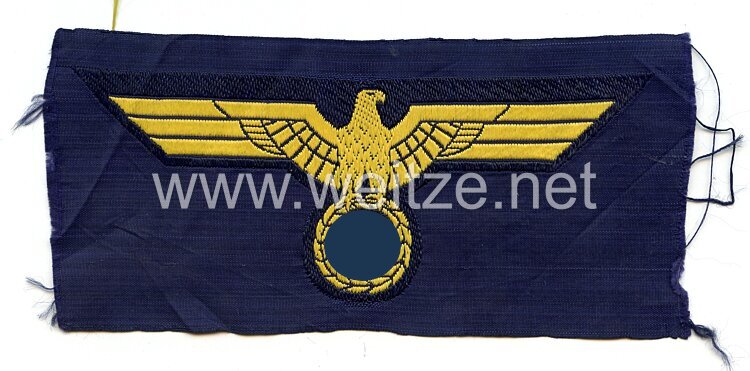
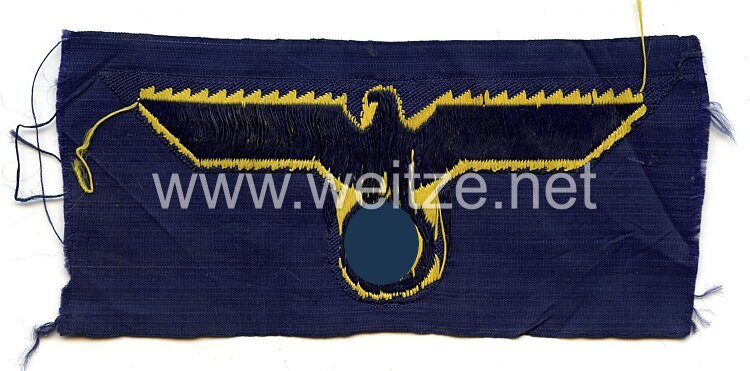
Kriegsmarine Breast Eagle for Enlisted Personnel
The Kriegsmarine Breast Eagle for Enlisted Personnel represents a characteristic insignia of the German Navy during World War II. This particular example is manufactured using the Bevo woven technique and was intended for wear on the blue uniform blouse of enlisted ranks.
The Bevo weaving technique, named after the Barmer Bandweberei Ewald Vorsteher company, revolutionized the production of military insignia in the 1930s. This mechanical weaving technique enabled mass production of precise, durable uniform badges with fine details. Unlike hand-embroidered versions, Bevo-woven eagles were more cost-effective and faster to produce, making them the preferred choice for enlisted ranks.
The Kriegsmarine, officially founded on June 1, 1935, was the naval warfare branch of the German Reich from 1935 to 1945. Following the Treaty of Versailles, which allowed Germany only a limited Reichsmarine, the establishment of the Kriegsmarine represented a significant step in military rearmament. Under the supreme command of Grand Admiral Erich Raeder (1935-1943) and later Grand Admiral Karl Dönitz (1943-1945), the Kriegsmarine grew substantially.
The breast eagle emblem was an essential component of the Kriegsmarine uniform. The introduction of these insignia followed the general uniform reform of the Wehrmacht after 1935. The eagle, a traditional German national symbol, held a swastika in its talons and symbolized the connection between the armed forces and the National Socialist state. For the Kriegsmarine, the eagle was depicted with wings spread to the right, distinguishing it from versions used by other Wehrmacht branches.
The blue uniform blouse of enlisted personnel was the standard service dress for daily duty and non-formal occasions. This blouse, part of the so-called “Borduniform” (shipboard uniform), was made from blue woolen fabric and was designed practically for service aboard ships. The breast eagle was attached to the right breast side of the blouse, according to regulations specified in the Anzugordnung für die Kriegsmarine (Dress Regulations for the Navy).
The distinction between insignia for enlisted personnel and higher ranks was strictly regulated in the Kriegsmarine. While enlisted men wore the Bevo-woven version, officers and non-commissioned officers often received hand-embroidered or metal variants on their uniforms. This hierarchy in insignia quality reflected the military rank structure and was common across all Wehrmacht branches.
The production of these insignia was carried out by various manufacturers throughout the German Reich. The Bevo company in Wuppertal was the leading producer, but other textile companies also received contracts to manufacture uniform insignia. Quality control was strict, and insignia had to meet certain standards to be approved for military use.
The unworn condition of this example is remarkable. Many Kriegsmarine insignia were heavily used during the war and show corresponding signs of wear. Unworn pieces either remained as warehouse stock or were preserved after the war ended. The fact that this insignia was never used makes it a particularly well-preserved example of this uniform component.
After the end of World War II in May 1945, the Kriegsmarine was dissolved. The Allies prohibited the wearing of Wehrmacht uniforms and their insignia. Many uniform pieces and insignia were destroyed, while others were taken as souvenirs or preserved for historical collections. This makes surviving originals today important historical artifacts.
From a conservation perspective, this Bevo-woven insignia represents an excellent example of German textile manufacturing from the 1930s and 1940s. The weaving technique allowed for detail accuracy that was comparable to hand-embroidered versions, while offering greater durability. The colors, typically in white or silver-gray on a blue background, were created through special woven threads that have maintained their color fastness over decades.
For military historians and collectors, such insignia provide important insights into the organization, hierarchy, and material culture of the Kriegsmarine. They document not only the military structure but also the industrial production, logistics, and uniform regulations of the period. Every detail, from the weaving technique to placement on the uniform, followed precise regulations that can today be reconstructed through documents and preserved examples.
The study of these insignia contributes to our understanding of the broader context of military material culture during the Third Reich. They represent the intersection of industrial production, military organization, and ideological symbolism that characterized the period. As historical objects, they serve as tangible connections to the men who served in the Kriegsmarine and the maritime warfare of World War II.