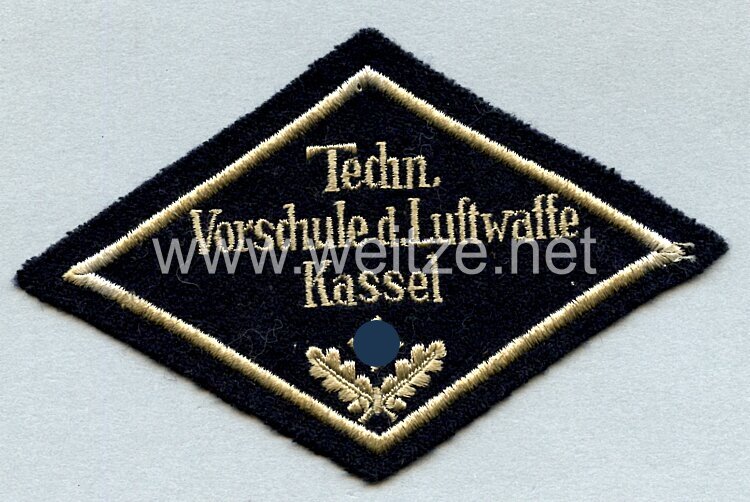
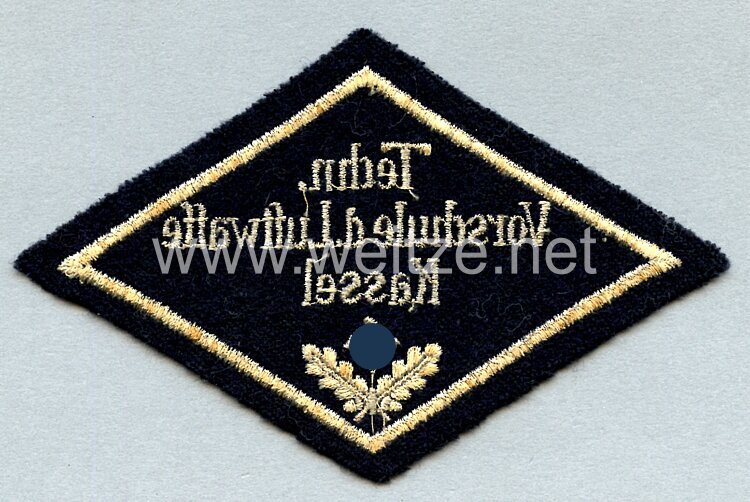
Flieger-HJ Sleeve Diamond “Techn. Vorschule d. Luftwaffe Kassel”

Sleeve diamond for the dark blue winter tunic of the Hitler Youth, white embroidered on blue cotton cloth. Lightly worn, condition 2.
238945
250,00

Flieger-HJ Sleeve Diamond “Techn. Vorschule d. Luftwaffe Kassel”

The Flieger-HJ sleeve diamond bearing the inscription “Techn. Vorschule d. Luftwaffe Kassel” (Technical Preparatory School of the Luftwaffe Kassel) represents a fascinating chapter in National Socialist youth education and the systematic preparation of young Germans for military service during the late 1930s and early 1940s.

The Flieger-Hitlerjugend (Flieger-HJ) or Flying Hitler Youth was established in 1937 as a specialized branch of the Hitler Youth, operating under the direct supervision of the Nationalsozialistisches Fliegerkorps (NSFK) or National Socialist Flying Corps. Its primary purpose was to provide aviation training for male youths aged 14 to 18, ensuring a continuous supply of recruits for the rapidly expanding Luftwaffe. By 1939, membership had grown to over 90,000 boys who received training in theoretical instruction, glider flying, and paramilitary activities.

The Technische Vorschulen der Luftwaffe (Technical Preparatory Schools of the Luftwaffe) formed a special institution within this system. Beginning in 1938, these schools were established at various locations throughout the German Reich, including Kassel, a city with significant aviation industry tradition. These schools served to provide intensive technical education to particularly talented youths who were designated for technical careers in the Luftwaffe. The curriculum included mathematics, physics, mechanics, engine studies, and aircraft construction – all subjects essential for future aircraft mechanics, flight engineers, or aeronautical engineers.

This sleeve diamond was worn on the dark blue winter tunic of the Hitler Youth, which was introduced as service uniform from 1938. The diamond itself is embroidered in white thread on blue cotton fabric – the characteristic colors of the Flieger-HJ, which followed Luftwaffe traditions. It was attached to the left upper arm and identified the wearer as a member of a specialized training institution.

The manufacture of such insignia was subject to strict regulations from the Reichsjugendführung (Reich Youth Leadership). Uniforming served not only practical purposes but was an integral component of National Socialist educational ideology. Through uniform clothing and specific badges, membership, hierarchy, and specialized functions were made visible. This promoted both esprit de corps and competition between different units.

The location of Kassel was strategically important for such an institution. The city housed important armaments manufacturers including the Gerhard Fieseler Works and Henschel Aircraft Works, where among other things the infamous Fi 103 (V1) and various military aircraft were produced. The proximity to these production facilities enabled practical insights and possibly internships for students of the Technical Preparatory School.

Training at such preparatory schools was intensive and selective. Admission was based on strict criteria that included academic performance, physical aptitude, and ideological reliability. Students frequently lived in boarding arrangements and were subject to a military-like daily structure. Instruction combined theoretical foundations with practical exercises, with preparation for military service always in the foreground.

As World War II progressed, training became increasingly shortened and intensified. The growing need for qualified personnel for the Luftwaffe meant that graduates of such schools were often transferred directly into active service after their training. Many of the young men who wore this sleeve diamond found themselves at 17 or 18 years of age working in aircraft factories, at airfields, or even as flight crew in combat operations.

Following the German capitulation in 1945, all organizations of the NSDAP, including the Hitler Youth and its subdivisions, were dissolved and banned by Allied Control Council laws. Uniforms, insignia, and equipment were largely destroyed or taken as war trophies. Surviving pieces like this sleeve diamond are today historical witnesses to a dark epoch in German history.

From a scholarly perspective, such objects offer important insights into the systematization of National Socialist youth education and militarization. They document how the regime methodically mobilized and ideologically shaped an entire generation for war. The specialized nature of this sleeve diamond – with its reference to a technical preparatory school – also illustrates the technocratic aspects of the NS state and its focus on military efficiency and modernization.

Today, such objects are preserved in museums and collections as educational tools to teach subsequent generations about the mechanisms of totalitarian indoctrination and militarization. They serve as reminders of the fate of thousands of young people who were instrumentalized by this system.

r