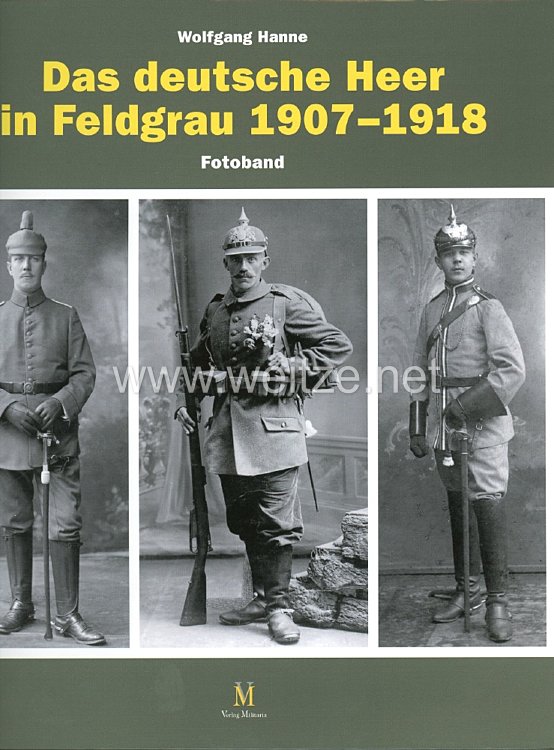
Wolfgang Hanne: The German Army in Field Gray 1907–1918 (Photo Volume)

Verlag Militaria. Illustrated volume with slipcase, 720 pages, approx. 1,100 photographs, hardcover with dust jacket. Format: 29.5×26 cm.

With the introduction of field gray uniforms, the era of the “colorful coat” ended for the German Army. Due to new weapons and combat methods, soldiers' clothing had to be adapted through a “camouflage uniform” to meet the requirements of industrial warfare. The new uniform had been developed several years before the outbreak of war, but underwent its great test during the World War, which led to a radical simplification of the field uniform.

Following the structure of the two-volume text “The Field Gray Uniforming of the German Army 1907–1918,” this photo volume illustrates almost comprehensively all described clothing and equipment items of the field gray uniform and their manner of wear through more than 1,000 period photographs. Through years of collecting activity, the author succeeded in compiling an incredible wealth of striking images that provide a representative cross-section of the entire uniforming. These previously unpublished photographs from what is likely the most extensive private collection on this subject constitute a valuable supplementary volume to the aforementioned work.

For deliveries to non-European countries, increased shipping costs may apply. We ask for a consultation. Pour les livraisons dans des pays non européens, des frais d'expédition plus élevés peuvent s'appliquer. Nous demandons une consultation.
296344
99,00

Wolfgang Hanne: The German Army in Field Gray 1907–1918 (Photo Volume)

This comprehensive photographic volume by Wolfgang Hanne documents one of the most significant transitions in German military history: the introduction of field-grey (feldgrau) uniforms between 1907 and 1918. With over 1,100 period photographs across 720 pages, this work represents an exhaustive visual documentation marking the end of centuries-old tradition of colorful military uniforms.

The development of the field-grey uniform did not begin with World War I, but several years earlier. The Prussian military leadership recognized that traditional colorful uniforms – the Prussian Pickelhaube, bright tunics, and conspicuous distinctions – had become deadly liabilities on the modern battlefield with machine guns, artillery, and aerial reconnaissance. Experiences from the Boer War (1899-1902) and the Russo-Japanese War (1904-1905) had demonstrated that camouflage was essential for survival.

On February 23, 1910, the All-Highest Cabinet Order mandated the introduction of field-grey peacetime uniforms for the entire German Army. This uniform reform resulted from years of trials and discussions. The chosen shade of grey – officially designated as “Feldgrau” or “Hechtgrau” (pike-grey) – proved to be a practical camouflage color with good concealment properties under various lighting conditions and different terrain.

Wolfgang Hanne's photographic volume follows the structure of his two-volume text work “Die feldgraue Uniformierung des deutschen Heeres 1907-1918” and supplements it with nearly complete photographic documentation. The photographs show not only the various uniform pieces but also their practical wear in the field, garrisons, and different operational situations. This makes the work an important source for military historians, uniform specialists, and collectors.

The evolution of the field-grey uniform during World War I reflects the increasing industrialization and rationalization of warfare. What began in 1914 as a relatively elaborate uniform with numerous details and distinctions was progressively simplified by 1918. Material shortages, the necessity of mass production, and practical combat experience led to this “radical simplification,” as mentioned in the object description.

Particularly valuable is the collection of over 1,000 previously unpublished photographs that the author compiled over years. These images from what is likely the most extensive private collection on this subject show soldiers from all branches – from infantry to cavalry to artillery, from pioneers to the newly created aviation units. They document the regional particularities of various German states (Prussia, Bavaria, Saxony, Württemberg) that were partially maintained despite standardization.

The work also covers the equipment items that belonged to the field-grey uniform: the Tornister (knapsack), belt equipment, various forms of helmets (from the initial Pickelhaube with field-grey cover to the Stahlhelm M1916 steel helmet introduced in 1916), gas masks, trench knives, and many other equipment pieces that characterized the life of German soldiers in World War I.

The generous format of 29.5×26 cm allows detailed presentation of photographs, making even fine details of uniforms visible. This is particularly important for understanding the various distinctions and rank insignia that, despite simplification, continued to serve for identifying rank, branch, and unit.

For militaria collectors, this photographic volume represents an indispensable reference work. The period photographs allow precise dating of preserved uniform pieces and equipment and reconstruction of their wear. For historians, the work offers insights into the daily life of German soldiers and the material culture of World War I. The visual documentation supplements written sources and service regulations, showing how military regulations were implemented in practice.

Wolfgang Hanne's work stands in the tradition of German Uniformkunde (uniform studies), which developed as an academic discipline in the 19th century. Unlike older, often idealized representations, this photographic volume is based exclusively on authentic photographs, giving it high documentary value. The field-grey uniform marked the transition from representative to functional military clothing – a process that continues to shape modern military uniforms today.

The 720-page hardcover volume with slipcase published by Verlag Militaria represents the culmination of years of collecting activity and research. It serves as an essential complement to the textual analysis of uniform regulations and provides visual evidence that brings the written word to life. The approximately 1,100 photographs form a representative cross-section of the entire uniform system, from the initial introduction through the various modifications necessitated by four years of total war.

r