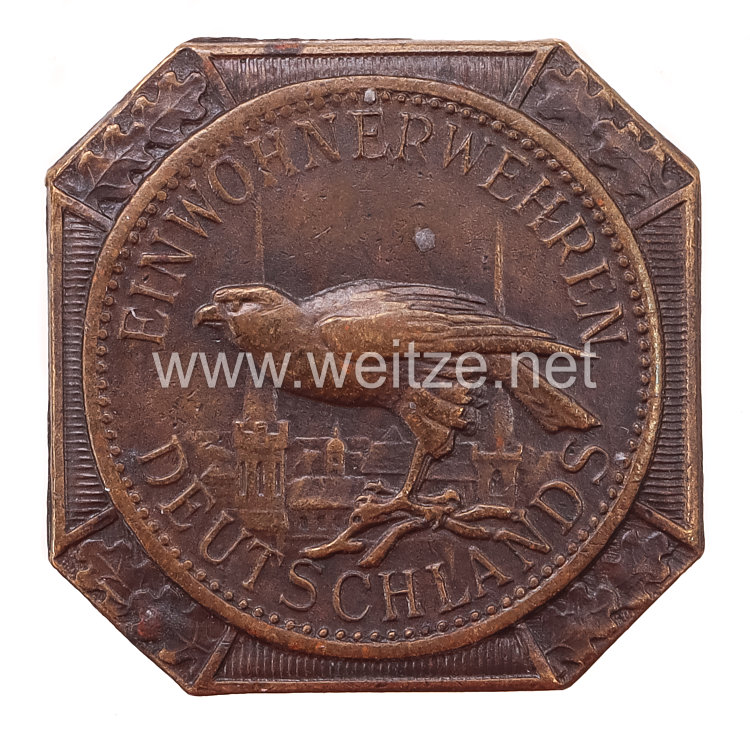
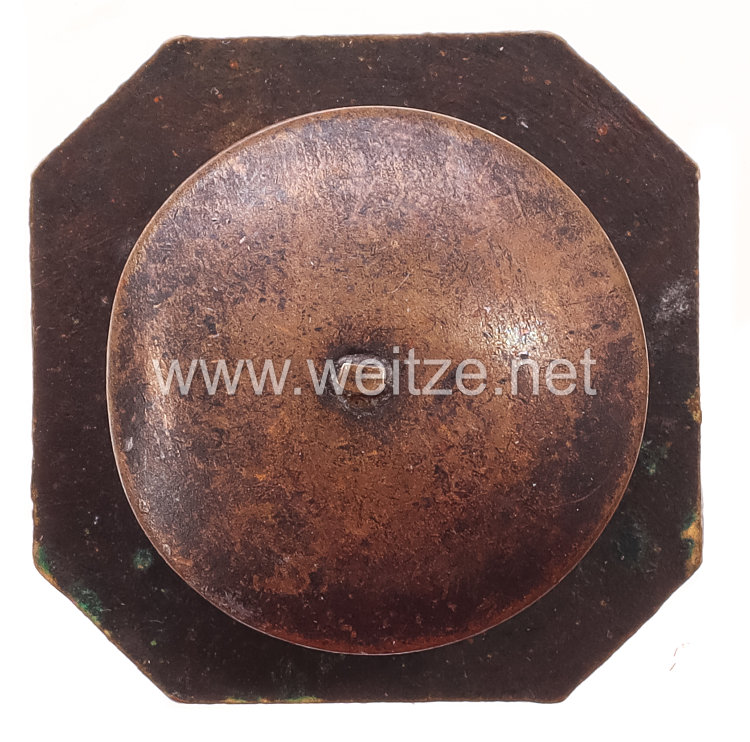
Weimar Republic/Freikorps Bronze Falcon Button of the Einwohnerwehr Deutschland
The bronze falcon button of the Einwohnerwehr Deutschland (Citizen Defense Force Germany) represents a fascinating testament to the turbulent post-war period of the Weimar Republic. This buttonhole decoration made of bronzed base metal embodies the brief but significant existence of paramilitary citizen militia organizations that emerged in the years immediately following World War I.
The Einwohnerwehren (Citizen Defense Forces) formed from 1918/1919 as a reaction to the revolutionary unrest that shook the German Reich after the November Revolution. In a time of political chaos, economic hardship, and social upheaval, citizens, veterans, and local authorities felt compelled to establish their own protective organizations. The Einwohnerwehren understood themselves as forces of order protecting property, public safety, and the existing social order against revolutionary aspirations, particularly against communist and socialist uprisings.
The largest and most significant of these organizations was the Bavarian Einwohnerwehr, which at times counted over 300,000 members. Alongside it existed nationwide organizations such as the Einwohnerwehr Deutschland represented here, which attempted to unite the various local and regional citizen militias under a common umbrella. These organizations recruited primarily from war veterans, bourgeois circles, civil servants, and members of the upper middle class.
The falcon symbol on this badge carries particular symbolic significance. The falcon, a bird of prey known for its keenness, vigilance, and swiftness, symbolized the watchfulness and determination of the Einwohnerwehr. In German symbolism, the falcon traditionally stands for freedom, martial prowess, and aristocratic virtues. The choice of this symbol underscored the organization's claim to function as elite guardians of order.
Such buttonhole decorations served several purposes: they were recognition marks for members, enabled discreet identification of like-minded individuals, and expressed belonging to a community that understood itself as defenders of the German nation. Unlike uniformed badges, these small decorations could also be worn with civilian clothing, which could be advantageous in the politically charged atmosphere of the early Weimar Republic.
The legal status of the Einwohnerwehren was controversial from the beginning. While conservative circles and parts of the Reichswehr regarded them as necessary instruments for maintaining order, left-wing parties and the Allies saw them as a threat to democratic development and a violation of the disarmament provisions of the Treaty of Versailles. Article 177 of the treaty explicitly prohibited the maintenance of militias and paramilitary organizations.
Under increasing pressure from the Allied Control Commission and the Inter-Allied Military Control Commission, the Einwohnerwehren had to be dissolved. In 1920, the Reich government issued corresponding dissolution orders. The Bavarian Einwohnerwehr was officially dissolved on June 30, 1921, other organizations even earlier. The dissolution occurred partly under protest from members and conservative political circles.
Many former members of the Einwohnerwehren later found their way into other paramilitary organizations of the Weimar era, particularly into Freikorps units, the Stahlhelm, or later into the SA. The experiences and networks from the Einwohnerwehr period thus remained effective in the right-wing political spectrum.
From today's historical perspective, the Einwohnerwehren are understood as an expression of the deep social divisions of the early Weimar Republic. They embodied the bourgeoisie's fears of revolution and social upheaval, as well as the weakness of the young democratic state, which was initially unable to fully enforce its monopoly on violence.
Such badges as this falcon button are today rare collector's items that document an important aspect of German history. They serve as reminders of a transitional phase in which state authority, bourgeois self-organization, and paramilitary violence existed in a tense relationship with one another. The bronzed finish testifies to the material shortages of the post-war period, when more expensive metals were not available for such purposes.