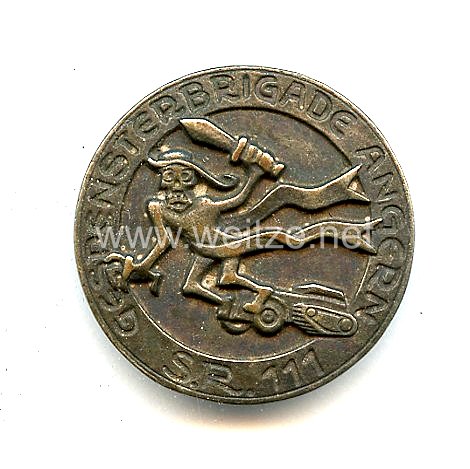
Wehrmacht Cap Badge of the 11th Panzer Division "Angern"
The cap badge of the 11th Panzer Division represents a significant artifact from German military history during World War II. The 11th Panzer Division, which bore the traditional name “Gespenster-Division” (Ghost Division), was established on August 1, 1940, in Silesia and developed into one of the Wehrmacht's most renowned armored formations.
The division originated from the reorganization and redesignation of the 11th Rifle Brigade, with Rifle Regiment 111 (Schützenregiment 111) playing a central role. This regiment, together with Rifle Regiment 110, formed the motorized infantry of the division. The term “Schützenregiment” designated motorized infantry units assigned to armored formations in the Wehrmacht, later renamed Panzergrenadier Regiments.
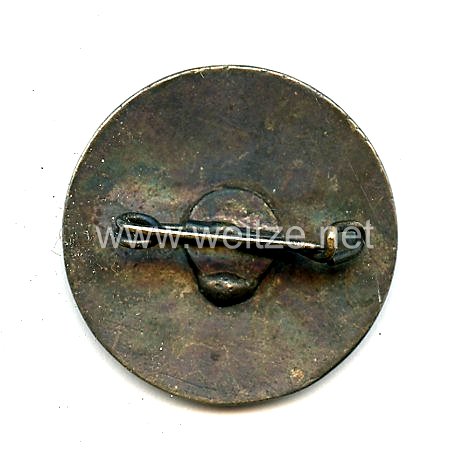
This badge dates from around 1940 and served as the official identification insignia for members of Rifle Regiment 111. Such divisional badges served multiple purposes: they strengthened esprit de corps and unit identification, enabled quick recognition of comrades, and documented membership in a specific formation. The badges were typically worn on the peaked cap, attached by a pin on the reverse side.
The manufacture of such badges was usually carried out by specialized firms that received official contracts. Quality and execution varied depending on the time of manufacture and available materials. Early badges from around 1940 were often characterized by high-quality workmanship and precise details, while later wartime production was frequently simplified due to material shortages.
The 11th Panzer Division participated in numerous significant operations. After its formation, it was initially stationed in occupied France. From June 1941, the division fought in Operation Barbarossa, the German invasion of the Soviet Union. It participated in the encirclement battle of Kiev and later fought at Rostov. Throughout the war, the division operated both on the Eastern Front and, after 1943, in Italy and France.
Rifle Regiment 111 underwent several organizational changes during the war. In 1942, in accordance with the general reorganization of armored formations, it was renamed Panzergrenadier Regiment 111. This redesignation reflected the growing importance and changed tactical role of motorized infantry, which worked closely with tank units.
Wearers of such badges were soldiers of various ranks, from simple riflemen to officers. The wearing of divisional badges was widespread but subject to certain regulations. Not all unit badges were officially approved, though the present badge of Rifle Regiment 111 is described as an official insignia.
From a military-historical perspective, such badges are valuable sources for researching organizational structure, tradition-building, and the self-conception of military units. They document the material culture of the military and provide insight into the symbolism and identity formation within the Wehrmacht. Collectors and researchers value these objects as authentic witnesses to history that establish a direct connection to historical events and the individuals involved.
The preserved condition of the badge with its pin attachment corresponds to the typical wearing method of this era. The rating of “Condition 2” indicates a well-preserved piece with normal signs of wear, which is quite expected for a worn badge from this period. Such traces of use give the object additional authenticity and historical value.
Engagement with such military-historical objects always requires a critical and context-aware approach. They serve historical documentation and research and help paint a more complete picture of twentieth-century military history, without forgetting the crimes and human suffering associated with this history.