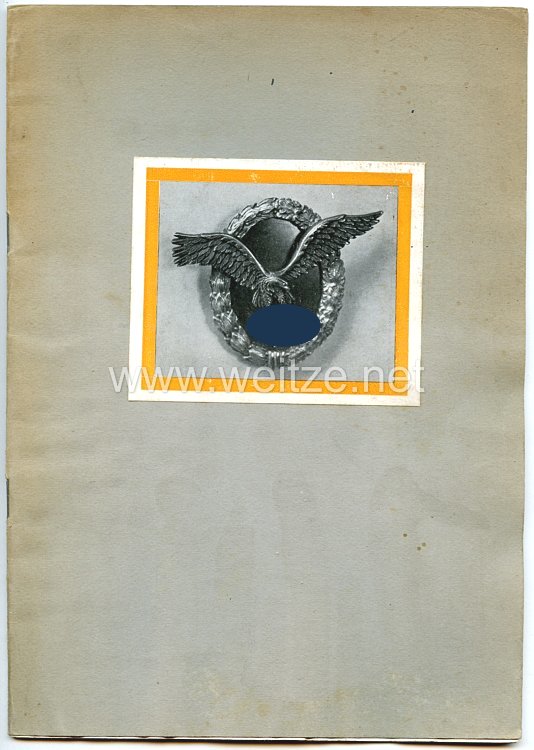
Luftwaffe - Memorial booklet for pilot Franz Erwein Graf von Schönborn-Wiesentheid “In Memory of Franz von Schönborn”

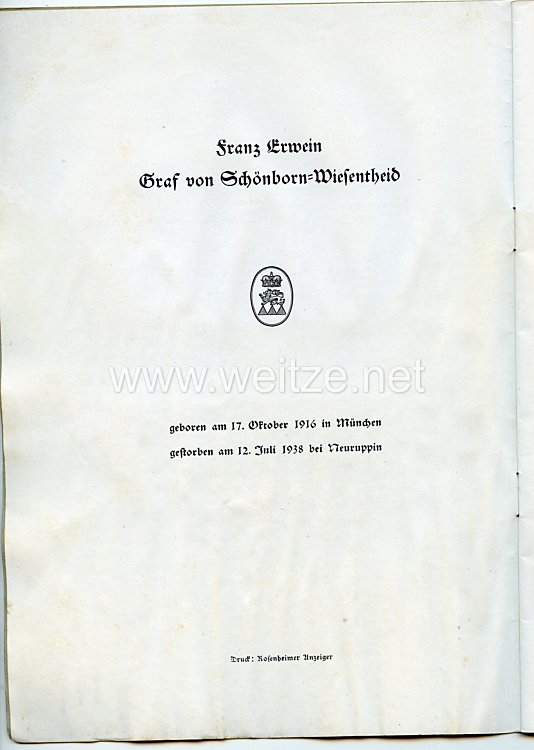
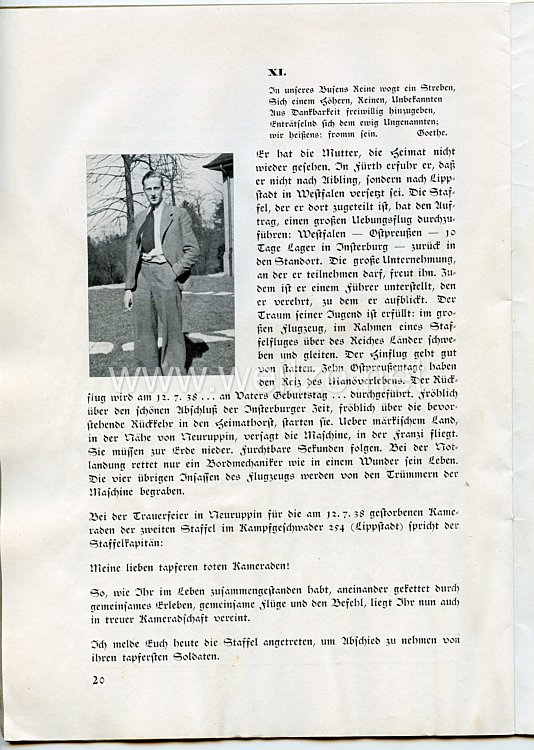
24 pages, with several illustrations, he was a member of II./Kampfgeschwader 254 in Lippstadt and was killed in a crash near Neuruppin on July 12, 1938, along with other comrades; used condition with moisture damage.
393544
40,00

Luftwaffe - Memorial booklet for pilot Franz Erwein Graf von Schönborn-Wiesentheid “In Memory of Franz von Schönborn”

This memorial booklet dedicated to pilot Franz Erwein Graf von Schönborn-Wiesentheid represents a significant aspect of commemorative culture in the German Luftwaffe during the pre-war period. Such memorial publications were frequently produced in the 1930s to honor fallen or deceased comrades and keep their memory alive within the military community.

Franz Erwein Graf von Schönborn-Wiesentheid served with the II. Gruppe of Kampfgeschwader 254, stationed in Lippstadt. The tragic accident occurred on July 12, 1938 near Neuruppin, claiming the lives of several crew members. This incident exemplifies the numerous accidents that occurred during the intensive rearmament and training phase of the Luftwaffe in the late 1930s.

The von Schönborn-Wiesentheid family ranks among the most distinguished noble houses of the Franconian region with centuries of history. The connection between German nobility and military service was traditionally strong, and many young aristocrats viewed service in the newly rebuilt Luftwaffe as an honorable contribution to the reconstruction of German armed forces after the restrictions of the Treaty of Versailles.

Kampfgeschwader 254 was part of the systematic expansion of the Luftwaffe in the second half of the 1930s. The unit at Lippstadt belonged to the growing bomber fleet intended for strategic aerial warfare. Pilot training was intensive but also risky, as modern aircraft were flown under sometimes difficult conditions and safety standards had not yet reached later benchmarks.

The year 1938 marked a phase of accelerated military rearmament in the German Reich. The Luftwaffe expanded rapidly, and the number of aircraft accidents increased proportionally to the intensity of training. Many young pilots lost their lives not in combat but during training flights, due to technical failures, or through human error under difficult conditions.

Such memorial booklets were typically compiled by comrades, superiors, or the deceased's family. They often contained biographical information, photographs in uniform, descriptions of the accident, obituaries from superiors and comrades, and sometimes private remembrances. The 24 pages of this booklet suggest a careful compilation intended to honor the count's life and service.

Illustrations in such booklets frequently showed the deceased in various situations: in uniform, with flight comrades, in front of his aircraft, or at military occasions. They served to convey a comprehensive picture of the personality and document military camaraderie.

The location Neuruppin in Brandenburg was an important area for Luftwaffe activities in the 1930s. The region northwest of Berlin offered suitable conditions for flight exercises and was characterized by several airfields and training areas. The accident of July 12, 1938 was presumably one of many that occurred during this intensive training phase.

The moisture damage and used condition of the booklet attest to its authenticity and age. Such documents were often preserved by family members and did not always survive the decades under optimal conditions. Nevertheless, they are important historical sources providing insight into commemorative culture, military organization, and personal fates of the era.

In the context of military historical research, such memorial booklets hold multiple values: they document the organizational structure of the Luftwaffe, provide information about accident frequency and safety conditions, show the social composition of the officer corps, and illustrate the commemorative practices of the time. Additionally, they enable the reconstruction of individual biographies that might otherwise have been lost.

The fact that several comrades died in the accident suggests a serious crash, possibly during formation exercises or in difficult weather conditions. Such multiple losses were particularly traumatic for affected units and often led to official investigations and adjustments to training regulations.

These memorial publications also reflect the broader culture of honor and remembrance that characterized military institutions of the period. They served not only as personal tributes but also as tools for maintaining unit cohesion and reinforcing the values of duty, sacrifice, and comradeship that were central to military identity.