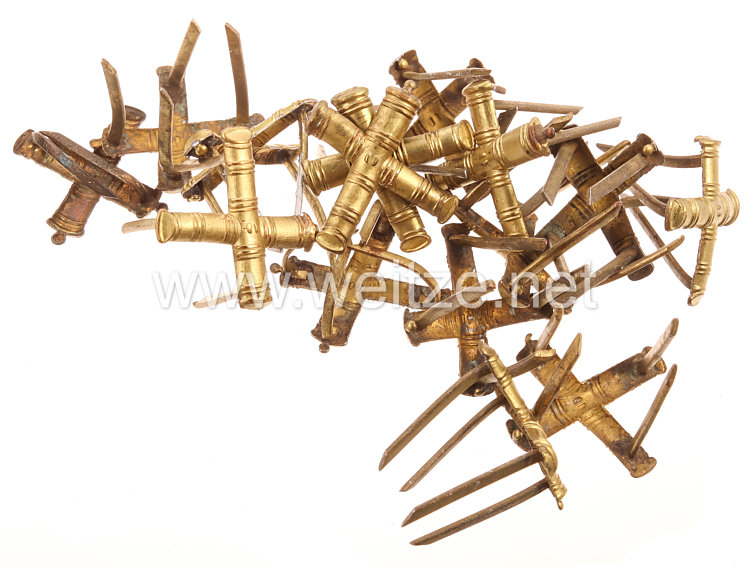
Kriegsmarine Pair of Shoulder Board Underlays for Officers, Line Officer Career

All split pins present, 21 mm, Condition 2

Price per pair:
441544
45,00

Kriegsmarine Pair of Shoulder Board Underlays for Officers, Line Officer Career

Kriegsmarine shoulder board overlays for officers of the executive branch represent a significant aspect of German naval uniforms during World War II. These rank insignia were not merely functional markers of military hierarchy, but also expressions of the long naval tradition that the Kriegsmarine inherited from its predecessor, the Imperial Navy.

The Kriegsmarine was officially established on June 1, 1935, as part of the rearmament of the German Reich under the National Socialist regime. It replaced the Reichsmarine, which had been severely limited by the Treaty of Versailles. With this renaming and expansion came new uniform regulations, detailed in the Anzugordnungen (dress regulations).

The shoulder board overlays described here, with a width of 21 mm, correspond to the standardized measurements for Kriegsmarine officer shoulder boards. The designation Waffenlaufbahn (executive branch) is of particular significance: it distinguished officers into different career paths. The executive branch comprised the actual naval officers trained for service aboard warships and in combat units, as opposed to engineering officers, administrative officers, or medical officers.

These shoulder board overlays were worn on dark blue uniform tunics and typically consisted of gold or silver braid, depending on rank. The split pins, which are completely present in this case, were the fastening elements that secured the shoulder boards to the uniform tunic. These small but important details were crucial for the correct attachment of rank insignia and were precisely regulated in uniform directives.

Kriegsmarine officer ranks ranged from Leutnant zur See (Sub-Lieutenant) to Großadmiral (Grand Admiral). Each rank had specific markings on the shoulder board overlays, displayed through various numbers and arrangements of stars, as well as the width and number of golden braids. The executive branch was additionally identified by specific colors: naval officers traditionally wore no additional branch color, as they represented the core group of the navy.

The manufacture of such shoulder board overlays was carried out by specialized military effects factories and tailoring establishments that had to maintain strict quality standards. The materials were high-quality—golden or silver metallic threads attached to a stable backing. The craftsmanship quality was crucial for the durability and appearance of these rank insignia.

Within the context of the Kriegsmarine, these uniform details played an important role in military identity and hierarchy. The navy particularly maintained the traditions of the imperial era and placed great emphasis on correct uniforming. This was reflected in detailed regulations recorded in manuals such as the “Anzugordnung für die Kriegsmarine” (Dress Regulations for the Kriegsmarine).

The Kriegsmarine itself comprised over 800,000 men at its peak and operated with a fleet ranging from U-boats to large battleships like the Bismarck and Tirpitz. The officers who wore such shoulder board overlays served in all areas of naval warfare, from the submarine service under Karl Dönitz to surface forces.

Following the unconditional surrender on May 8, 1945, the Kriegsmarine was dissolved. Its uniform items and equipment were partly destroyed, partly taken as souvenirs, or passed into collections. Today, well-preserved originals like the described shoulder board overlays are sought-after military-historical objects that provide insight into the uniform regulations and organization of the German Navy during World War II.

The stated condition 2 indicates well-preserved quality, whereby in the military-historical collecting world, a scale is typically used where lower numbers indicate better states of preservation. The completeness of the split pins is an important quality feature, as these small fastening elements were often lost.

These artifacts serve as tangible connections to the organizational structure and visual culture of the Kriegsmarine, offering historians and collectors valuable material evidence of naval uniforming practices during one of history's most significant conflicts.

r