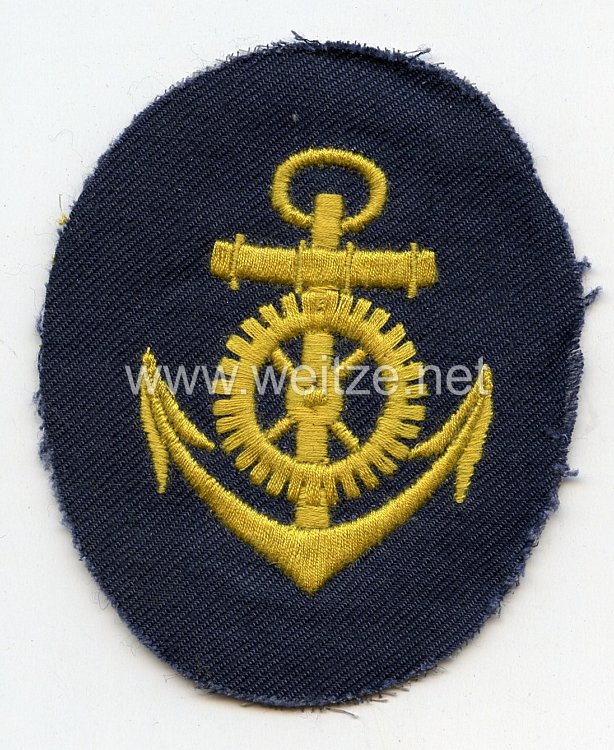
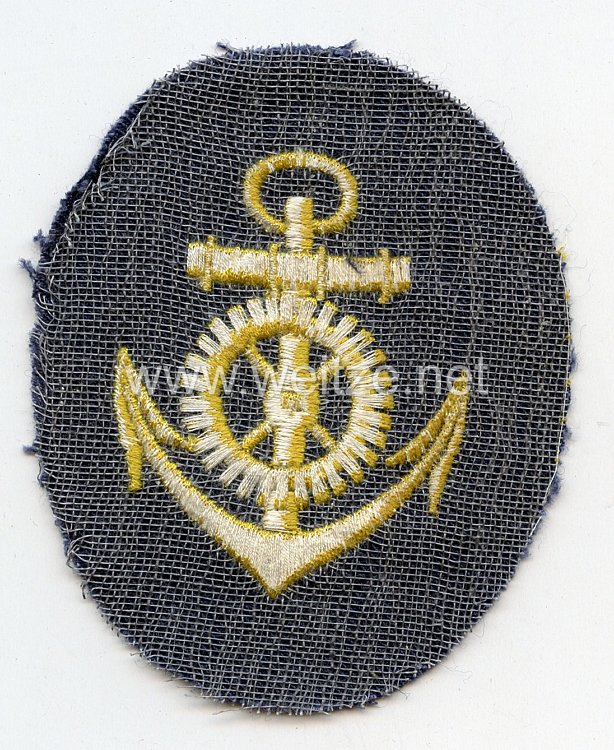
Kriegsmarine Sleeve Insignia Career Path Maschinenmaat (Engine Room Petty Officer)
The Kriegsmarine career sleeve badge for Maschinenmaat (Engine Petty Officer) represents an authentic artifact of the complex rank structure and organizational hierarchy of the German Navy during World War II. This particular version for the blue shirt was machine-embroidered on thin gabardine and represents the technical career path within the non-commissioned officer ranks of the Kriegsmarine.
The Kriegsmarine, established in 1935 following Germany's official repudiation of the Treaty of Versailles, developed an elaborate system of badges and rank insignia that clearly distinguished it from other Wehrmacht branches. Career badges served not only for rank identification but also for designating a sailor's specific specialization. The Maschinenmaat belonged to the technical career path and was responsible for operating and maintaining ship machinery installations.
The Kriegsmarine's career system was divided into several main categories: the seamanship career path, the technical career path, the medical career path, and other specialized paths. The Maschinenmaat was part of the technical career path, which was identified by a special sleeve badge. These badges were worn according to the Anzugordnung für die Kriegsmarine (Uniform Regulations for the Navy), which contained precise regulations about the position, form, and execution of all uniform elements.
The machine embroidery on thin gabardine indicates wartime production, when materials were rationalized and manufacturing methods simplified. Earlier versions were often more elaborately hand-embroidered, while later wartime productions were increasingly machine-made. Gabardine as a backing material was a dense, finely woven fabric particularly suitable for application to uniforms.
The blue shirt (blaues Arbeitshemd or blue work shirt) was an important component of the Kriegsmarine uniform, especially for non-commissioned officers and enlisted men in daily service aboard ship. Unlike parade dress, this uniform was designed for practical use. Engine room personnel spent their service time in the often hot and confined engine rooms of warships, where practical work clothing was essential.
The rank of Maat corresponded roughly to non-commissioned officer in other Wehrmacht branches and represented the first NCO rank. A Maschinenmaat had already completed several years of service experience and technical training. The training encompassed not only theoretical knowledge of ship propulsion systems but also practical skills in maintenance, repair, and emergency procedures. These specialists were indispensable for operating the complex steam turbines, diesel engines, and later electric propulsion systems of warships.
The organization of the Kriegsmarine required thousands of such technical specialists. From small fast attack craft to large battleships like the Bismarck or Tirpitz, every vessel needed qualified engine room personnel. The U-boat force, which played a central role in German naval warfare, was particularly dependent on well-trained Maschinenmaten, as the complex diesel-electric propulsion systems required the highest reliability.
The preservation of such sleeve badges today offers important insights into the material culture and organizational structure of the Kriegsmarine. The stated condition of 2- indicates a well-preserved specimen that was likely worn but shows no significant damage. Such objects are important study materials for uniform experts and military historians, as they document authentic details about manufacturing techniques, materials, and wearing regulations.
Research into these military equipment items contributes to understanding the technical and organizational aspects of naval warfare and helps create a more complete picture of maritime war, beyond the tactical and strategic considerations that often dominate the foreground. These badges represent the thousands of skilled technicians whose expertise kept the German naval war machine functioning throughout the conflict.