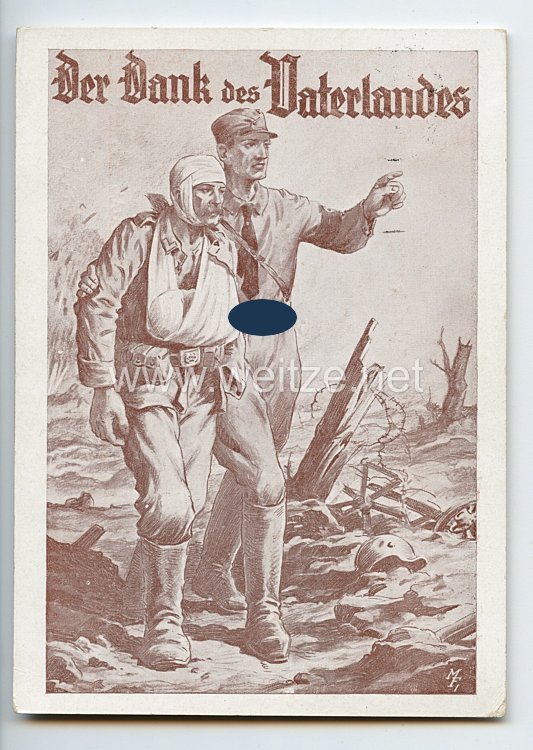
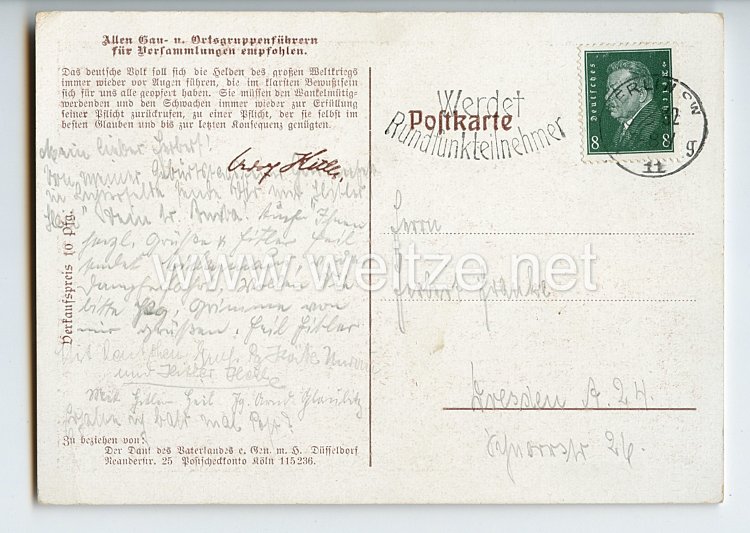
Third Reich - Color Propaganda Postcard - "The Gratitude of the Fatherland - Recommended to All Gau and Ortsgruppen Leaders for Assemblies"

available from: Der Dank des Vaterlandes e.Gen.m.H. Düsseldorf, mailed 1932, condition 2.
383944
120,00

Third Reich - Color Propaganda Postcard - "The Gratitude of the Fatherland - Recommended to All Gau and Ortsgruppen Leaders for Assemblies"

Nazi Propaganda Postcards: Instruments of Political Mobilization

This colored propaganda postcard from 1932, titled “Der Dank des Vaterlandes” (The Gratitude of the Fatherland), impressively documents the propaganda methods of the NSDAP during the crucial phase before the seizure of power. The card bears the note “Recommended to all Gau and local group leaders for meetings” and was available through Der Dank des Vaterlandes e.Gen.m.H. in Düsseldorf.

The year 1932 marks a turning point in German history. Several decisive elections took place that year: the Reich presidential election in March and April, as well as two Reichstag elections in July and November. The NSDAP was engaged in an intensive propaganda campaign to win voters and strengthen its organization at all levels. Postcards like this played an essential role as cost-effective and far-reaching propaganda tools.

The organizational structure of the NSDAP was already highly developed at this time. The party was divided into Gaue (regional districts), led by Gauleiters, while Ortsgruppen (local groups) represented the smallest territorial units. The direct address to “Gau and local group leaders” on this postcard shows how propaganda materials were systematically distributed through the party structure. These functionaries were to use the cards at meetings, which were a central element of National Socialist agitation.

The title “Der Dank des Vaterlandes” draws on a classic military and patriotic motif. This phrase was traditionally associated with honoring soldiers and war veterans. The NSDAP skillfully exploited the resentments and sense of humiliation that many Germans felt after the Treaty of Versailles. By alluding to the “gratitude of the Fatherland,” the propaganda appealed to the population's sense of honor and national identity.

The fact that the card was distributed through a registered cooperative with limited liability (e.Gen.m.H.) in Düsseldorf illustrates the professional organization of Nazi propaganda. Even before seizing power, the party had built an extensive network for producing and distributing propaganda materials. Düsseldorf, as an industrial city in the Rhineland, was an important center of political confrontations during this period.

The use of colored postcards was remarkable for that time, as color printing was more expensive than simple black-and-white printing. This indicates that the NSDAP invested considerable financial resources in its propaganda and recognized the psychological impact of colored images. Colored representations were more emotionally appealing and particularly stood out in an era when most printed matter was still black and white.

Postcards were a widespread means of communication in the Weimar Republic. They were inexpensive to send and reached all social classes. Propaganda postcards were not only mailed but also distributed at meetings, displayed in shop windows, or passed on as collectibles. They thus served as versatile carriers of political messages.

The recommendation for meetings underscores the central importance of these events in Nazi propaganda. In the years before 1933, the NSDAP organized countless meetings where speakers sought to inspire the masses with emotional appeals. Propaganda materials like this postcard reinforced the oral messages and created lasting visual impressions.

The inscription “1932 gelaufen” (mailed in 1932) shows that this specific card was actually transported through the postal system, underscoring its historical authenticity. It thus served not only as propaganda material but was actively used for communication, allowing the political message to reach even more recipients.

In the context of collecting history, such objects are today important witnesses to the propaganda methods of totalitarian regimes. They document how political movements systematically used visual media to mobilize support and spread their ideology. For research, they offer insights into everyday propaganda beyond the well-known posters and films.