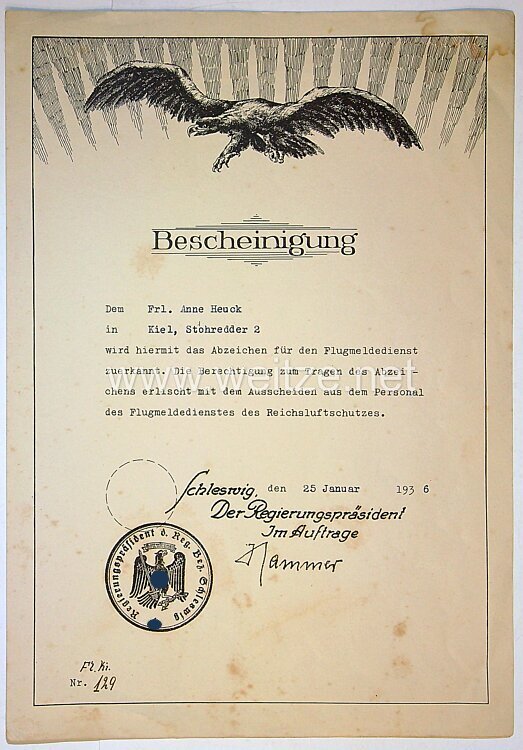
Reichsluftschutz - Aircraft Warning Service Badge - Certificate for a Woman in Kiel

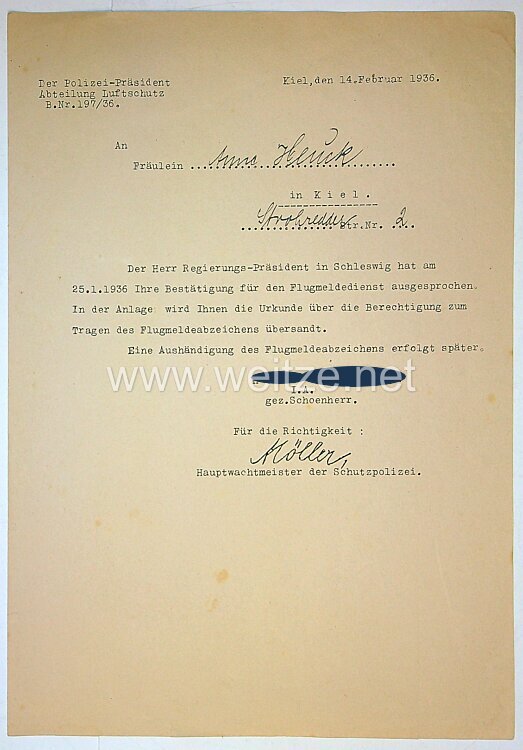
for wearing the badge which expires upon leaving the Aircraft Warning Service personnel, issued on January 25, 1936 in Schleswig; attached is the cover letter for the certificate dated February 14, 1936; slightly used condition, some foxing.
457343
140,00

Reichsluftschutz - Aircraft Warning Service Badge - Certificate for a Woman in Kiel

This certificate documents a fascinating chapter of German civil air defense history from the National Socialist era. It relates to the awarding of the Aircraft Warning Service Badge of the Reich Air Protection League to a woman in Kiel, issued on January 25, 1936, in Schleswig, with an accompanying cover letter dated February 14, 1936.

The Reichsluftschutzbund (RLB) was founded on April 29, 1933, and rapidly developed into the largest civilian organization in Nazi Germany. Its primary task was to prepare the civilian population for possible air raids and to establish a comprehensive network of air defense measures. By 1939, the RLB counted over 13 million members, which underscores the enormous importance of this organization for the NS regime.

The Aircraft Warning Service (Flugmeldedienst) formed an essential component of the civilian air defense system. This institution was responsible for early detection of enemy aircraft, reporting their presence, and tracking their movements. The network of observation posts extended across the entire Reich territory and worked closely with the Luftwaffe. Aircraft spotters were often stationed in elevated positions – on towers, hills, or special observation posts – and reported their sightings via telephone or radio to central reporting stations.

The year 1936, when this certificate was issued, marked a significant moment in German rearmament. The reintroduction of universal conscription in 1935 and the remilitarization of the Rhineland in March 1936 demonstrated Hitler's increasingly aggressive foreign policy. The systematic expansion of air defense was part of comprehensive war preparations, even though these were presented to the population as purely defensive measures.

Particularly noteworthy is that this certificate was issued to a woman. This reflects the important role that women played in the Aircraft Warning Service. As many men were or would be conscripted for military duties, women increasingly assumed responsibility in civilian air defense organizations. The Aircraft Warning Service offered women an opportunity to actively participate in the “protection of the homeland,” with their activity considered particularly responsible.

The certificate contains an important legal note: The right to wear the badge expires upon departure from the personnel of the Aircraft Warning Service. This regulation emphasizes that this was a service badge, not a permanently awarded decoration. The badge itself was typically made of metal and frequently displayed symbolic elements such as aircraft, radio waves, or the RLB emblem.

The issuance in Schleswig for a person in Kiel illustrates the administrative structure of the Reich Air Protection League. Kiel, as an important naval base and industrial city, was considered a particularly vulnerable target for potential air raids. The Aircraft Warning Service in this region therefore had strategic importance for the early detection of aircraft approaching across the Baltic Sea.

The two-week interval between the issuance of the actual certificate (January 25) and the cover letter (February 14) was typical of the bureaucratic procedures of the time. The NS administration placed great emphasis on proper documentation and multiple documents for different purposes and archives.

The preserved condition with slight signs of use and foxing is characteristic of documents from this period that were actually used and not merely archived. The foxing suggests storage under less than optimal conditions, possibly during or after World War II, when many personal documents were kept under difficult circumstances.

Such documents today are important testimonies to everyday life under National Socialism. They document the comprehensive mobilization of society and the integration of women into the military-civilian system of war preparation. For historical research, they offer insights into organizational structures, the motivation of participants, and the systematic preparation for the coming war, long before it began in 1939.

The certificate represents a tangible connection to a period when German society was being systematically prepared for total war. The Aircraft Warning Service, while ostensibly a defensive measure, was an integral part of Germany's offensive military planning. The participation of civilians, including women, in this system demonstrates how deeply the militarization of society had penetrated by the mid-1930s, years before the outbreak of World War II.

r