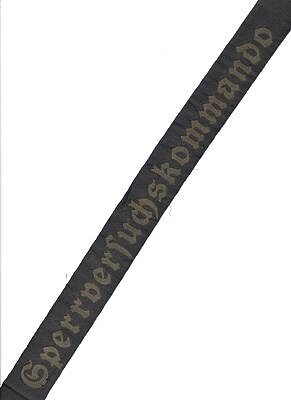
Kriegsmarine Cap Tally "Sperrversuchskommando"
The cap tally of the Sperrversuchskommando (Barrier Trials Command) of the Kriegsmarine represents a particularly rare and significant piece of German naval history from World War II. This metal-thread woven version represents a highly specialized unit that dealt with the development and testing of barrier weapons – a crucial aspect of maritime warfare.
The Sperrversuchskommando belonged to the scientific-technical special units of the Kriegsmarine, whose task was the development, testing, and improvement of mine barriers and other maritime barrier weapons. These commands played an important role in German naval warfare strategy, as sea mines and barriers were of great importance for both defensive and offensive operations. The unit was responsible for conducting trials with various types of mines, net barriers, and other obstacle devices.
The cap tallies of the Kriegsmarine had served since the Imperial Navy as an important identifying feature and bore the designation of the ship, shore establishment, or special unit to which the wearer belonged. According to the Regulation on the Uniform of the Kriegsmarine, cap tallies were prescribed for enlisted men and non-commissioned officers and were worn on the peaked cap. The ribbons typically had a length of approximately 140-150 cm and were tied into a bow at the back of the head.
The metal-thread woven version presented here represents a special variant. While simple cap tallies were made from cotton or artificial silk with printed or embroidered inscriptions, the metal-thread bands were more elaborately manufactured. In this technique, the letters and decorations were woven directly into the band, using metal threads – usually aluminum or silver-plated wire. These versions were more expensive and were often privately purchased by the naval personnel themselves, who wanted to emphasize their affiliation with an elite or special unit.
The design of the cap tallies followed a standardized pattern: the name of the unit appeared in Gothic or Latin script, framed by gold or silver decorations. Stylized oak leaves or other naval symbols were typical. The base color was traditionally black, symbolizing the connection to Prussian-German naval tradition.
The Sperrversuchskommando was organizationally subordinated to the Torpedo Experimental Institute or similar technical establishments. Such commands operated from various locations, frequently in the Baltic Sea, where protected waters were available for trials. The work of these units was strictly secret, as developments in mine technology were of strategic importance. Germany deployed various innovative mine types during World War II, including ground mines with magnetic, acoustic, and pressure fuzes, which caused significant losses among Allied ships.
Members of the Sperrversuchskommando were typically highly qualified technical personnel, including engineers, technicians, and specially trained sailors. Their activity included not only theoretical development but also practical trials at sea, where new weapons were tested under realistic conditions. This was associated with considerable dangers, as handling explosives and detonation mechanisms involved high risk.
The described condition of the cap tally – worn and faded – indicates actual service use. The metal threads could lose their luster through saltwater, sun exposure, and mechanical stress in everyday naval life. This gives the object authentic historical patina and documents actual use by a member of this specialized unit.
Cap tallies from special commands and smaller units are particularly rare today, as these units had only limited personnel strength and correspondingly few ribbons were produced. This makes the cap tally of the Sperrversuchskommando an important historical witness to the technical-scientific work within the Kriegsmarine.
After the war, many of these cap tallies were destroyed or lost. Surviving examples are now found in museums, collections, and with private militaria collectors. They serve as material witnesses to a vanished military organization and its highly specialized subdivisions, whose work significantly influenced maritime warfare in World War II.