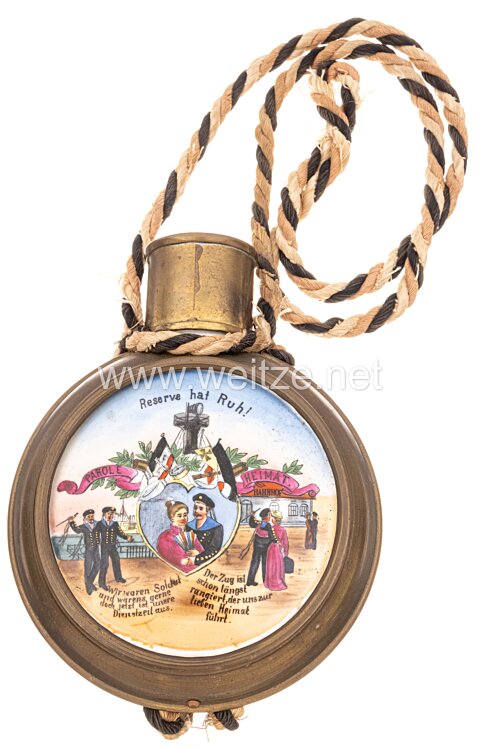
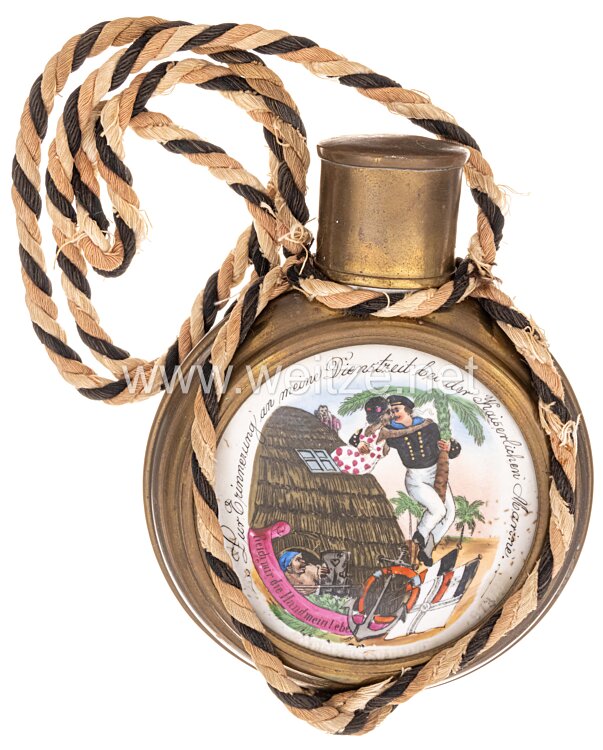
Imperial German Navy Reservist's Flask with “African” Motif for Reservist “Helm. Kramner 1913”
This Imperial Navy reservist flask from 1913 with African motifs represents a fascinating chapter of German military and colonial history on the eve of World War I. This hand-painted porcelain flask in brass mounting belonged to reservist Helm. Kramner and documents the tradition of reservist farewell gifts in the German Empire.
The Imperial Navy (Kaiserliche Marine) experienced unprecedented expansion between 1898 and 1914 under the aegis of Grand Admiral Alfred von Tirpitz and Kaiser Wilhelm II. The Naval Acts of 1898 and 1900 envisioned the construction of a modern war fleet that would not only control European waters but also protect German colonial territories in Africa, Asia, and the South Pacific. Naval servicemen typically served three years of active duty, followed by several years in the reserves.
The custom of commissioning personalized reservist flasks or reservist steins upon discharge from active service became established in the second half of the 19th century and reached its peak between 1890 and 1914. These commemorative pieces were manufactured by specialized porcelain factories and potteries, particularly in Thuringia, Saxony, and Bavaria. The objects were not intended for practical use but served as mementos of military service and status symbols in middle-class households.
The African motif on this flask references German colonial aspirations in Africa. At the time of Kramner's discharge in 1913, the German Empire maintained four colonial territories on the African continent: German East Africa (present-day Tanzania, Rwanda, and Burundi), German Southwest Africa (present-day Namibia), Cameroon, and Togo. The Imperial Navy played a central role in enforcing and maintaining German colonial rule through its cruiser squadrons and various stations such as the East Asia Squadron in Tsingtao.
Naval personnel were regularly deployed for colonial operations. They served on cruisers and gunboats patrolling African coasts, participated in suppressing uprisings such as the Maji-Maji Rebellion (1905-1907) in German East Africa or the Herero Uprising (1904-1908) in German Southwest Africa. The depiction of African motifs on reservist flasks often reflected the romanticized perception of colonial service that was popular in the German Empire.
The artistic design of such flasks followed established conventions. Typically, they displayed military symbols such as anchors, ships, flags, and coats of arms, combined with personal information about the soldier, his unit, and period of service. The hand-painted execution on porcelain required specialized craftsmanship. Manufacturers employed trained porcelain painters who applied the decorations freehand before the pieces were fired at high temperatures to permanently fix the colors.
The brass mounting with lid and cord was characteristic of high-quality reservist flasks. The brass not only offered practical protection for the neck and opening of the flask but also gave the object a military-official character. The cord allowed for carrying or hanging the flask and was frequently colored in the Imperial colors of black-white-red.
The year 1913 marks the last year of peace before World War I. The Imperial Navy was at the height of its expansion and comprised the world's second-largest war fleet after Britain. Naval armament had significantly contributed to the deterioration of German-British relations and was a factor in the complex alliance system that led to the outbreak of war in 1914. Reservist Kramner, who completed his service in 1913, was likely reactivated when war broke out in 1914, as was the case with millions of German reservists.
The condition grade 2 of this flask indicates good preservation with minimal signs of wear. The completeness with original lid and cord is remarkable, as these components were frequently lost. Such objects were often hidden or discarded after 1918 because they were associated with the defunct Empire. Surviving examples today are important cultural-historical witnesses to the Wilhelmine era and German military history.
This reservist flask documents the intersection of personal military history, colonialism, and material culture in the German Empire and offers valuable insights into the mentality of the Wilhelmine epoch.