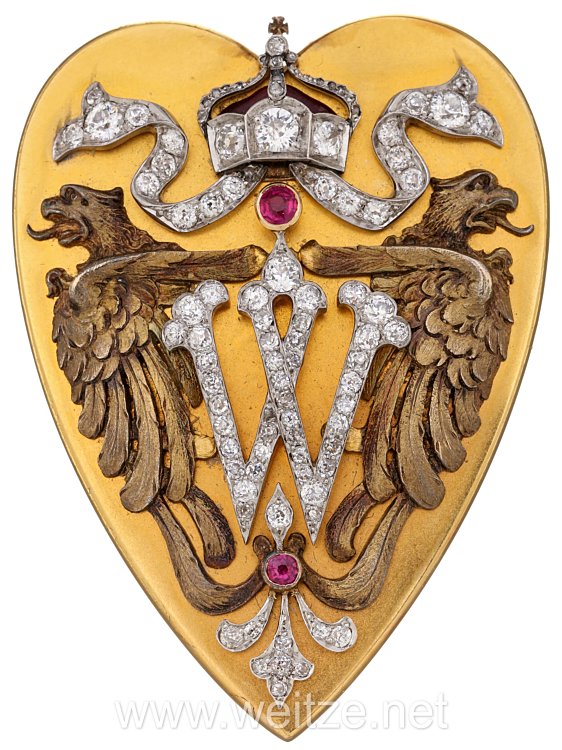
Kaiser Wilhelm II: Golden Heart-Shaped Appliqué with Diamonds for a Presentation Box on the Occasion of the Christening of the Youngest Son of his Brother Prince Heinrich of Prussia

Circa 1900. Heart-shaped coat of arms in gold with 2 applied Prussian eagles shown in profile, at the center the cipher of Wilhelm II set with diamonds and rubies: Imperial crown over “W”. Height 65 mm, weight 42.5 grams. Beautiful finest jeweler's work, the 93 old mine cut diamonds (approx. 2.75 carats) of fine quality, the 2 rubies (approx. 0.6 carats) of very fine quality and color.
On March 15, 1900, Kaiser Wilhelm presented his brother Prince Heinrich with a magnificent golden presentation case on the occasion of the christening of his youngest son Heinrich (1900-1904). The golden box was melted down after World War I, but the appliqué was removed beforehand. On the reverse, a fine engraving was added as a remembrance “Kiel, 15. März 1900”, below it the crowned cipher of the young Prince Heinrich, who died at the tender age of only 4 years in 1904. (The old mounting pins for the gold box are still present on the reverse). An imperial presentation object of the highest jeweler's quality. In excellent condition.

Heinrich von Preußen (born August 14, 1862 in Potsdam; died April 20, 1929 in Hemmelmark).
Albert Wilhelm Heinrich von Preußen was a son of the later Kaiser Friedrich III and grandson of Kaiser Wilhelm I. His mother, Empress Victoria, was the eldest daughter of British Queen Victoria. Heinrich was the younger brother of Kaiser Wilhelm II.

340143

An Imperial Gift: The Heart-Shaped Gold and Diamond Appliqué of Kaiser Wilhelm II

Among the personal presentation objects of the House of Hohenzollern, few carry as poignant a story as this extraordinary piece. This heart-shaped gold appliqué – a heraldic shield originally mounted on a magnificent gold presentation box – was created circa 1900 as a personal gift from Kaiser Wilhelm II to his younger brother, Prince Heinrich of Prussia, on the occasion of the baptism of Heinrich’s youngest son. The ceremony took place on 15 March 1900 at Kiel, near the naval base where Prince Heinrich was stationed.

The appliqué is a unique piece of the finest jeweler’s craft. The heart-shaped heraldic shield is fashioned from gold and bears two applied Prussian eagles facing sideways. At its center is the cypher of Wilhelm II – an Imperial crown over the letter “W” – set with 93 old-cut diamonds (approximately 2.75 carats) of fine quality and two rubies (approximately 0.6 carats) of very beautiful quality and color. The piece measures 65 mm in height and weighs 42.5 grams. On the reverse, a fine engraving reads “Kiel, 15. März 1900” alongside the crowned cypher of the young prince. The original attachment pins that once secured the appliqué to the gold box remain present on the reverse side.

The Occasion: A Prince’s Baptism

The gift commemorated the baptism of Prince Heinrich’s youngest son, who bore the full name Prince Heinrich Viktor Ludwig Friedrich, born on 9 January 1900. The baptism was held at Kiel Castle. Such jeweled gold boxes were characteristic of imperial diplomatic and familial gift-giving customs during the Wilhelmine era, serving as tangible expressions of dynastic bonds and sovereign magnificence.

The young prince’s story would end in tragedy. The infant was a hemophiliac, afflicted by the hereditary bleeding disorder that haunted several European royal houses. At the age of just four, Prince Heinrich died on 26 February 1904 from a brain hemorrhage following a fall. His early death lent his uncle’s baptismal gift a deeply melancholic significance as a memorial to a brief and fragile life.

The Giver and the Recipient

Kaiser Wilhelm II was German Emperor and King of Prussia, the most powerful sovereign in continental Europe at the turn of the twentieth century. His younger brother, Albert Wilhelm Heinrich of Prussia (born 14 August 1862 in Potsdam, died 20 April 1929 in Hemmelmark), rose to the rank of Grand Admiral in the Imperial German Navy. Both were sons of the later Emperor Friedrich III and grandsons of Emperor Wilhelm I. Their mother, Empress Victoria, was the eldest daughter of Britain’s Queen Victoria, a fact that underscored the intimate dynastic ties between the German and British ruling houses – ties that would be tested and ultimately shattered by the catastrophe of the First World War.

Prince Heinrich had devoted his career to the navy and was based at Kiel, the foremost naval station of the German Empire. The choice of Kiel as the site of the baptism was thus entirely fitting, reflecting the prince’s deep identification with the fleet and the maritime ambitions of the Hohenzollern dynasty.

Fate After the First World War

Following the First World War and the fall of the German monarchy in November 1918, the Hohenzollern family faced a fundamentally altered reality. Stripped of political power and confronting severe financial constraints, the former imperial family found itself compelled to dispose of many treasured possessions. In this context, the gold presentation box was melted down, likely for financial reasons. However, before the box was destroyed, the precious jeweled appliqué was carefully removed and preserved. A commemorative engraving was added to the reverse side, ensuring that the historical significance of the piece would endure beyond the destruction of the box itself. The appliqué thus survived as an independent object and subsequently entered the collector and antiques market.

Significance for Collectors

This piece holds extraordinary significance for several reasons. First, it is a unique object – only one was created for this specific occasion. Second, it represents the highest traditions of imperial gift-giving in their most refined form: the marriage of precious metals, gemstones, and heraldic symbolism in service of dynastic ceremony. Third, the narrative woven into this object – the birth and early death of a prince, the splendor and ultimate collapse of an empire – elevates it beyond its considerable material value into the realm of genuine historical testimony.

The preservation of the appliqué after the destruction of the box speaks to the enduring impulse to safeguard imperial memory even in times of upheaval. Today, this object stands as a silent but eloquent witness to a vanished epoch – the Wilhelmine era in all its grandeur and all its tragedy. For the discerning collector, it represents not merely a remarkable piece of court jewelry, but a tangible fragment of European dynastic history at a pivotal moment of transformation.