Infantry Assault Badge - Franke & Co

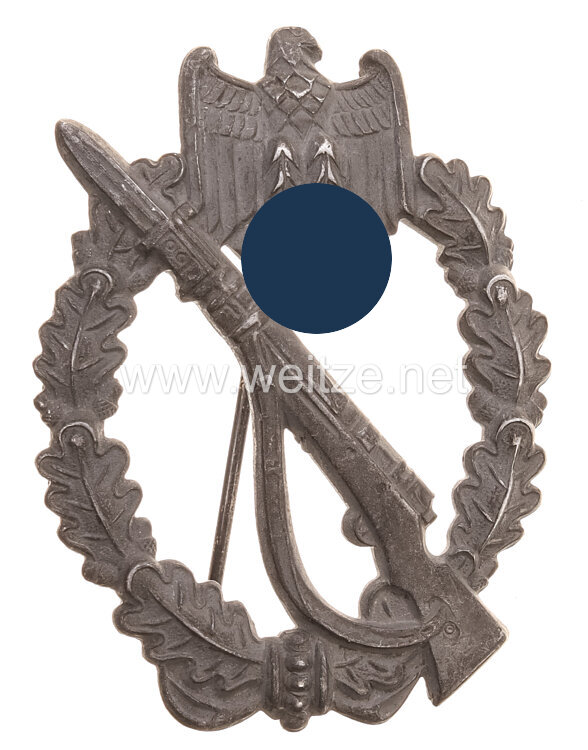
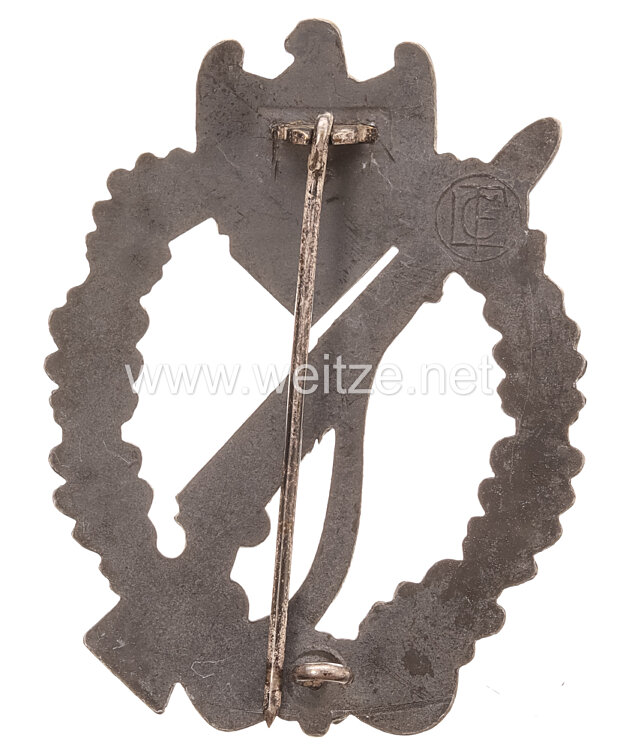
Fine zinc, with maker’s mark.
460443
300,00

Infantry Assault Badge - Franke & Co

The Infantry Assault Badge (Infanteriesturmabzeichen or ISA) ranks among the most recognized and significant military decorations of World War II. This special combat award was instituted on December 20, 1939, by Adolf Hitler to honor the particular achievements of infantrymen in ground combat.

The decoration had its roots in the experiences of World War I, when the Assault Badge was created for particularly distinguished members of the storm battalions. The new Infantry Assault Badge of World War II built upon this tradition but was broader in scope and intended to honor the entire fighting infantry.

Award Criteria: The Infantry Assault Badge was awarded to members of the infantry and other branches who had actively participated in combat operations. The original criteria required that the recipient had participated in at least three infantry attacks on three different days. These regulations were modified and adjusted several times throughout the war. Wounds received in infantry combat could also be counted toward the required number of combat days.

Design and Symbolism: The badge displays a rifle with fixed bayonet overlaid by a stick grenade, surrounded by an oval oak leaf wreath. These elements symbolize the primary weapons of the infantryman in close combat. The design was deliberately kept simple and was meant to emphasize the fighting character of the infantry. The badge was worn on the left breast of the uniform, below the Iron Cross First Class, if present.

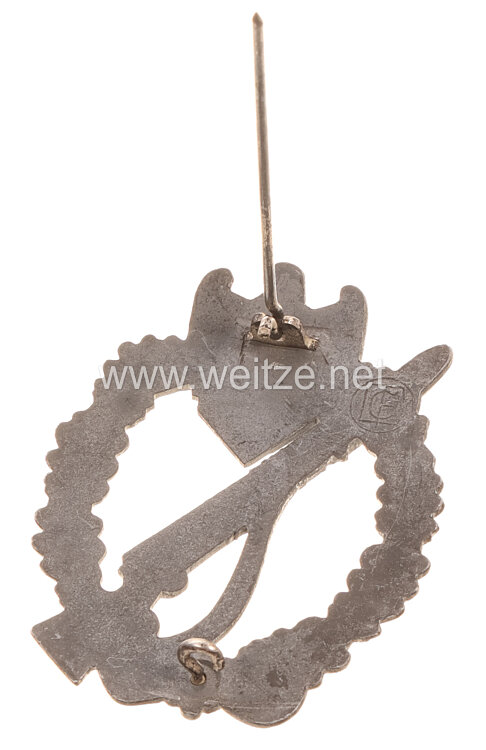
Manufacturing and Makers: The present specimen was manufactured by the firm Franke & Co. of Lüdenscheid, one of numerous authorized producers of this decoration. The maker's marking on the reverse was common on many, but not all, examples. Zinc alloy was one of the primary materials used, especially in the later war years when non-ferrous metals became increasingly scarce and had to be reserved for more critical war purposes.

Production was carried out using the hollow stamping process, whereby two stamped halves were joined together. The surface was typically blackened or bronzed to achieve a dark, matte finish. Attachment to the uniform was accomplished through a horizontal pin on the reverse. The quality of workmanship varied considerably depending on the manufacturer and production period. Early examples often showed finer detail work, while later wartime productions became increasingly simplified.

Variants: Besides the basic silver form, there were additional grades of this decoration. The Infantry Assault Badge in Bronze was created for members of motorized or armored units who supported the infantry in combat. Later followed special forms such as the Assault Badge in Gold for 25, 50, 75, and 100 combat days, as well as special variants for other branches like the General Assault Badge.

Historical Significance: The Infantry Assault Badge was awarded in large numbers throughout the war and was one of the most widespread German combat decorations. It documents the central role that infantry continued to play despite the increasing mechanization of warfare. For the recipients, it represented official recognition of their front-line service and personal commitment under mortal danger.

Collector Value and Authenticity: Today, original Infantry Assault Badges are sought-after objects in military historical collections. The marking of a known manufacturer like Franke & Co. can be helpful in authentication, as the characteristics of various producers are well documented. However, numerous post-war reproductions also exist, making precise knowledge of materials, manufacturing techniques, and aging characteristics essential for reliable identification.

The study of such decorations provides important insights into military culture, the award system, and material economy during World War II. They are material witnesses of a historical epoch and today serve primarily for scientific and museum documentation of military history. Understanding the context of these awards helps illuminate not only the military history of the period but also the social and political structures that created and distributed such honors.