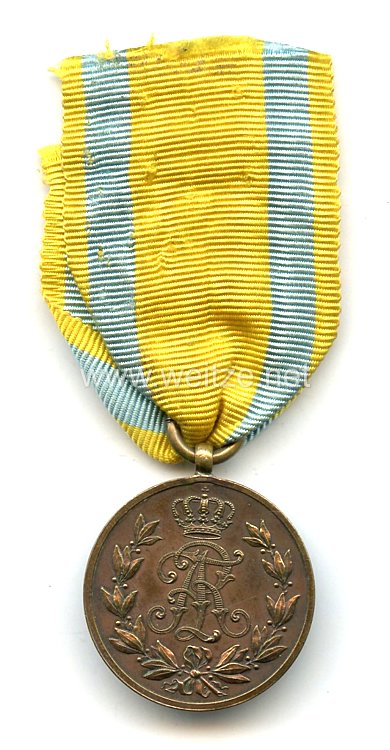
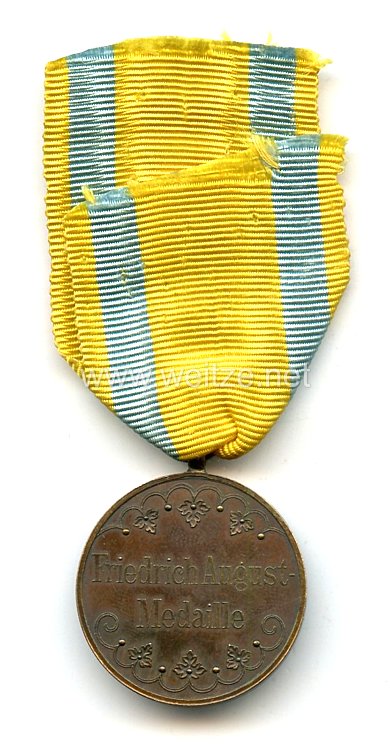
Saxony Kingdom Friedrich August Medal in Bronze

on 35 mm ribbon, condition 2.
398742
45,00

Saxony Kingdom Friedrich August Medal in Bronze

The Friedrich August Medal of the Kingdom of Saxony in bronze represents a significant decoration within the German honors system of the 19th and early 20th centuries. This medal was instituted to honor the Saxon royal house and bears the name of one of Saxony's most distinguished rulers.

The Kingdom of Saxony existed from 1806 to 1918 as a sovereign federal state of the German Confederation and later the German Empire. The Wettin Dynasty, which ruled Saxony, maintained a long tradition of instituting orders and decorations to recognize both military and civil merit. The Friedrich August Medal fits into this tradition and was typically awarded for long-standing loyalty, special service to the state, or meritorious actions for the benefit of the kingdom.

The name Friedrich August most likely refers to one of three Saxon kings bearing this name: Friedrich August I (reigned 1806-1827), known as “the Just,” Friedrich August II (reigned 1836-1854), or Friedrich August III (reigned 1904-1918), the last King of Saxony. Depending on the precise date of the medal's institution, it would reflect different historical contexts.

The execution in bronze indicates a lower class of award, as most German orders and medals of the 19th century were awarded in a hierarchy from bronze through silver to gold. However, this by no means suggests the decoration was insignificant – it was awarded to a broad circle of deserving individuals, including soldiers, civil servants, craftsmen, and citizens who had rendered service to the kingdom.

The described 35 mm wide ribbon corresponds to the standardized measurements for Saxon decorations of this era. The colors of Saxon order ribbons were typically green and white, the national colors of Saxony, with various patterns and combinations distinguishing different awards. The ribbon served not only to attach the medal to the uniform but could also be worn as a ribbon bar when full wearing of the medal was not appropriate.

The medal itself would typically have featured on the obverse the portrait of the namesake King Friedrich August in profile, surrounded by a Latin or German inscription with his name and title. The reverse would usually display the Saxon coat of arms, the rue crown, or an allegorical representation, possibly with a dedicatory inscription. The craftsmanship of Saxon medals was traditionally of high quality, reflecting the rich artistic tradition of the land.

The indicated condition 2 according to the numismatic grading scale suggests a very well-preserved specimen showing only minimal signs of wear. This is remarkable for an object that could be over a century old and possibly actively worn. The good preservation significantly increases both historical and collector value.

In the military-historical context, such medals played an important role in the honor system of the Kingdom of Saxony. They served not only individual recognition but also promoted loyalty and motivation within Saxon army and society. Wearing such decorations on the uniform was a visible demonstration of personal merit and social status.

After the end of the monarchy in 1918 and the abdication of Friedrich August III, these royal decorations lost their official significance but remained as historical mementos and collector's items. Today they are important witnesses to Saxon history and German phalерistics, valued by collectors and museums worldwide.