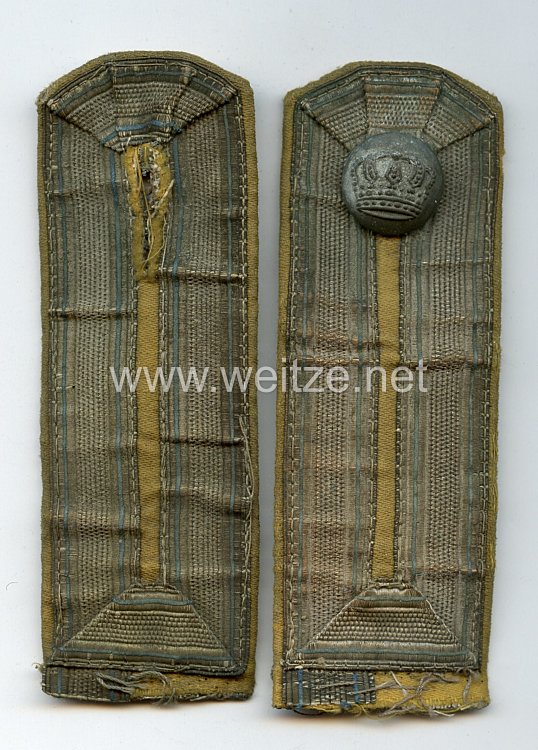
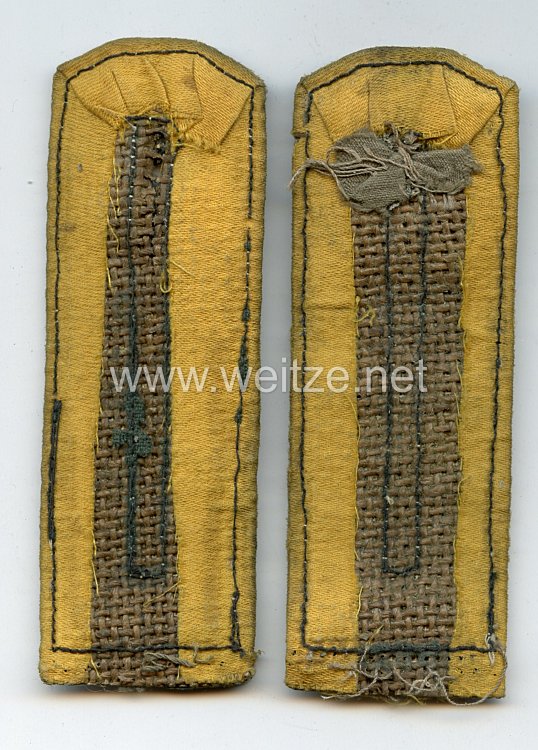
Prussia World War I Pair of Shoulder Straps for Civil Service Deputy in Sergeant Rank Proviant Office
These shoulder straps for civil service deputies holding NCO rank at the Proviant Office from the First World War represent a fascinating aspect of Prussian military administration during the Great War. These rank insignia document the complex organizational structure of the Imperial Army and the important role that civil servants played in military administrative functions.
The Proviantamt (Provisions Office) was an essential institution within the Prussian and German military organization, responsible for supplying troops with food, fodder, and other vital goods. With the outbreak of World War I in August 1914, the importance of these administrative units grew exponentially. Supplying millions of soldiers on various fronts presented a logistical challenge that required a significant expansion of the administrative apparatus.
The Beamtenstellvertreter (civil service deputies) formed a special category within military administration. They were typically civil servants or individuals not fully fit for military service who took on administrative functions. To give them a clear position within the military hierarchy and to clarify their authority over troops, they were equipped with rank insignia corresponding to military grades. The shoulder straps described here correspond to Feldwebel rank, a non-commissioned officer grade.
The dating to around 1915 is historically significant. By this year, the war had already developed into a war of attrition, and supply problems were becoming increasingly critical. The British naval blockade was beginning to show its effects, and the efficient management of available resources became a matter of survival. This led to a professionalization and expansion of the Proviant offices.
The shoulder straps themselves followed Prussian uniform regulations, which also applied to military civil servants. They were typically made of cloth, bearing specific colors and insignia that indicated affiliation with the Proviantamt. The execution in Feldwebel rank meant that the wearer possessed non-commissioned officer authority and corresponding command powers.
The description “lightly worn” indicates that these shoulder straps were actually used in service, giving them authentic historical value. They are silent witnesses to the daily service in military administration during the war.
The organization of military administration in the German Empire was highly complex. Besides the fighting troops, there existed an extensive system of administrative units ranging from intendancies to provisions offices to arsenals. The officials of these institutions wore uniforms and rank insignia that reflected their function and position.
During the war, the supply situation continuously deteriorated. The “Turnip Winter” of 1916/17 and increasing rationing showed the limits of German supply economy. The employees of the Proviant offices were under enormous pressure to maintain troop supply while the civilian population simultaneously suffered shortages.
These shoulder straps are today important military-historical collectibles that provide insight into the less-known aspects of military history. While weapons and combat equipment often take center stage, such administrative insignia document the organizational reality of modern warfare, which could not be waged without functioning logistics and administration.
The study of such items contributes to our understanding of total war, where military success depended not only on battlefield prowess but also on the efficient organization of the home front and supply lines. The civil servants who wore these insignia were integral to the German war effort, even if they never fired a shot in combat.