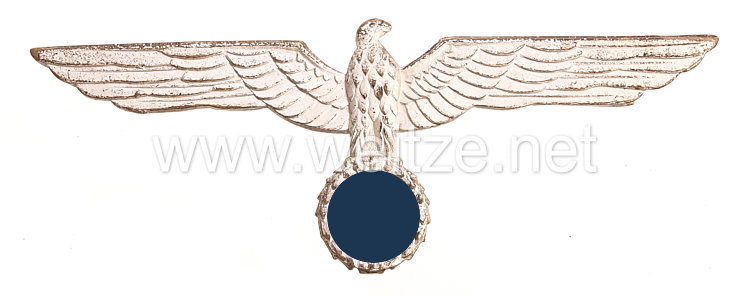
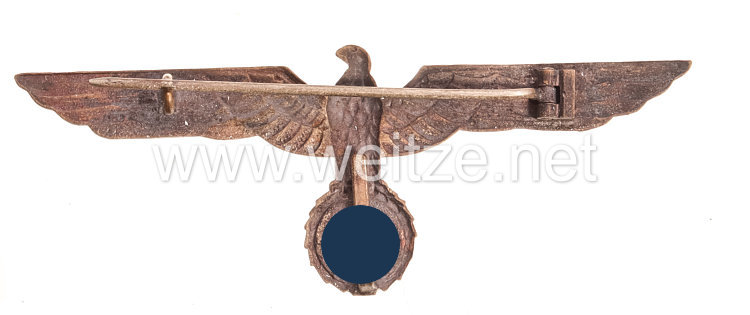
Kriegsmarine Metal Breast Eagle for Officers' Summer Uniform (Officials)

Silver-plated non-ferrous metal. Lightly worn, condition 2-.
443541
165,00

Kriegsmarine Metal Breast Eagle for Officers' Summer Uniform (Officials)

The Kriegsmarine metal breast eagle for officers' summer uniform represents a significant example of Third Reich military insignia. This particular breast badge was worn by officers and officials of the German Kriegsmarine on white summer uniforms during the years 1935 to 1945.

The Kriegsmarine, officially established on June 1, 1935, replaced the Reichsmarine of the Weimar Republic and constituted the naval forces of National Socialist Germany. With this reorganization, new uniform regulations and insignia were introduced that differed significantly from previous provisions. The characteristic eagle with outstretched wings, clutching a swastika in its talons, became the central national emblem for all branches of the Wehrmacht.

This example is manufactured from silver-plated base metal, which was typical for the summer uniform variant. Unlike winter uniforms, on which embroidered breast eagles were worn, officers used these metal versions on the white summer tunic. The silver plating served not only aesthetic purposes but also provided protection against corrosion in the maritime environment.

The uniform regulations of the Kriegsmarine were detailed in various directives, particularly in the “Dress Regulations for the Kriegsmarine” (M.Dv. No. 45). These regulations precisely specified when and how various uniform parts and insignia were to be worn. The white summer uniform was typically worn during summer months and in tropical and subtropical operational areas.

The production of such breast eagles was carried out by various authorized manufacturers who had to maintain strict quality standards. The eagles were typically manufactured using stamping processes, with details such as feather structure, swastika, and wreath carefully worked out. Attachment was accomplished through two or three pins on the reverse, which were inserted through the uniform and secured with washers or threads.

The distinction between officers and officials in the Kriegsmarine was significant. While officers formed the military command level, officials belonged to the technical and administrative personnel. Both groups wore similar insignia, with differences mainly in rank badges and certain detail aspects.

Wearing the breast eagle on the left breast was mandatory and served for immediate identification of affiliation with the Kriegsmarine. The position was precisely prescribed and was located above the breast pocket. Size varied slightly between different manufacturers but generally ranged between 11 and 13 centimeters in wingspan.

In the context of maritime warfare during World War II, the Kriegsmarine played a central role, particularly through the U-boat campaign in the Atlantic and operations in northern and central European waters. Officers and officials wearing such insignia served on various units, from U-boats to destroyers and the large battleships such as Bismarck or Tirpitz.

After 1945, all National Socialist symbols were banned in Germany. However, collecting and scholarly engagement with such objects is permitted and important within the framework of historical research and education. Today, such breast eagles are sought-after collectibles that provide insight into the uniform traditions and material culture of the German Kriegsmarine.

The condition of this example is described as “lightly worn,” indicating actual use during service. Signs of wear such as light scratches, minimal wear to the silver plating, or small oxidation traces are common on such objects and confirm their authenticity. The preservation of such historical artifacts is invaluable for understanding military history.