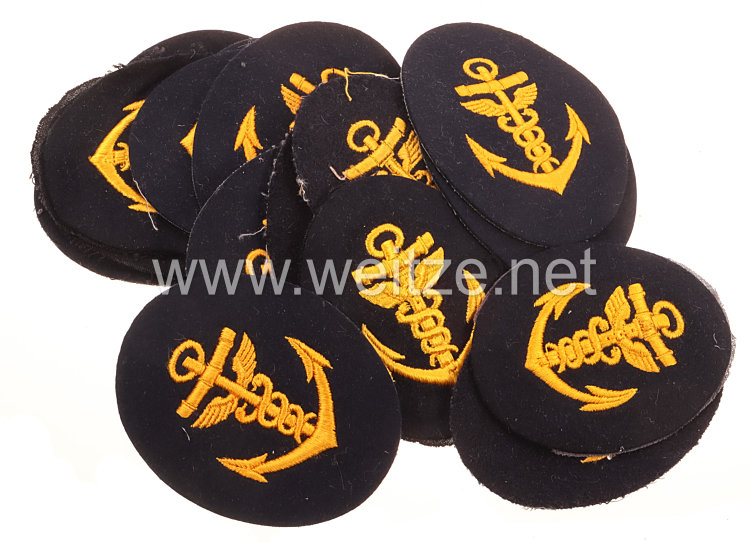
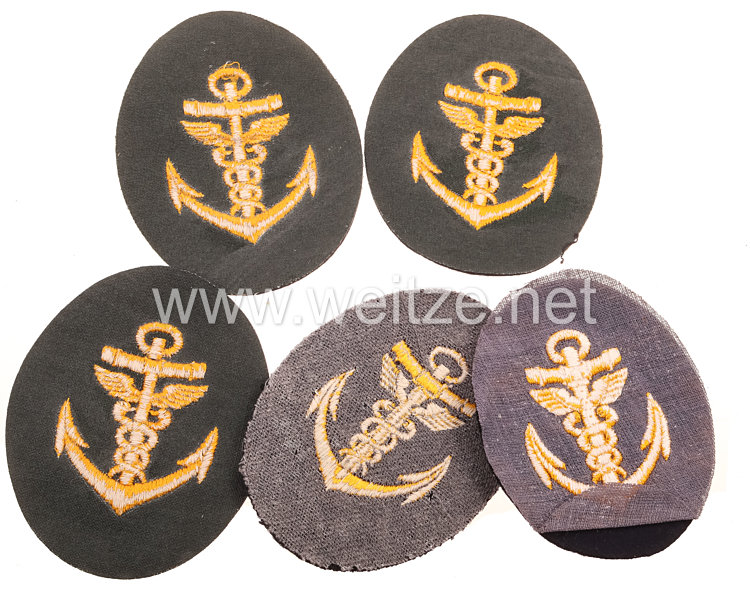
Kriegsmarine Sleeve Insignia Career Path Administrative Petty Officer

Variant for the blue blouse. Condition 2.

Price per piece: 10 Euro.

Condition may vary.
440941
10,00

Kriegsmarine Sleeve Insignia Career Path Administrative Petty Officer

The Kriegsmarine sleeve badge for Administration Mates (Verwaltungsmaate) represents an important component of the rank insignia system of the German Navy during World War II. These special badges served to identify the professional career path and rank of naval personnel in the administrative sector.

The Kriegsmarine, officially founded on June 1, 1935, replaced the Reichsmarine of the Weimar Republic and represented the naval forces of the German Reich until 1945. With the rearmament under the National Socialist regime, a complex system of rank insignia and career path identifications developed, enabling precise identification of each soldier's military function.

The career path badges (Laufbahnabzeichen) of the Kriegsmarine differed fundamentally from rank insignia. While rank insignia indicated military grade, career path badges identified professional specialization within the navy. Administrative personnel formed a distinct career group responsible for administrative, financial, and logistical tasks.

The rank of Maat represented a non-commissioned officer grade in the Kriegsmarine hierarchy, comparable to a sergeant in the Wehrmacht. The Maate formed the backbone of military organization and functioned as a link between ordinary enlisted personnel and higher non-commissioned officers and commissioned officers. A Verwaltungsmaat (Administration Mate) was specifically trained and employed for administrative duties.

The version for the blue blouse refers to the working and service clothing of the Kriegsmarine. The navy used various types of uniforms: parade uniform, service uniform, and work clothing. The blue blouse was part of the daily service dress and was worn during routine shipboard duties. The sleeve badges were sewn directly onto the left upper arm of the uniform.

According to the clothing regulations of the Kriegsmarine, the career path badges were precisely regulated. The administrative career path was marked by specific symbols that distinguished it from other career paths such as artillery, torpedo service, communications, or medical service. The exact design, size, and positioning were specified in the dress regulations.

The manufacture of such badges was carried out by specialized manufacturers and uniform tailors, both through official navy depots and private suppliers. Quality could vary, with differences between early war years and later productions, when material shortages increasingly became a problem.

Wearing the correct badges was not only a matter of regulation but also of military identity and esprit de corps. Naval personnel took pride in their career path affiliation, and the badges enabled immediate identification of competencies and areas of responsibility aboard ship.

From a collecting history perspective, such sleeve badges today represent important contemporary historical documents. They provide insights into the organizational structure of the Kriegsmarine and the differentiation of its personnel structure. For military historians and collectors, these objects are significant for understanding the complex hierarchy and administration of German naval warfare.

The administrative organization of the Kriegsmarine was extensive and complex. It encompassed pay, provisions, equipment, material management, and numerous administrative tasks essential for operating a modern war fleet. Specialized personnel in this area required commercial and administrative skills that went beyond purely military training.

After the end of World War II in May 1945, the Kriegsmarine was dissolved. Many uniform parts and badges were either destroyed, lost, or came into private hands as souvenirs or war booty. Today, such objects can be found in museums, collections, and in the antiques market.

The scholarly engagement with such military equipment items serves historical understanding and documentation of a significant, albeit dark, epoch of German history. It enables us to grasp the military organization and everyday reality beyond the major strategic and political events.

These artifacts remind us of the complexity of military institutions and the many specialized roles required to maintain naval operations. The administrative branch, though often overlooked in popular accounts focusing on combat personnel, was essential to the functioning of the Kriegsmarine. Understanding these career distinctions through material culture helps historians reconstruct the complete picture of naval organization and daily life during this period.