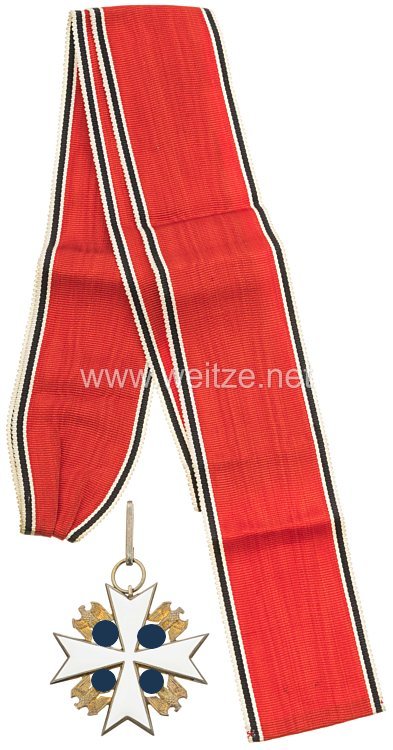
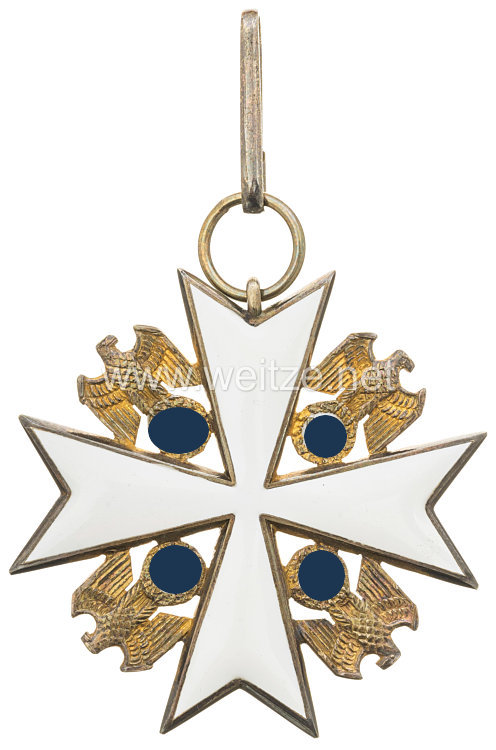
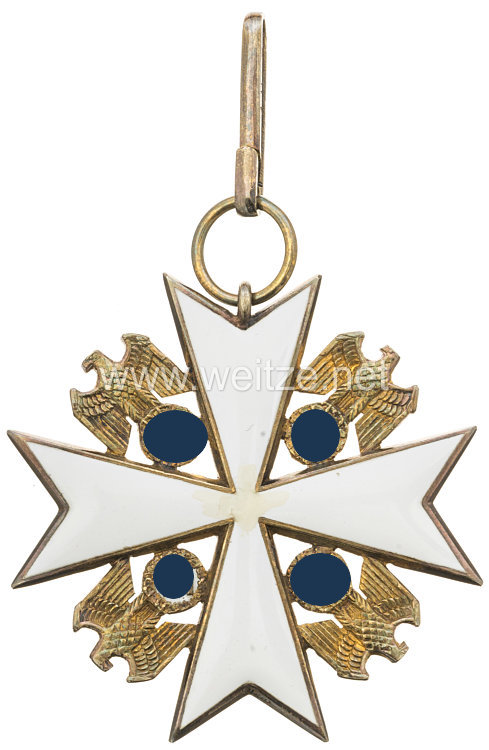
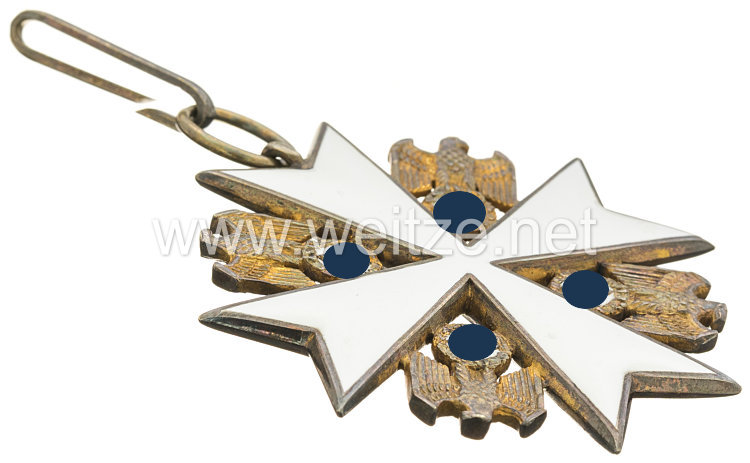
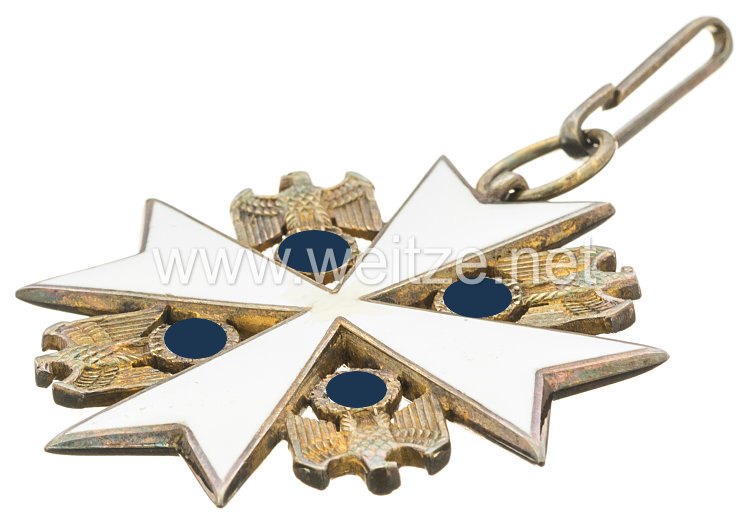
German Order of the German Eagle Merit Cross 1st Class - 1st Model
The 1st Model was only awarded from 1937 to 1939 and is very rare.
The German Eagle Order (also known as Order of the German Eagle) was a significant state decoration of National Socialist Germany, instituted by Adolf Hitler on May 1, 1937. This decoration was the second-highest award that the Third Reich could bestow upon foreigners and primarily served diplomatic purposes.
The Merit Cross 1st Class described here in its first model variant represents a particularly rare and historically significant version of this award. The first model variant was exclusively awarded between 1937 and 1939, before a revised second model variant was introduced in 1939. This makes examples of the first model especially rare objects in military-historical research.
The characteristic features of the first model differ distinctly from later versions. The cross was manufactured in heavy execution, made of silver with fire-gilding. The bilateral fine enameling in white and red colors demonstrates the high craftsmanship quality of the period's decoration manufacturers. Particularly striking are the significantly larger eagles in the cross arms, which distinguish the first model from the later, more subtly designed second model. The special ribbon ring at the upper cross arm is another identifying feature of the early manufacture.
The “900” stamp on the lower cross arm documents the silver content and corresponds to the regulations for state decorations of that time. The neck cross was worn on an approximately 90 cm long ribbon, held in the national colors.
The German Eagle Order was awarded in several classes: The Grand Crosses (with and without star), the Merit Crosses (1st to 4th Class), and the Merit Medal. The Merit Cross 1st Class was the second-highest level of the Merit Crosses and was worn as a neck cross, while the lower classes were executed as breast crosses.
The awarding of the German Eagle Order occurred primarily to foreign statesmen, diplomats, industrialists, and other personalities who, from the perspective of the NS regime, had rendered service to German-foreign relations. Recipients included heads of state, government members, and high officials from various nations. The order thus served as an important instrument of the Third Reich's foreign policy.
The manufacture of the first model variant took place from 1937 to 1939 by specialized decoration manufacturers. The elaborate craftsmanship with fire-gilding and bilateral enameling required highly qualified artisan craftsmen. The quality of the enameling and the precise execution of the eagle emblems testify to the technical mastery of the workshops involved.
With the introduction of the second model in 1939, the proportions were changed and the execution made lighter overall. The eagles were reduced in size and the entire construction simplified. This makes the heavy first models sought-after collector's items, which must always be viewed in the context of their historical significance.
After the end of World War II, Control Council Law No. 1 of September 20, 1945, prohibited all National Socialist orders and decorations. Wearing and public display of these awards was made punishable. Today, preserved examples serve exclusively for historical research and museum documentation.
The military-historical significance of such objects lies in their function as primary sources for researching NS foreign policy and diplomatic ceremonial in the Third Reich. They document the awarding practices of state decorations and provide insight into the regime's self-representation toward foreign countries.