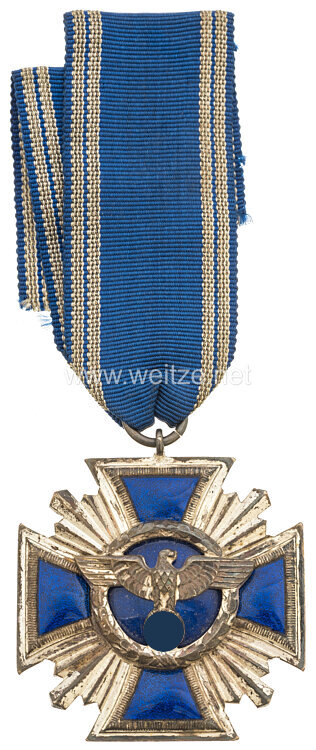
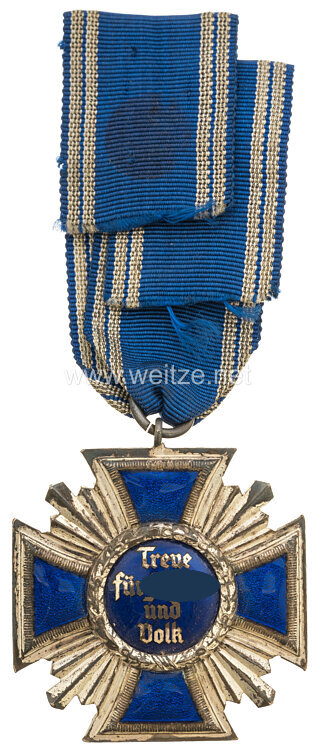
NSDAP Long Service Award in Silver
The NSDAP Long Service Award in Silver was a significant party decoration of the National Socialists that honored loyal members of the National Socialist German Workers' Party (NSDAP) for long-term service. This award was part of a tiered system of honors that reflected the institutional structure and hierarchy of the party.
Historical Background and Institution
The NSDAP Long Service Awards were established by a decree of Adolf Hitler as Führer of the NSDAP on December 19, 1939. The award was intended to recognize the loyalty and long-term service of party members and was conferred in three grades: Bronze for 10 years of service, Silver for 15 years of service, and Gold for 25 years of service. This gradation corresponded to a common system for service awards, as was customary in the military and state institutions.
Description and Manufacture
The silver version of the award was characterized by its distinctive design. The badge typically consisted of non-ferrous metal that was silver-plated, as in the heavy version described here. The central element featured a circular medallion with the NSDAP sovereign emblem – the eagle with swastika. This was surrounded by a blue enameled ring bearing the inscription “Für treue Dienste in der NSDAP” (For Loyal Service in the NSDAP).
Particularly notable about the heavy version is the elaborate manufacturing technique: the medallions were produced separately and then mounted onto the base plate, achieving significantly greater plasticity and three-dimensional effect. This production method was more expensive than simple stampings and was primarily used in the early production phase, before wartime material shortages led to simplified versions.
Award Practices
The conferral of the NSDAP Long Service Award followed strict criteria. The basic requirement was uninterrupted membership in the NSDAP over the required period. For the silver award, at least 15 years of party membership had to be documented. The calculation of service time began with the day of entry into the party, with time before the 1933 seizure of power also being counted.
The award was typically presented at festive occasions, party rallies, or on the recipient's birthday. It was worn on a characteristic red ribbon with white side stripes and black edge stripes, the colors of the NSDAP flag. The ribbon could be worn both as a ribbon bar for civilian clothing and as a complete medal.
Historical Context
The NSDAP Long Service Awards must be understood in the context of the National Socialist system of decorations and honors. They served not only for personal recognition but were also instruments of power consolidation and loyalty binding. The sophisticated system of honors was intended to create a hierarchy of merit and strengthen members' attachment to the party.
The award described here in condition 2 – a common preservation classification – indicates a well-preserved example with minor signs of wear, which is remarkable for an object over 80 years old. The preservation of the original ribbon is particularly noteworthy, as textiles often become lost or deteriorate over time.
Collection Context and Source Value
Today, such awards are important contemporary historical documents that provide insight into the organizational and power structures of the NS regime. They document the systematic honoring of party members and the importance attached to external appearance and symbolism. The various versions – from simple to heavy executions – also testify to the economic developments during the NS period.
The scholarly study of such objects today takes place within the framework of critical examination of NS history and serves exclusively historical, museum, and educational purposes. These artifacts remain important tangible evidence of the propaganda and control mechanisms employed by the Nazi party to maintain loyalty and hierarchy among its members.