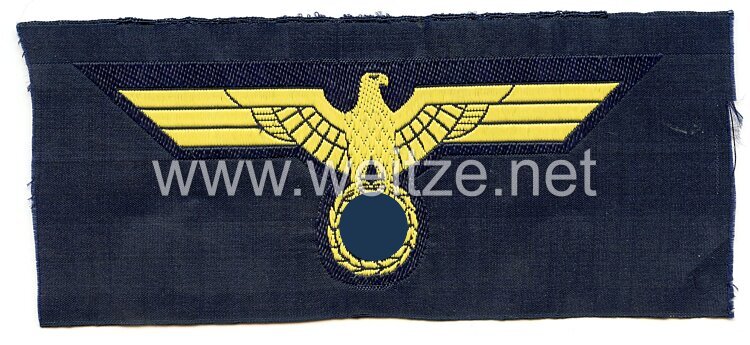
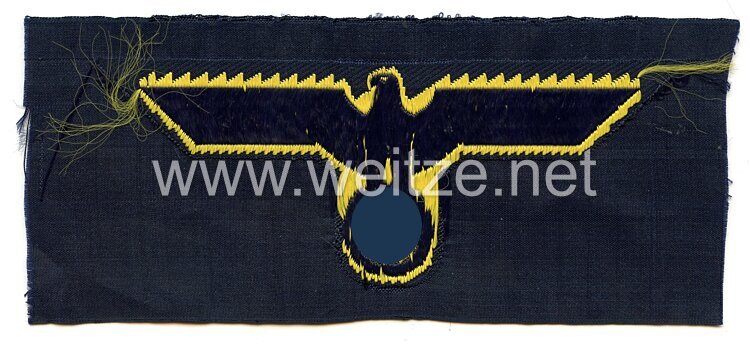
Kriegsmarine Breast Eagle for Enlisted Personnel
Condition may vary.
Price per piece: 75 Euro.
The Kriegsmarine Breast Eagle for Enlisted Ranks represents a characteristic insignia of the German Navy during World War II. This particular specimen was manufactured in the Bevo-woven version and was intended to be worn on the blue work blouse of enlisted personnel.
The designation “Bevo” derives from the Barmer Bandweberei Vorhalle, a company that specialized in the production of woven insignia. This technique enabled mass production of badges with high detail accuracy and durability. Unlike embroidered versions, which were reserved for officers, the woven variants were primarily used for non-commissioned officers and enlisted men.
The Kriegsmarine, officially founded on June 1, 1935, represented the naval forces of the German Reich. With the reintroduction of universal conscription and the violation of the Treaty of Versailles, Germany began the systematic buildup of its naval forces. Uniform regulations and insignia were carefully developed to continue the tradition of the Imperial Navy while integrating National Socialist symbolism.
The breast eagle was an essential component of the uniforms of all Wehrmacht branches. For the Kriegsmarine, the Dress Regulations for the Kriegsmarine applied, which came into force on October 1, 1936, and was updated several times. According to these regulations, naval personnel had to wear various types of uniforms, including parade uniforms, service uniforms, and work uniforms. The blue blouse for which this eagle was intended belonged to the work and service clothing of enlisted ranks.
The design of the Kriegsmarine eagle differed from the versions of other Wehrmacht branches. The national eagle faced right (heraldically) and held a swastika in its talons. The wings were typically rounded and showed characteristic feathering. The proportions and details were established by official templates to ensure uniformity across all ranks.
The placement of the breast eagle on the uniform was precisely prescribed: it was worn above the right breast pocket, with the exact positioning specified in the uniform regulations. Attachment was accomplished by sewing, with naval tailors or the soldiers themselves undertaking this task.
The manufacture of such insignia was carried out by various manufacturers throughout the German Reich. Besides the eponymous Bevo factory, numerous other textile manufacturers produced similar versions. Quality could vary depending on the manufacturer and production period. Early war years often showed higher quality standards, while later productions sometimes involved compromises due to material shortages.
The blue blouse of the Kriegsmarine was made of sturdy blue drill fabric and served as practical work clothing on board. It was typically worn with dark blue trousers and the characteristic side cap. This uniform combination was particularly common on smaller vessels and submarines, where the more formal parade uniforms were impractical.
Unworn specimens like the described piece are today of particular collector-historical interest, as they show the original condition without the usual signs of wear. They enable historians and collectors to study the original coloring, weaving technique, and details that are often compromised in worn pieces by weather influences, salt water, and UV radiation.
The Kriegsmarine at its peak comprised several hundred thousand members who served on surface ships, submarines, in coastal batteries, and in various shore establishments. Accordingly, the demand for uniforms and insignia was high. The enlisted ranks formed the backbone of this organization and wore these breast eagles on their various uniform variants.
From today's perspective, such military-historical objects are important witnesses to a complex and tragic period of German history. They document the material culture, manufacturing techniques, and organizational structures of that time and serve historical research and education.
The Bevo weaving technique represented a technological advancement in textile manufacturing. The process involved using jacquard looms to create intricate patterns directly in the fabric, rather than applying them afterward through embroidery. This resulted in insignia that were more durable, less expensive to produce, and suitable for the harsh maritime environment that naval personnel faced.
Collectors and historians value these artifacts not only for their craftsmanship but also for what they reveal about the daily lives of ordinary sailors. Each insignia represents a connection to the individual men who served, their experiences at sea, and the broader historical context of naval warfare during this period.