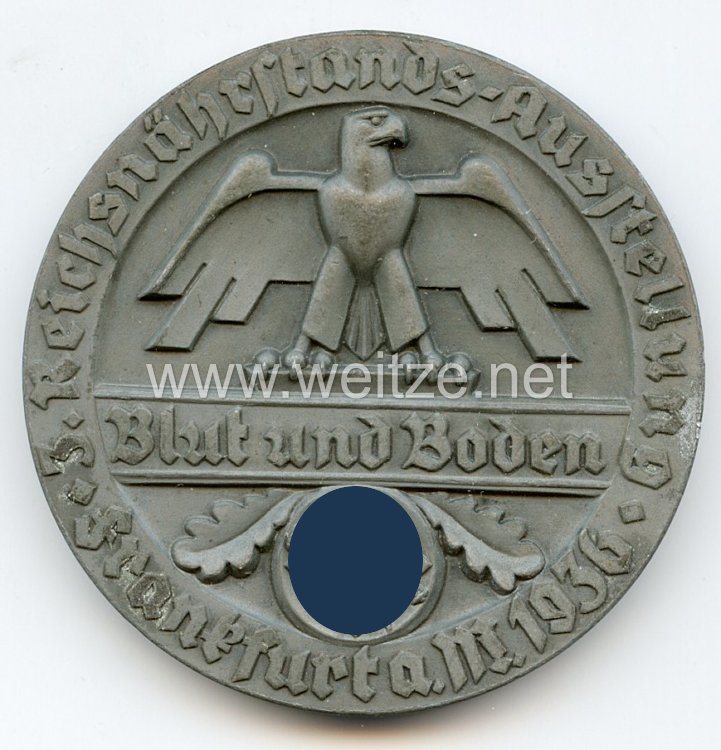
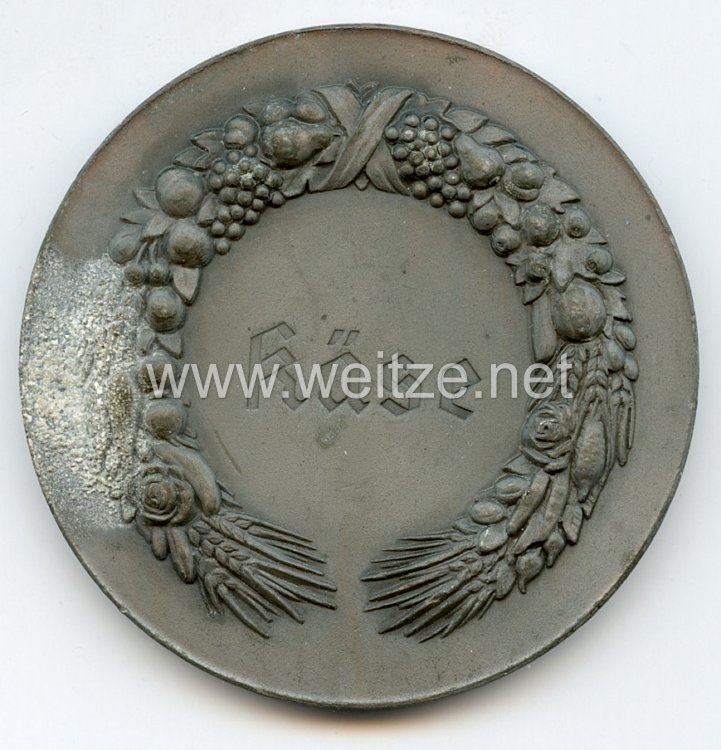
Reichsnährstand - “3rd Reichsnährstands-Ausstellung Frankfurt am Main 1936”
The large silver victory medal described here, made of fine zinc, originates from the 3rd Reichsnährstand Exhibition held in 1936 in Frankfurt am Main. With a diameter of 60 mm, it represents National Socialist agricultural policy and its propaganda apparatus in the mid-1930s.
The Reichsnährstand (Reich Food Estate) was established on September 13, 1933, through the Reichsnährstandsgesetz (Reich Food Estate Law) and was a compulsory organization that encompassed all persons and enterprises active in agriculture, fisheries, and the food economy. Under the leadership of Richard Walther Darré, who simultaneously served as Reich Farmers' Leader and Reich Minister of Food and Agriculture, this organization was intended to ensure complete control over German food production and distribution.
The Reichsnährstand exhibitions were significant propaganda and performance shows designed to demonstrate the supposed successes of National Socialist agricultural policy. The third of these exhibitions took place in 1936 in Frankfurt am Main, an important trade fair location with a long tradition. These events served multiple purposes: they were meant to integrate the rural population into the NS system, emphasize the importance of Blood and Soil ideology, and propagate the regime's alleged autarky policy.
The present medal was awarded specifically for the category of cheese, demonstrating the differentiated evaluation systems at these exhibitions. Various agricultural products and goods were assessed in separate categories, and the awarding of medals was intended to promote quality standards while honoring the achievements of individual producers. Cheese was an important product of German dairy farming, and its quality was a focus of Reichsnährstand policy.
The manufacture from fine zinc is characteristic of the period. While more prestigious awards were often made from silver or other precious metals, exhibition medals frequently used zinc alloys that were silver-plated. This enabled cost-effective mass production while maintaining a representative appearance. The size of 60 mm indicates a significant award that could be visibly worn or displayed.
The historical context of 1936 is particularly relevant: Germany was in a phase of intensive rearmament and preparation for the coming war. Food supply was a critical factor, and memories of the hunger blockade of World War I shaped the NS leadership. The Reichsnährstand was supposed to ensure that Germany would be self-sufficient in terms of food economy in the event of war. The Erzeugungsschlacht (Battle of Production), as the campaign to increase agricultural production was called, was in full swing.
The awarding of such medals also had an important socio-psychological function. They were intended to motivate producers to increase their performance while simultaneously conveying a sense of recognition and integration into the "Volksgemeinschaft" (people's community). Public recognition at large events reinforced this effect and served propaganda purposes.
The organization of the Reichsnährstand was strictly hierarchical, ranging from the Reich level through state and district farmers' associations down to local farmers' associations. This structure enabled comprehensive control and direction of agricultural production. Prices, production quantities, and distribution channels were centrally determined.
After the end of World War II, the Reichsnährstand was dissolved by the Allies. Such awards and medals became historical documents of a dark period in German history. Today they are important sources for researching NS agricultural policy and the propaganda mechanisms of the regime. They document how the NS regime attempted to penetrate all areas of social and economic life and instrumentalize them for its purposes.
The medal stands as an example of the connection between economic policy, propaganda, and ideological indoctrination in National Socialism, whereby even seemingly apolitical areas such as cheese production were placed in the service of the overall ideology.