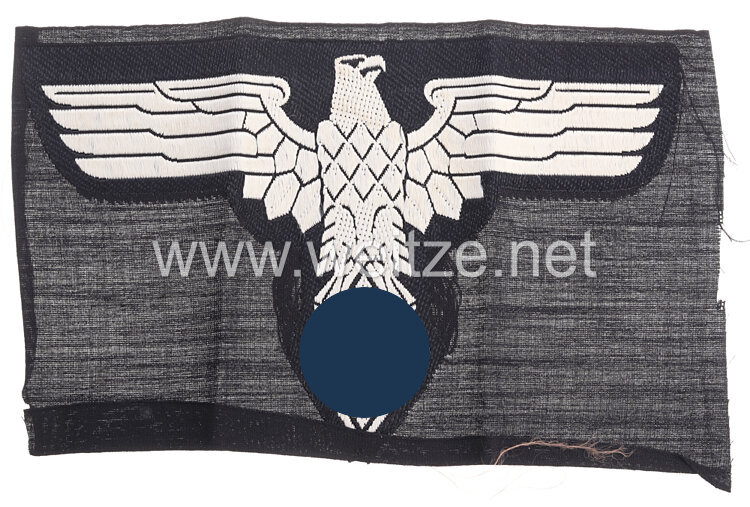
NS-Studentenbund Large Breast Eagle for Sports Shirt
Unfortunately, numerous reproductions exist of this type; this is one of the few originals!
The NS-Studentenbund (National Socialist German Students' League, abbreviated NSDStB) was one of the most important branches of the NSDAP, dedicated to organizing and ideologically aligning German students. Founded in January 1926 in Munich, the NSDStB developed into a central organization for infiltrating the academic world with National Socialist ideology.
The large breast eagle for the sports shirt described here represents a characteristic piece of NS-Studentenbund uniform equipment. The Bevo-woven execution refers to a special manufacturing technique in which the insignia was machine-woven on a Jacquard loom. The company Bevo (Barmer Bandweberei) was one of the main manufacturers of such textile insignia during the NS period and stood for high-quality workmanship.
The dimensions of approximately 16 x 10 cm characterize this insignia as a large breast eagle worn on the NS-Studentenbund sports shirt. Sports clothing played an important role in the organization, as physical fitness was considered an essential component of student education. The Reich eagle with the swastika symbolized the direct connection to the NSDAP and the National Socialist state.
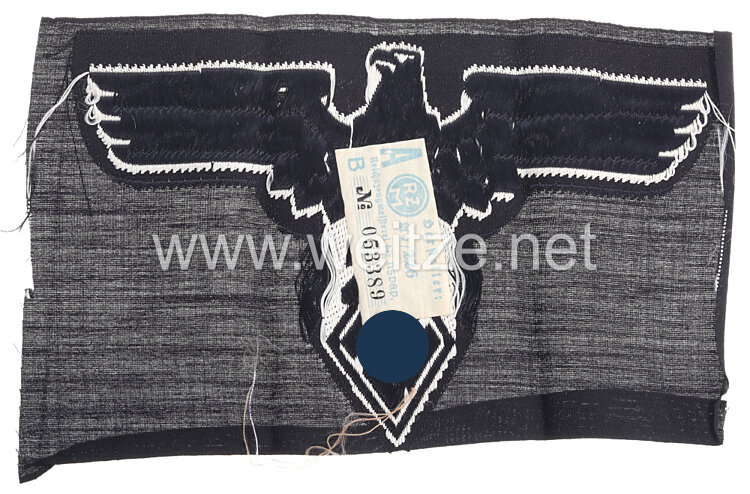
The RZM paper label on the reverse is an important authenticity feature. The Reichszeugmeisterei (RZM) was established in 1929 as the central procurement office of the NSDAP and was responsible for testing and approving all uniform parts, insignia, and equipment of the party and its branches. Each approved manufacturer received an RZM number that was affixed to the products. This was intended to ensure quality standards and control production.
The NS-Studentenbund reached its peak in the 1930s. Under the leadership of Baldur von Schirach (1931-1932) and later Oskar Stäbel, the organization succeeded in gaining considerable influence at German universities. After the seizure of power in 1933, the NSDStB became the sole political representative body of the student body. Membership increasingly became a prerequisite for a successful academic career.
The uniforming of the NS-Studentenbund followed the general guidelines of NSDAP branches. In addition to the brown service shirt, members wore special sports shirts during athletic activities, on which the large breast eagle was attached. These uniform parts served not only for identification but also for demonstrating membership in the “Volksgemeinschaft” (people's community) and emphasizing the military-hierarchical character of the organization.
The problem of forgeries, as indicated in the object description, is a significant issue in the field of militaria. Particularly with NS memorabilia, there has been a market for reproductions and deliberate forgeries for decades. Original pieces with RZM marking, especially in unworn condition, are correspondingly rare and sought after by collectors and museums.
The unworn condition with slight fading suggests that this specimen may have been preserved as warehouse stock and never actually used. Many uniform parts were destroyed after 1945 or disposed of by their wearers to hide their connection to National Socialism. Preserved pieces, especially with original labels, are therefore historically valuable testimonies to this era.
From today's perspective, such objects serve exclusively for historical documentation and research. They illustrate the systematic penetration of all areas of life with National Socialist symbolism and the importance of uniforming and external insignia for the regime's self-presentation. The NS-Studentenbund played an important role in indoctrinating the academic elite and bringing universities into line with Nazi ideology.