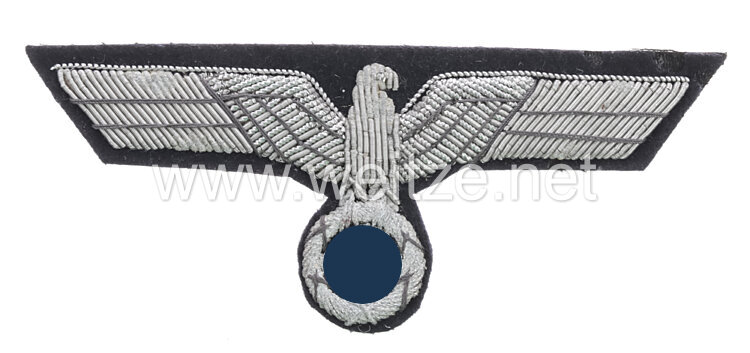
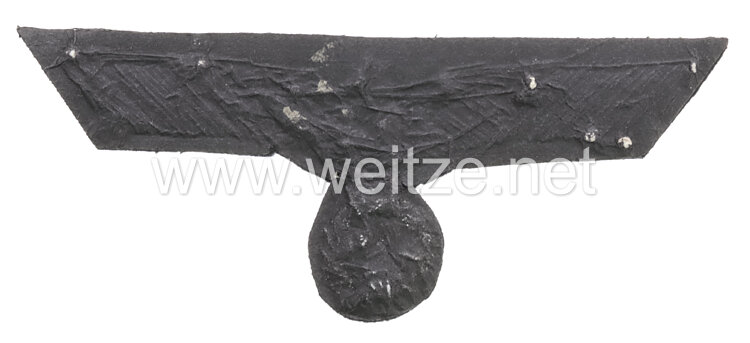
Kriegsmarine Breast Eagle for Officers and Naval Officials

Silver bullion hand-embroidered on dark blue, unissued, swastika slightly oxidized, condition 2
463939
175,00

Kriegsmarine Breast Eagle for Officers and Naval Officials

The Kriegsmarine Breast Eagle for Officers and Naval Officials represents a significant example of maritime uniform insignia from the German Wehrmacht during World War II. This artful hand-embroidery in metallic thread embodies the strict hierarchy and symbolic significance attributed to military insignia during the National Socialist era.

The Kriegsmarine, officially founded on June 1, 1935, was the naval force of the German Reich from 1935 to 1945. It emerged from the Reichsmarine of the Weimar Republic and was significantly expanded following the Treaty of Versailles. Grand Admiral Erich Raeder commanded the Kriegsmarine from 1935 to 1943, followed by Grand Admiral Karl Dönitz, who held command until the war's end.

The Breast Eagle, also referred to as the National Emblem, was a mandatory identification mark on German military uniforms. For the Kriegsmarine, the eagle was designed in a specific maritime variant. The present specimen displays the characteristic execution for officers and naval officials: hand-embroidery in silver metallic thread on dark blue base fabric, the typical color of naval uniforms.

The uniform regulations of the Kriegsmarine were precisely defined in various dress orders. The Dress Regulations for the Kriegsmarine (M.Dv. Nr. 52) detailed the wearing and execution of all uniform components. The breast eagle was attached to the blue service coat, transition coat, and other uniform jackets above the right breast pocket. For officers, the high-quality hand-embroidered execution was prescribed, while enlisted ranks wore machine-woven variants.

The manufacture of such breast eagles was carried out by specialized military effects companies. Well-known manufacturers included the firms BeVo (Mechanische Bandweberei Bevoelkerung & Wippermann), BEKA, and various gold embroidery workshops. Hand-embroidery required considerable craftsmanship and several hours of work per piece. The silver metallic thread typically consisted of aluminum wire wrapped around a cotton core.

The National Emblem itself depicts the Reich Eagle with outstretched wings, holding a swastika within an oak wreath in its talons. This symbolism was introduced in 1935 with the founding of the Wehrmacht and used across all branches of service, with execution varying according to service branch. The Kriegsmarine's eagle differed from the Army's through its specific stylization and characteristic arrangement of flight feathers.

The use of dark blue base fabric corresponded to traditional maritime coloring. The Kriegsmarine thus connected to the traditions of the Imperial Navy, which had already introduced dark blue uniforms in the 19th century. This color was practical for service at sea and became the characteristic identifying color of all German naval forces.

Naval officials were civilian officials in service of the Kriegsmarine who fulfilled technical, administrative, and medical duties. They wore uniforms similar to officers but with specific distinguishing features. For both groups – officers and naval officials – the high-quality hand-embroidered execution of the breast eagle was prescribed.

The unworn condition of the present specimen is remarkable, as most such insignia were used during the war. The slight oxidation of the swastika is a typical aging characteristic that occurs in silver metallic threads through air humidity and time. This confirms the authenticity and age of the piece.

After the end of World War II, the Kriegsmarine was dissolved. Control Council Law No. 2 of October 10, 1945, prohibited all National Socialist organizations and their symbols. The use of national emblems with swastikas is today forbidden in Germany and many other countries, except for scientific and historical documentation purposes.

Today, such breast eagles are important historical documents for uniform studies and military history. They document the craftsmanship quality of military equipment, the hierarchical structures of the Wehrmacht, and the symbolic representation of state power. Military history museums and archives preserve such objects as part of the documentation of this dark epoch of German history.

r