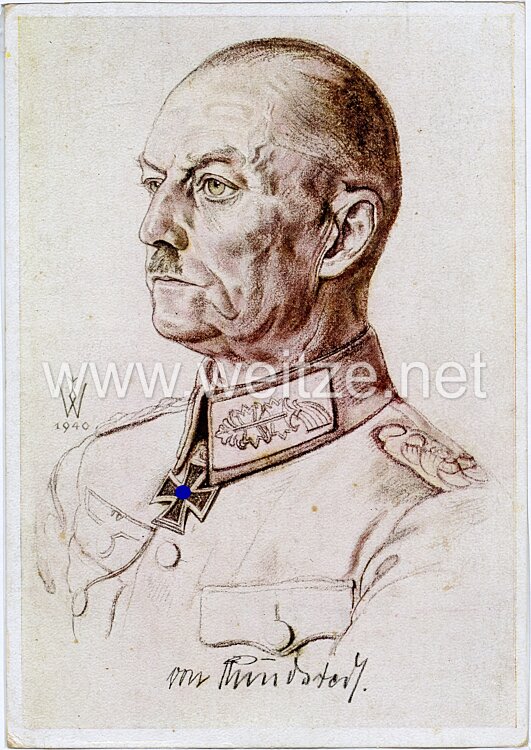
Army - Willrich Color Propaganda Postcard - Knight's Cross Recipient Generaloberst v. Rundstedt

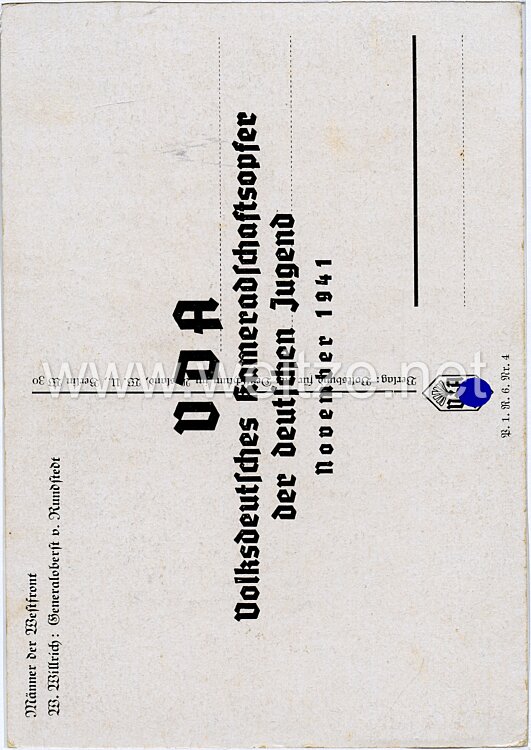
VDA card P.1.R.6.No.4, unmailed, condition 2.
288039
15,00

Army - Willrich Color Propaganda Postcard - Knight's Cross Recipient Generaloberst v. Rundstedt

This colored propaganda postcard from the Second World War period depicts Generaloberst Gerd von Rundstedt, one of the highest-ranking officers of the Wehrmacht and recipient of the Knight's Cross of the Iron Cross. The card belongs to the VDA series (Volksbund für das Deutschtum im Ausland - League for Germans Abroad) with catalog number P.1.R.6.Nr.4 and was designed by the renowned artist Wolfgang Willrich.

Wolfgang Willrich (1897-1948) was a German painter and graphic artist who established himself as one of the leading portraitists of military personnel during the National Socialist regime. His works were characterized by an idealizing, heroic style that perfectly matched the propaganda aesthetics of the regime. Willrich created numerous portraits of Knight's Cross recipients that were mass-distributed as postcards to glorify military achievements and boost civilian morale.

Generaloberst Gerd von Rundstedt (1875-1953) was among the most significant army commanders of the Wehrmacht. He commanded Army Group South during the Polish campaign of 1939 and played a central role in the Western campaign of 1940 as commander of Army Group A. Von Rundstedt was awarded the Knight's Cross of the Iron Cross on September 30, 1939, as one of the first senior officers. He later received higher grades of this decoration. His military career was marked by multiple dismissals and reinstatements, reflecting his complex relationship with the Nazi leadership.

The propaganda postcards featuring Knight's Cross recipients were an essential component of National Socialist public relations. They served multiple purposes: First, they were meant to create military heroes and portray the Wehrmacht as invincible. Second, they strengthened the connection between the front and home front. Third, they were collectibles particularly popular among youth, contributing to the militarization of society.

The VDA (Volksbund für das Deutschtum im Ausland) was originally founded in 1881 as the “Allgemeiner Deutscher Schulverein” (General German School Association) and was brought into line with Nazi ideology in 1933. During the war, the VDA produced various propaganda materials, including this postcard series. The systematic numbering (P.1.R.6.Nr.4) indicates an extensive, carefully organized series.

The designation “ungelaufen” (unmailed) means this postcard was never sent through the postal system and therefore bears neither stamps nor postmarks. The stated condition 2 corresponds in philatelic and militaria collecting grading scales to very good to good preservation with possibly minimal signs of wear.

These postcards were printed in high volumes and distributed in stationery shops, at field post offices, and through various organizations. They cost only a few pfennigs, making them affordable for broad segments of the population. Soldiers frequently purchased them to send to relatives, while collectors assembled complete series.

The colored execution was technically more complex and expensive for that time than simple black-and-white prints. The coloring enhanced the propagandistic effect and made the depicted persons appear more vivid and impressive. Willrich's style emphasized military bearing, medals and decorations, as well as the determined facial features of those portrayed.

From today's perspective, such objects are important historical documents that provide insight into the propaganda machinery of the Nazi regime. They demonstrate how systematically personality cult was practiced and military violence was glorified. For collectors of military-historical objects and museums, they represent significant sources for researching the visual culture and everyday propaganda of the Third Reich.