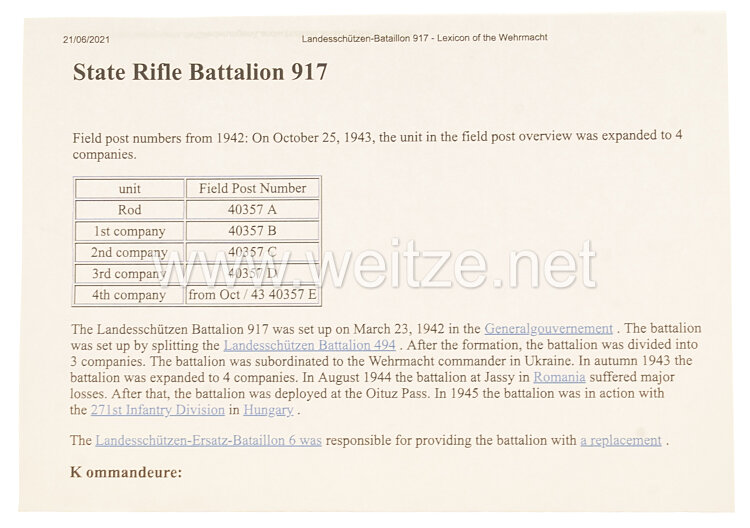
Tank Destruction Badge for Single-Handed Destruction of Armored Fighting Vehicles in Black: Estate from the possession of Feldwebel Karl Pflaum, 3./Landes-Schützen-Bataillon 917

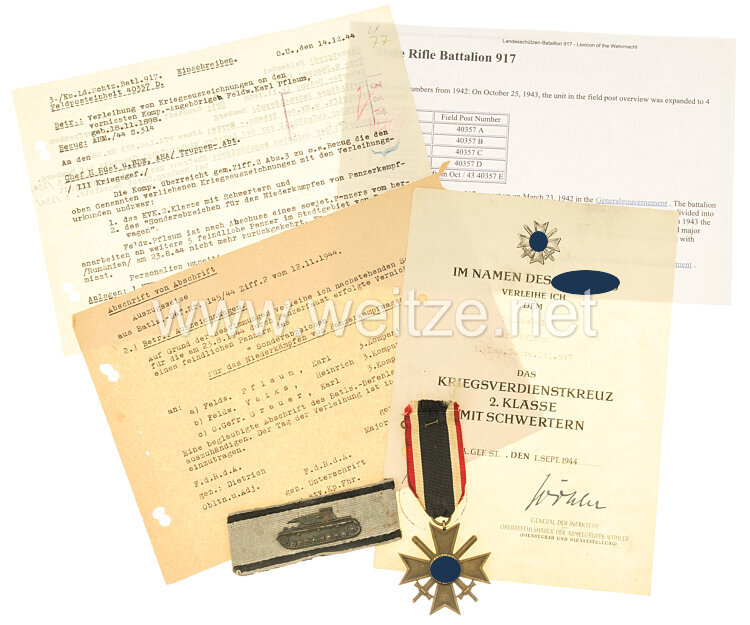
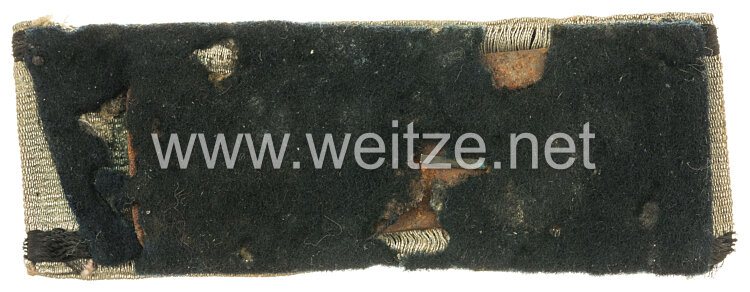
Tank Destruction Badge in Black. Burnished magnetic tank, fastened with 3 split pins on silver braid, with iron backplate. Reverse with dark blue cloth backing. Unworn, with age marks, condition 2-.
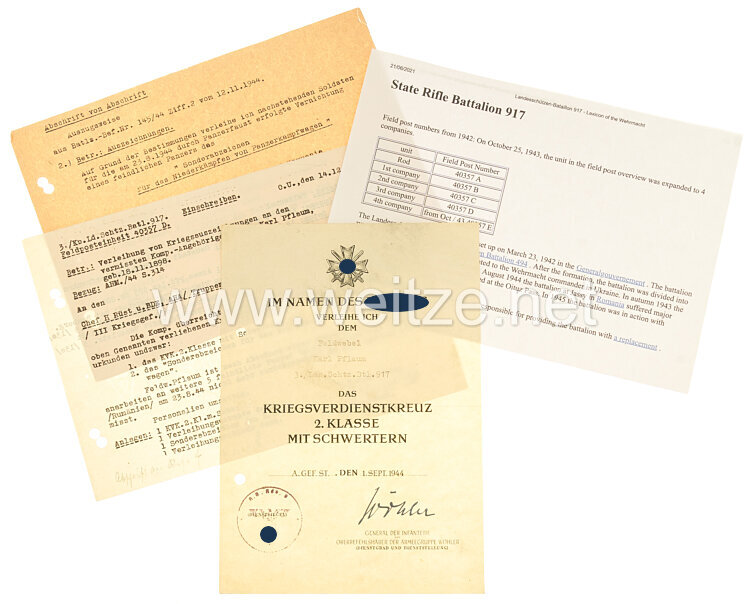
Together with the award certificate, copy from Battalion Order No. 145/44 dated 12.11.1944 with the nominal mention of Feldwebel Pflaum, 3. Kompanie, one of 3 awards on that day.
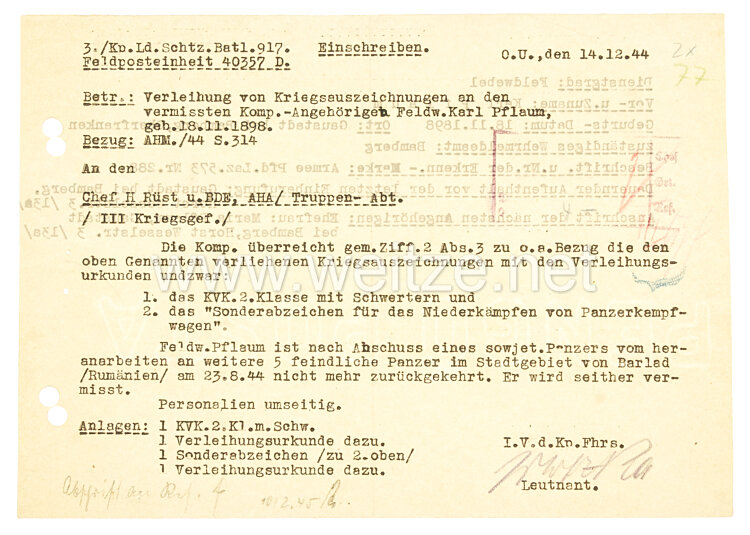
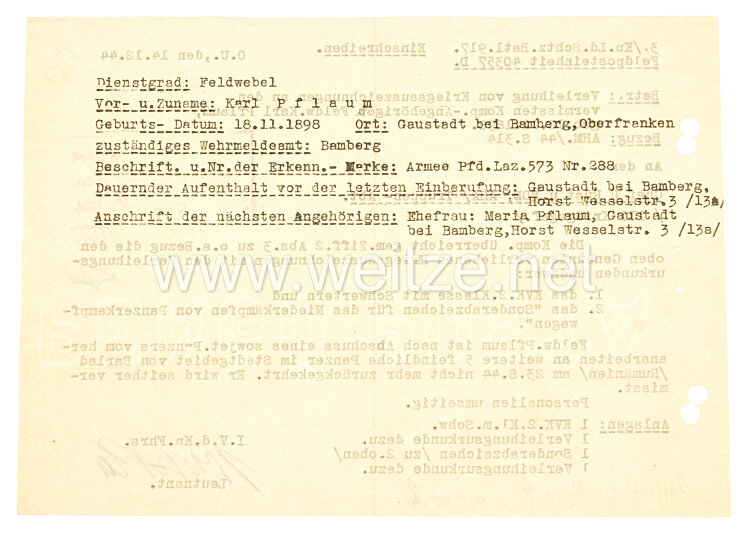
Together with the registered letter from the 3./Kp. Ld. Schtz. Batl.917 dated 14.12.44 “Re.: Award of war decorations to the missing company member Feldw. Karl Pflaum, born 18.11.1898. .. The company hereby presents ... the war decorations awarded to the above-named with the award certificates, namely:
1. the War Merit Cross 2nd Class with Swords and
2. the ‘Tank Destruction Badge’..
Feldw. Pflaum, after destroying a Soviet tank while advancing on 5 additional enemy tanks in the city area of Barlad/Romania on 23.8.44, never returned. He has been missing since then.”..
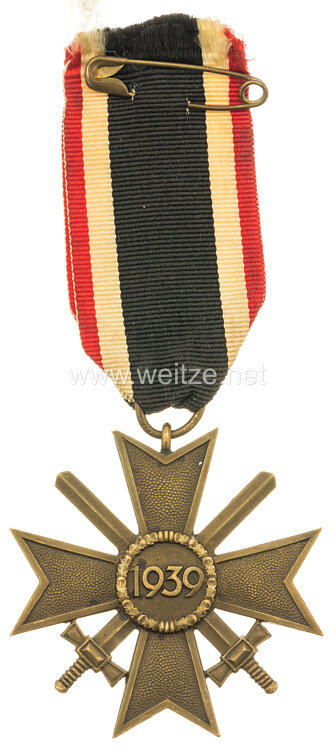
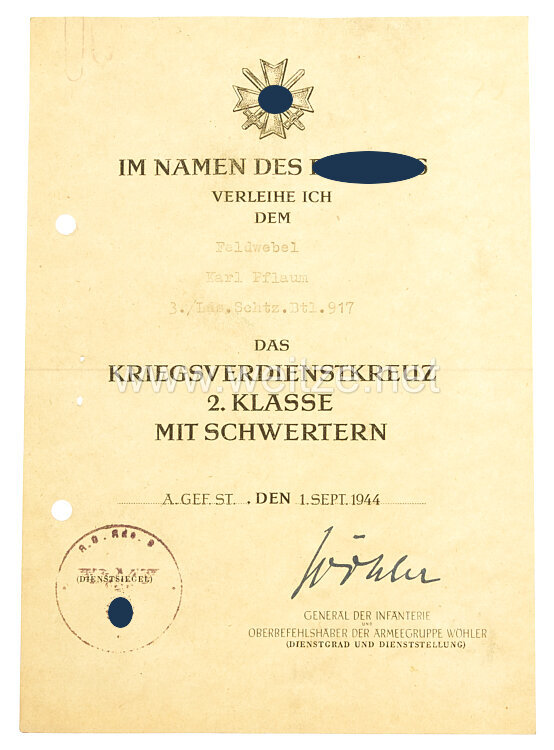
Together with the War Merit Cross 1939 2nd Class with Swords with the award certificate, issued A.Gef. St., dated 1 Sept. 1944, with signature Wöhler, General der Infanterie and Commander-in-Chief of Armeegruppe Wöhler.
Condition 2.
An impressive estate. Feldwebel Pflaum, 46 years old, destroyed a Russian tank on 23.8.1944 during defensive fighting in Romania and most likely did not survive the day - missing. The decorations and certificates were sent by military post to the family.
458838
3.500,00

Tank Destruction Badge for Single-Handed Destruction of Armored Fighting Vehicles in Black: Estate from the possession of Feldwebel Karl Pflaum, 3./Landes-Schützen-Bataillon 917

The Special Badge for the Destruction of Armored Fighting Vehicles by Individual Combatants, commonly known as the Tank Destruction Badge (Panzervernichtungsabzeichen), ranks among the rarest and most remarkable German military decorations of World War II. This award was instituted on March 9, 1942, by the Commander-in-Chief of the Army, Field Marshal Walther von Brauchitsch, to recognize the extraordinary courage and determination of individual soldiers who destroyed enemy armored vehicles using hand-held weapons.

The award criteria were exceptionally stringent. A soldier had to destroy an enemy tank or armored fighting vehicle single-handedly or as the gunner of an anti-tank weapon. The decoration was awarded in five grades, with each subsequent destruction earning a higher grade. The first grade in silver was awarded for destroying one tank, the second grade in black for three tanks, the third grade in silver for five tanks, with the highest grades in gold reserved for even greater achievements.

The badge itself depicts a stylized tank in profile surrounded by an oval laurel wreath. The design was deliberately austere to underscore the serious-heroic character of the decoration. The various grades differed in their material composition and surface treatment - the black badge was typically burnished, while the silver grades were manufactured in correspondingly lighter metal.

The technical construction of the badge was characteristic of cloth badges of this period. The metal tank was clamped onto a base of silver braid using multiple split pins, which was in turn attached to a backing plate. This construction allowed it to be worn on the uniform, typically on the right upper arm.

The historical context of this decoration reflects Germany's desperate military situation, particularly on the Eastern Front. From 1941 onward, German infantry units faced massive Soviet armored formations. The Red Army deployed tanks such as the T-34 and later heavy models like the KV-1 and IS-2, which were technically superior to German infantry capabilities. The Tank Destruction Badge was intended to motivate soldiers to engage these overwhelming opponents with Panzerfausts, anti-tank mines, magnetic hollow charges, or other close-combat weapons despite extreme danger.

Award numbers remained relatively low, underscoring the extraordinary danger of such operations. Destroying a tank in close combat required not only extreme courage but also tactical skill and often a considerable amount of luck. Many soldiers who attempted to approach tanks did not survive the attempt.

In late summer 1944, the period of the documented award described here, the Wehrmacht found itself in a catastrophic retreat situation. The Soviet Jassy-Kishinev Offensive in August 1944 led to the destruction of large parts of the German-Romanian forces in Romania. The Landes-Schützen-Battalions (Regional Rifle Battalions) typically consisted of older age groups and soldiers with limited front-line fitness, deployed for security and occupation duties. That such units were drawn into heavy defensive combat against Soviet armored formations demonstrates the desperate military situation.

The city of Barlad in Romania lay in the operational area of the Soviet offensive that led to Romania's capitulation and defection on August 23, 1944. German troops were surprised by the speed of the Soviet advance and suffered heavy losses. Many soldiers were captured or reported missing.

The practice of awarding decorations posthumously or to missing soldiers and sending them to families was common during the war. These awards served not only to recognize individual achievements but also to maintain morale on the home front. The careful documentation through battalion orders and award certificates demonstrates the bureaucratic precision with which military administration was maintained even in chaotic retreat situations.

The War Merit Cross (Kriegsverdienstkreuz), also mentioned in this grouping, was instituted in 1939 as a general military and civilian decoration for war service. The Second Class with Swords indicated military service and was a relatively common award, though its combination with the rare Tank Destruction Badge in this documented case underscores the recognition of exceptional service.

The involvement of General Otto Wöhler as commander of Army Group Wöhler (later renamed Army Group South Ukraine) places this award firmly in the context of the collapsing southern sector of the Eastern Front in August-September 1944. Wöhler commanded during one of the Wehrmacht's most catastrophic defeats, losing approximately 150,000 men in the Romanian debacle.

The Tank Destruction Badge remains a significant historical document that illustrates both the technological evolution of warfare and the human cost of the conflict. It stands as an example of the desperate tactical adaptations of an outmatched Wehrmacht in the final years of the war, and serves as a sobering reminder of the individual sacrifices demanded in industrial-scale armored warfare.