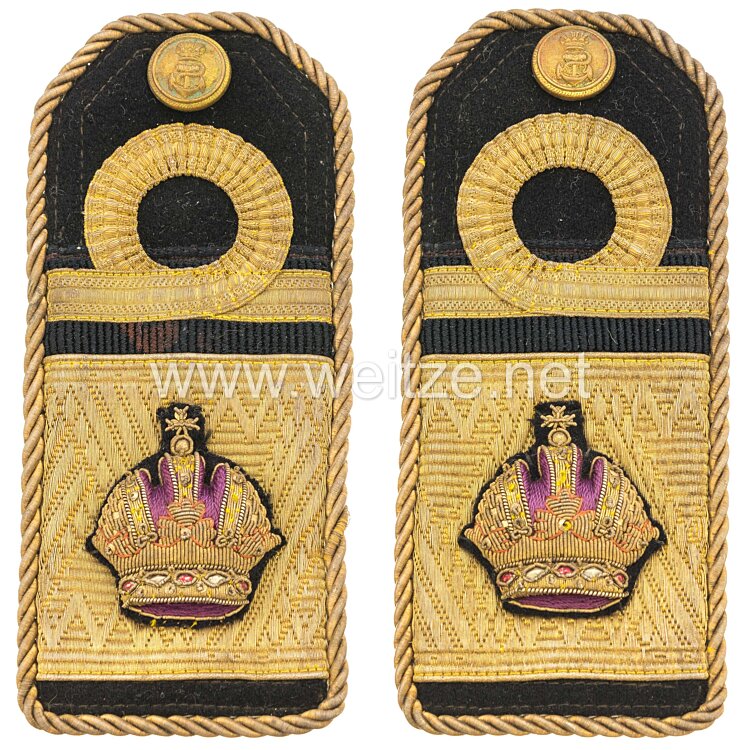
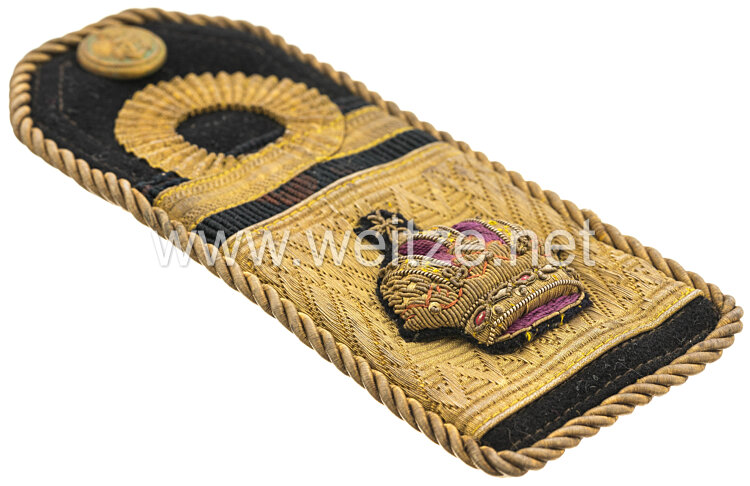
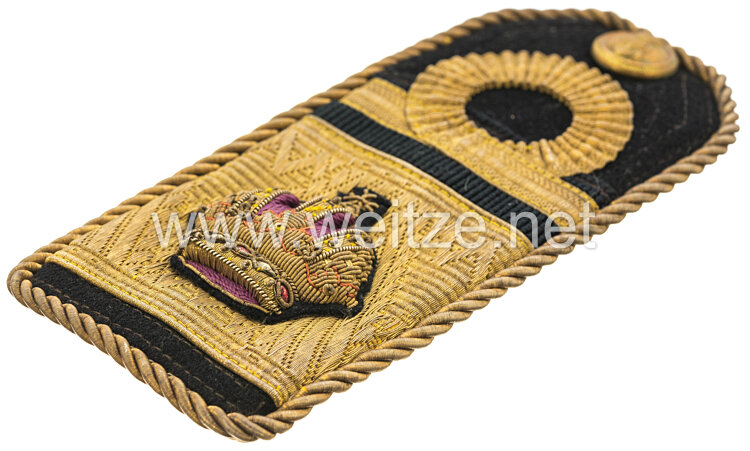
Austria/Imperial and Royal Navy Pair of Shoulder Boards for a Rear Admiral
Very rare, there were only 12 Rear Admirals until the end of the war in 1918.
These shoulder boards for a Rear Admiral of the Imperial and Royal Navy (k.u.k. Kriegsmarine) represent an extraordinarily rare testimony to Austro-Hungarian naval history from the late period of the Dual Monarchy. Manufactured around 1914, these insignia of rank document not only the military hierarchy of a significant European naval power, but also the traditional craftsmanship and strict uniform regulations of the Habsburg armed forces.
The Imperial and Royal Navy had developed during the 19th century from a modest coastal defense fleet into a respectable naval power. Under the leadership of admirals such as Wilhelm von Tegetthoff, who won a legendary naval victory at Lissa in 1866, the Austro-Hungarian Navy established itself as an important factor in the Adriatic region and the eastern Mediterranean. The uniform and rank system was based on international maritime traditions, particularly those of the British Royal Navy, while also developing distinctive Habsburg characteristics.
The design of these shoulder boards for the white uniform and the mess jacket corresponds to the uniform regulations of the k.u.k. Navy, which prescribed different types of dress for various occasions and seasons. The white uniform served as summer dress and tropical uniform, while the dark blue mess jacket was prescribed for social occasions and official receptions. The dual equipment underscores the representative duties of an admiral, who was not only a military commander but also a diplomatic representative of the monarchy.
The manufacture from blue cloth with gold braiding follows the traditional coloring of naval powers, with navy blue being internationally established as the identifying mark of naval service. The gold-embroidered rank insignia for a rear admiral displayed the specific number of stars and stripes that characterized this rank. In the k.u.k. Navy, a rear admiral typically wore one gold admiral's star above two gold stripes. The elaborate gold embroidery was executed by specialized military effects workshops that had to meet the highest standards of craftsmanship.
The rarity of these shoulder boards is emphasized by the historical fact that only twelve officers held the rank of rear admiral in the k.u.k. Navy until the end of the war in 1918. This small number reflects both the limited size of the Austro-Hungarian fleet compared to the great naval powers such as Great Britain or Germany, and the strict promotion practices within the naval officer career path. Advancement to flag officer required decades of service, outstanding achievements, and often also aristocratic origin or patronage.
In the context of World War I, the k.u.k. Navy played a significant, if limited, role. Its main task consisted of controlling the Adriatic and supporting land operations along the coast. Rear admirals commanded important fleet units, naval bases, or assumed specialized functions in the naval staff. The base at Pola (today Pula, Croatia) served as the fleet's headquarters and was the scene of important strategic decisions.
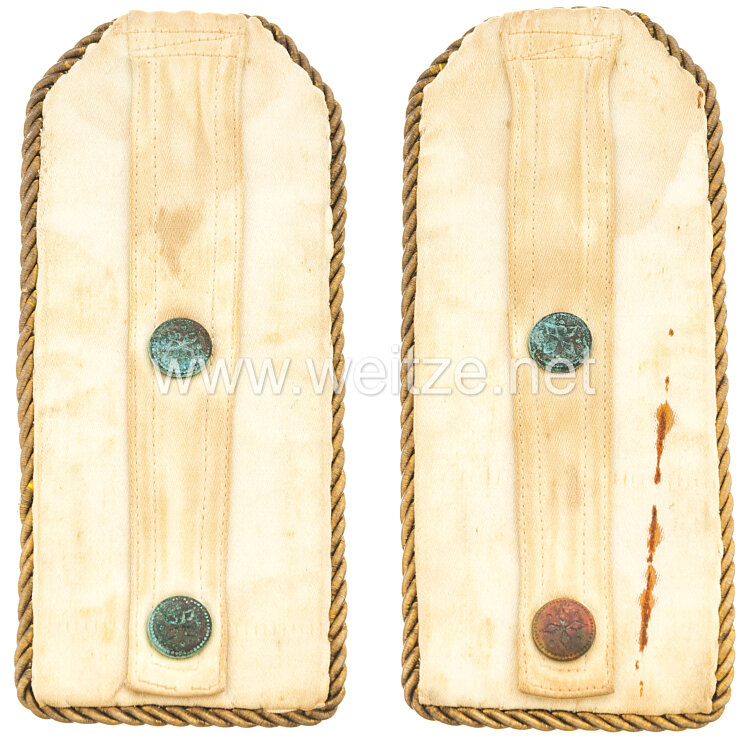
The technical details of the shoulder boards – the white cloth backing, the complete shoulder buttons, and the detachable shoulder loops – correspond exactly to the regulations for admiral's rank insignia. The detachability allowed changing between different uniform jackets and facilitated cleaning and maintenance. The shoulder buttons usually bore the imperial monogram or the double eagle of the monarchy.
After the collapse of the Dual Monarchy in 1918 and the dissolution of the k.u.k. Navy, such uniform items were partly adopted by the successor states, but mostly preserved or dispersed as historical relics. The fleet itself was divided among the victorious powers, with many ships falling to Italy. Many of the last k.u.k. admirals retired or died in the following years, making these uniform pieces authentic testimonies of a vanished era.
Today, such admiral's shoulder boards represent important museum objects that document not only the military hierarchy but also the social history, craftsmanship, and political significance of the Habsburg Navy. They recall a time when the Dual Monarchy still counted among the European great powers and its navy proudly flew the black-and-yellow flag in the Mediterranean.