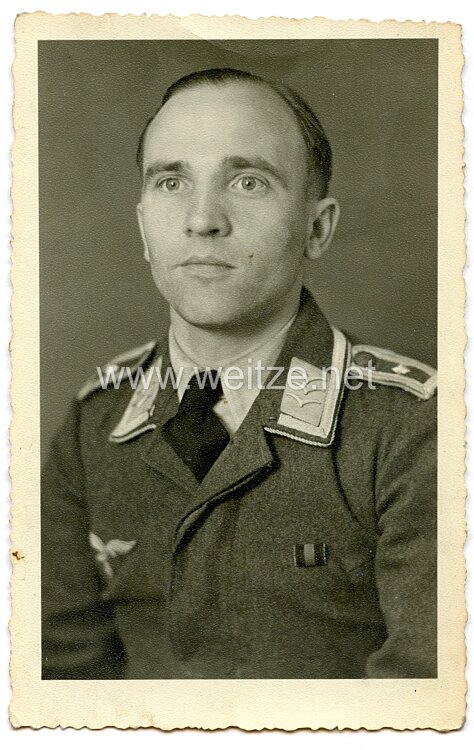
Luftwaffe Portrait Photograph, Feldwebel with Ribbon Bar
This portrait photograph of a Luftwaffe Feldwebel (sergeant) in postcard format represents an important aspect of military everyday culture during World War II. Such photographs served not only as personal mementos but also document the rank insignia, uniforms, and decorations of the German Air Force between 1935 and 1945.
The Luftwaffe was officially established as an independent branch of the Wehrmacht on February 26, 1935, after the National Socialist regime initiated Germany's rearmament. Under the command of Reichsmarschall Hermann Göring, the Luftwaffe developed into one of the most formidable air forces of its time. The rank of Feldwebel represented a middle non-commissioned officer position that carried considerable responsibility in the military hierarchy.
The Feldwebel belonged to the non-commissioned officers with portepee (sword knot) and was positioned in the chain of command between simple non-commissioned officers and commissioned officers. This rank group was responsible for the immediate leadership of smaller units and formed the backbone of military organization. In the Luftwaffe, Feldwebel could perform various functions: as pilots, observers, gunners, mechanics, or in administrative positions.
The ribbon bar visible in the photograph represents an important element of military decoration culture. Ribbon bars were textile representations of orders and decorations worn with service uniforms when wearing the complete medals was not appropriate. Luftwaffe uniform regulations precisely governed how and when these ribbon bars were to be worn. The arrangement of ribbons on the bar followed a strict hierarchy established in the Wehrmacht dress regulations.
Portrait photographs in postcard size (approximately 9 x 14 cm or 10.5 x 14.8 cm) were widespread during World War II. Soldiers frequently had themselves photographed in photo studios to send these pictures to family members, fiancées, or wives. The photographs documented not only personal appearance but also military status and earned decorations. Many soldiers took pride in presenting their uniforms and honors.
Photographic practice in the Wehrmacht was widespread and was conducted by both professional photographers and amateurs. Numerous military photo studios existed in occupied territories and throughout the Reich, specializing in portrait photographs of soldiers. These studios had standardized backgrounds and lighting techniques to create dignified military portraits.
The Luftwaffe uniform was distinguished by its characteristic blue-gray color, which differentiated it from the field-gray uniforms of the Army and the black or field-gray uniforms of the SS. Uniform design followed the Army regulation gazette for the Luftwaffe, later its own clothing regulations. Rank insignia were worn on shoulder straps and on sleeves, with non-commissioned officers displaying specific braids and piping.
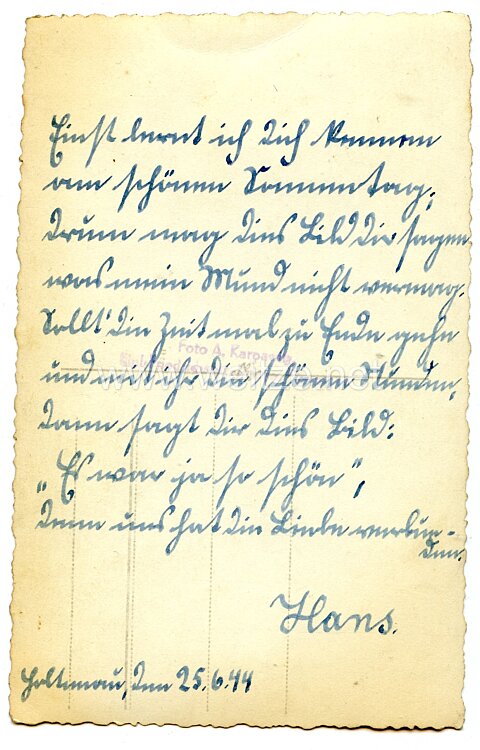
Such photographs possess significant historical and collectors' value today. They enable military historians and uniform specialists to study the precise representation of rank insignia, decorations, and uniform details. The provenance and authenticity of such photographs can be verified through various characteristics: photo paper quality, studio stamps on the reverse, photo format, and technical characteristics of contemporary photography.
The preservation of such documents is important for historical research, as they capture personal aspects of military experience. Unlike official documents or propaganda material, private portrait photographs convey an immediate impression of the individual soldiers who served in the armed forces. They remind us that behind military structures and organizations stood concrete persons with individual biographies.
The scholarly examination of such objects requires a critical perspective that considers both military-historical and cultural-historical dimensions. Such photographs are testimonies of an era that profoundly shaped the 20th century and whose historical processing remains a central task of historical research.