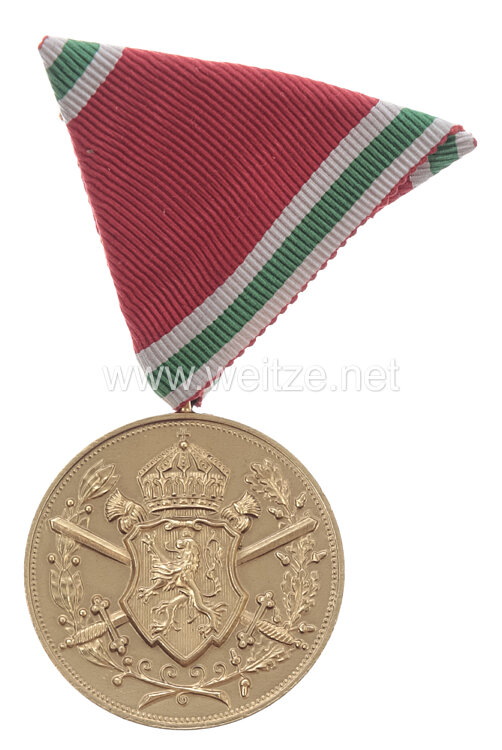
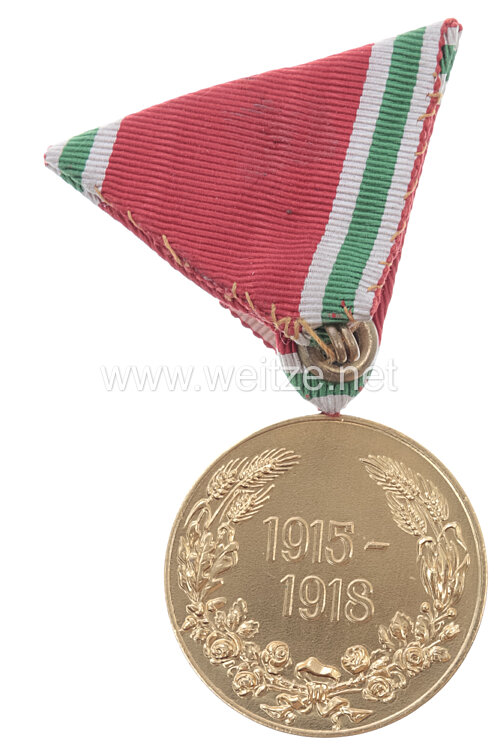
Bulgaria War Commemorative Medal 1915 - 1918

on triangular ribbon, condition 2.
466938
25,00

Bulgaria War Commemorative Medal 1915 - 1918

The Bulgarian War Commemorative Medal 1915-1918

The Bulgarian War Commemorative Medal 1915-1918 (Bulgarian: Военноспоменателен медал 1915-1918) represents a significant military decoration of the Kingdom of Bulgaria, instituted to commemorate participation in World War I. This medal documents Bulgaria's involvement as an ally of the Central Powers in one of the most devastating conflicts of modern history.

Bulgaria entered World War I on October 14, 1915, after receiving territorial concessions from Germany and Austria-Hungary, particularly regarding Macedonia, which Bulgaria had lost to Serbia in the Second Balkan War of 1913. Under Tsar Ferdinand I, the Bulgarian army fought on multiple fronts: against Serbia, Romania, Greece, and the Allied forces at the Salonika Front.

The War Commemorative Medal was instituted by royal decree after the war's end to honor all members of the Bulgarian armed forces who had served between 1915 and 1918. The medal was intended to recognize the sacrifice and dedication of Bulgarian soldiers, regardless of the conflict's ultimate outcome, which ended for Bulgaria with defeat and the Treaty of Neuilly-sur-Seine in November 1919.

The medal was typically manufactured from bronze or gilt metal. The obverse usually displays the portrait of Tsar Ferdinand I or military symbols such as crossed swords and laurel wreaths. The reverse typically bears an inscription with the dates “1915-1918” along with patriotic or military emblems. The artistic design followed the conventions of European military orders of this era.

The distinctive triangular ribbon is a special feature of Bulgarian military decorations from this period. The ribbon's coloring held symbolic significance and frequently represented Bulgaria's national colors: white, green, and red. The triangular format differed from the rectangular ribbons of many other European orders, giving Bulgarian decorations a distinctive appearance.

The award criteria for the War Commemorative Medal were relatively broad. Essentially all soldiers, non-commissioned officers, and officers of the Bulgarian Army who had performed active war service were eligible. Members of supporting units such as medical personnel, military administration, and supply troops could also receive the medal. The decoration was awarded posthumously to fallen soldiers, with the medal then presented to their surviving family members.

The condition designation “Condition 2” in military-historical collecting terminology indicates a very good to good state of preservation. The medal thus shows only minimal signs of use, the striking is clearly visible, and the material displays a natural, age-appropriate patina. Such specimens are particularly sought after by collectors as they preserve historical authenticity without being impaired by excessive wear or damage.

In historical context, the medal stands symbolically for a traumatic period in Bulgarian history. World War I cost approximately 100,000 Bulgarian soldiers their lives, with another 150,000 wounded. The defeat led to significant territorial losses, economic hardship, and political instability, ultimately resulting in the overthrow of Tsar Ferdinand I in October 1918, who abdicated in favor of his son Boris III.

For military historians and collectors, the Bulgarian War Commemorative Medal 1915-1918 represents an important testament to the role of smaller European nations in World War I. It recalls the complex alliance structures, national ambitions, and human costs of this global conflict. Today, these medals are sought-after collectibles possessing not only military-historical but also cultural-historical value, contributing to the research and remembrance of this formative epoch of European history.