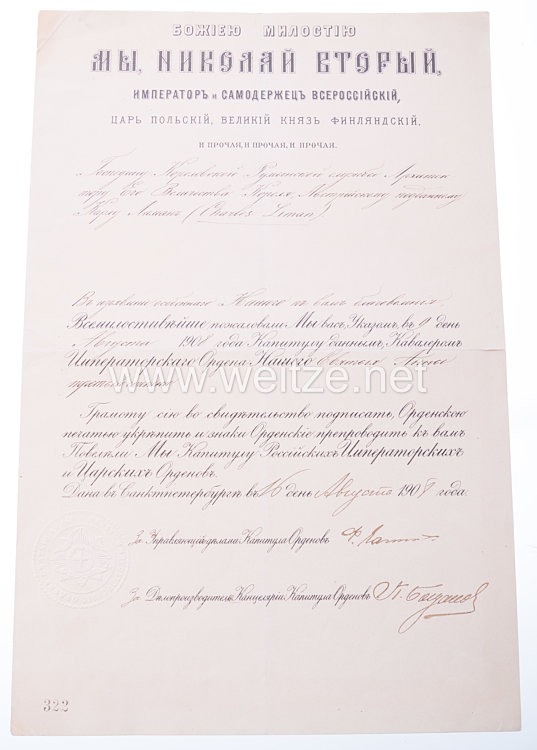
Imperial Russia Award Document for the Order of St. Anna 3rd Class

1908, awarded to the Royal Architect Karl Liman, embossed seal of the Order Chancellery. Condition 2
331037
550,00

Imperial Russia Award Document for the Order of St. Anna 3rd Class

The Award Document for the Order of St. Anna, 3rd Class from 1908 represents a significant testament to the Imperial Russian honors system during the late Tsarist period. This document was awarded to the royal architect Karl Liman and bears the embossed seal of the Order Chancellery, underscoring its authenticity and official origin.

The Imperial Order of Saint Anna was originally established in 1735 by Duke Karl Friedrich of Holstein-Gottorp in memory of his deceased wife Anna Petrovna, daughter of Peter the Great. After his son's accession to the throne as Tsar Paul I in 1796, the order was integrated into the official Russian honors system and became one of the most significant decorations of Tsarist Russia.

The 3rd Class of the Order of St. Anna was awarded according to the statutes of 1829 for special merit in civil and military service. This class was worn as a cross on a neck ribbon and represented an important recognition for middle-ranking officials, officers, and professionals who had rendered extraordinary services to the Empire. The bestowal upon foreigners, particularly upon specialists from Germany, was not uncommon in the late 19th and early 20th centuries, as the Tsarist Empire maintained close ties with German states.

The year 1908 marks an interesting period in Russian history. Tsar Nicholas II had been ruling since 1894, and the Empire was in a phase of modernization following the Revolution of 1905 and the lost Russo-Japanese War. The awarding of orders to foreign experts reflected the Tsarist Empire's efforts to utilize Western expertise for the construction and modernization of the country.

The reference to Karl Liman as a royal architect indicates his significant role in the construction industry. During this period, German architects and engineers were highly regarded in Russia and often entrusted with important building projects. The bestowal of a Russian order upon a German specialist underscores the close cultural and professional relationships between the German Empire and Tsarist Russia before World War I.

The embossed seal of the Order Chancellery on the document is of particular significance. The Order Chancellery was a specialized institution within the imperial administration responsible for maintaining order records, manufacturing order insignia, and issuing award documents. The embossed seal served as an official authentication feature and prevented forgeries. These seals typically displayed the imperial coat of arms or specific order symbols.

The award documents themselves were artfully designed certificates, often printed on heavy paper or parchment, with calligraphic elements and decorative borders. They contained the recipient's name, the reason for the award, the date, and the signature of the Tsar or an authorized official. These documents were not merely bureaucratic records but prestigious mementos highly valued by recipients and their families.

The Order of St. Anna, 3rd Class consisted of a red enameled cross with gold edges, bearing the monogram “AIPF” (Anna Imperatrix Petri Filia - Anna, Empress, Daughter of Peter). The cross was worn on a red ribbon with yellow edges. The insignia were manufactured in the imperial workshops, often by renowned goldsmiths and jewelers such as Eduard or Carl Fabergé.

After the October Revolution of 1917 and the fall of the Romanov Dynasty, all Tsarist orders were abolished. The Bolsheviks regarded the old order system as a symbol of the hated monarchy and class distinction. Many order recipients attempted to hide their decorations and documents or take them out of the country. This makes preserved award documents valuable historical artifacts today.

The collector value of such documents depends on several factors: the condition, completeness, historical context of the award, and the significance of the recipient. A document from 1908 in good condition with the original embossed seal is a rare and prized collectible. The indicated “Condition 2” suggests very good preservation with minimal signs of use.

Today, such documents are important sources for researching Russian social and administrative history, German-Russian relations, and the biographies of individuals who worked in the Tsarist Empire. They bear witness to a vanished era of European monarchies and their complex diplomatic and cultural interconnections before World War I.

r