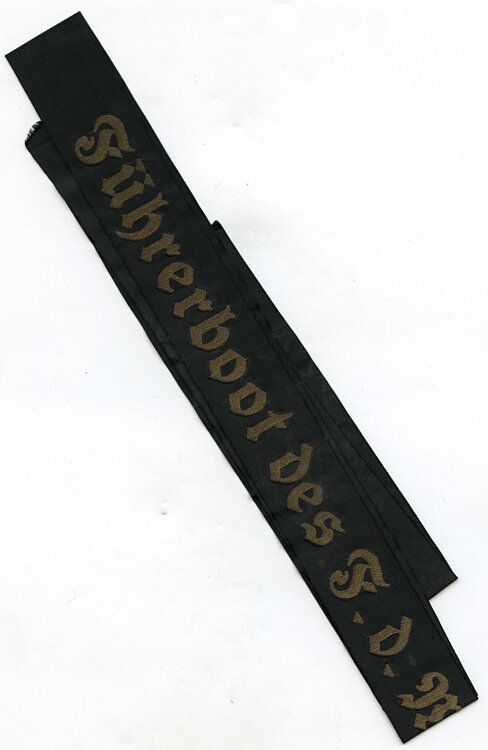
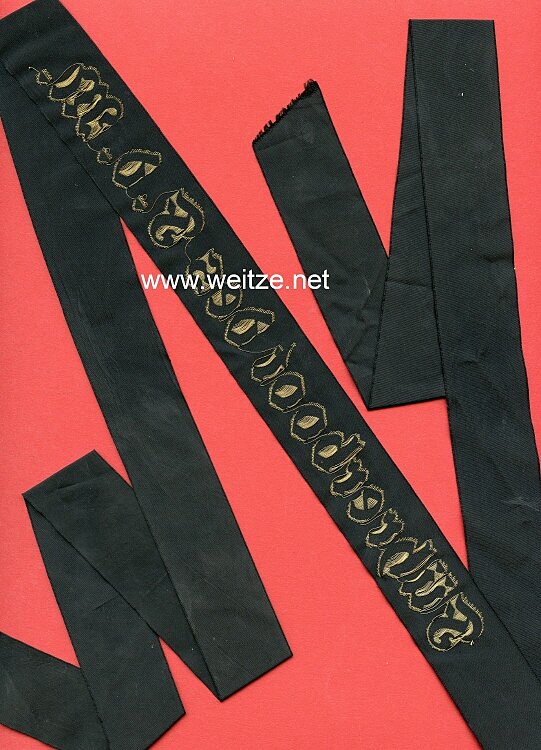
Cap Tally "Führerboot des F. d. M."
The cap tally "Führerboot des F. d. M." represents an exceptional piece of German Kriegsmarine equipment closely associated with the highest levels of naval mine warfare command. The abbreviation "F. d. M." stands for Führer der Minensucher (Commander of Minesweepers) or possibly Flottille der Minensuchboote (Minesweeper Flotilla), with the designation "Führerboot" indicating the command vessel of such a unit.
In German naval organization, cap tally inscriptions played a central role in identifying ship assignments and units. This tradition dates back to the Imperial Navy (Kaiserliche Marine) and was continued by the Reichsmarine (1919-1935) and the Kriegsmarine (1935-1945). This specimen, woven with metal thread, indicates high-quality manufacture typically used for officers or special units.
Mine warfare formed a crucial aspect of naval operations during both World Wars. Already in World War I, the German Navy recognized the strategic importance of mine barriers for both offensive and defensive operations. The North Sea and Baltic Sea became extensive minefields requiring constant clearing operations. Minesweeper units thus became indispensable elements of the fleet.
After the Treaty of Versailles in 1919, the German Navy was severely restricted, yet the development and testing of minesweepers remained a permitted area. The Reichsmarine systematically expanded its minesweeping capabilities, and with the founding of the Kriegsmarine in 1935, this area received increased priority. The organization of minesweeper units into flotillas was commanded by a lead vessel, the Führerboot.
The Führerboot of a minesweeper flotilla held special significance: it served as command center for the flotilla commander, coordinated operations of individual minesweepers, and possessed enhanced communication facilities. The crew of such a command vessel enjoyed high prestige, as they served directly under an experienced officer's command. Wearing a specific cap tally like "Führerboot des F. d. M." documented this special position within the naval organization.
The length of 144 cm corresponds to standardized dimensions of German naval cap tallies. These were manufactured to wrap around the cap with the ends hanging down at the back. Weaving in metal thread – typically gold or silver-colored wire – was technically demanding and executed by specialized manufacturers. Such high-quality ribbons were often designated for officer caps or special units.
During World War II, German minesweeper units experienced enormous operational scope. They operated in the North Sea, Baltic Sea, English Channel, and later also in the Mediterranean and Black Sea. Clearing Allied mines and securing their own shipping routes were among their primary tasks. Losses among minesweepers were substantial, as these vessels were constantly exposed to mine strikes, enemy submarine attacks, and air raids.
The command structure of minesweeper units was hierarchically organized. Above individual flotillas stood regional commands such as the "Führer der Minensuchboote" (Commander of Minesweepers) for various sea areas. This command level coordinated operations of multiple flotillas and maintained direct contact with naval high command.
After the war's end, many German minesweepers were employed by the Allies for clearing operations, as German crews possessed the necessary expertise and knowledge of minefields. The "German Mine Sweeping Administration" continued this dangerous work into the early 1950s.
Today, originally preserved cap tallies like this are sought-after collector's items and important documents of naval history. They provide insights into the organization, hierarchy, and daily life of naval units. The good condition of this specimen makes it a valuable historical testimony to German naval mine warfare.