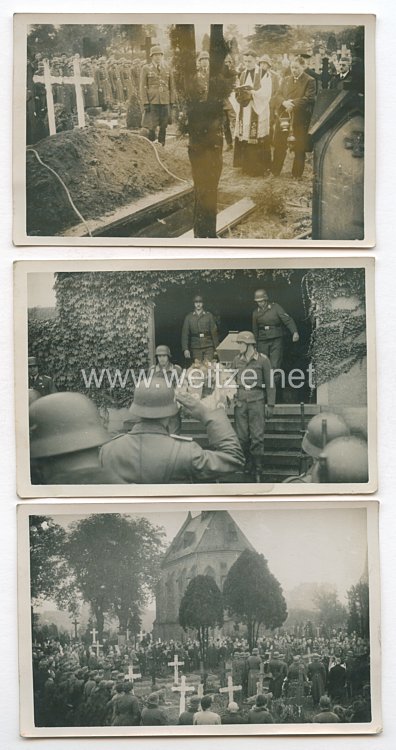
Luftwaffe Photographs, Funeral of a Soldier

3 photographs, postcard size, used condition.
330637
40,00

Luftwaffe Photographs, Funeral of a Soldier

These three postcard-sized photographs document the funeral of a German Luftwaffe soldier during World War II. Such private images represent important historical documents that provide insights into military burial rituals and the commemorative culture of the Wehrmacht between 1939 and 1945.

The Luftwaffe, officially founded on February 26, 1935, as the youngest branch of the Wehrmacht, developed its own traditions and ceremonial practices that were partially based on older military branches while incorporating modern elements. Military funerals were strictly regulated and followed precise guidelines established in various service regulations and decrees.

During the war, hundreds of thousands of Luftwaffe personnel fell at all fronts. Army Service Regulation 10/9 and other directives determined the conduct of military burials. These typically included the lying-in-state of the fallen, a funeral procession with military honors, a memorial ceremony at the grave, as well as the three-volley salute and the playing of the song “Ich hatt' einen Kameraden” (I Had a Comrade) by a trumpeter or bugler.

Photographs of funerals were quite common in the military context, though emotionally challenging. They served various purposes: documentation for military records, informing relatives about a dignified burial, and as personal remembrance for comrades. The postcard-size format (typically 9 x 14 cm or 10 x 15 cm) was the standard for private photographs of that era and facilitated easy mailing to the families of the fallen.

Luftwaffe burial rituals reflected the military hierarchy. Officers received more elaborate ceremonies than non-commissioned officers or enlisted ranks. At the front, possibilities were often limited, yet efforts were made to bury the fallen with military honors. Coffins were frequently covered with the Reich War Flag or the Balkenkreuz (bar cross) of the Luftwaffe. Honor guards formed ceremonial lines, and the deceased's comrades attended the ceremony in uniform.

The used condition of these photographs is characteristic of documents preserved over decades. Creases, discoloration, or signs of wear testify to their history as personal mementos that may have been sent in field post letters, pasted in albums, or carried in pockets.

War grave care during the war was the responsibility of the Wehrmacht itself. Each unit maintained casualty lists, and graves officers were responsible for registering and marking burial sites. After the war, the Volksbund Deutsche Kriegsgräberfürsorge (German War Graves Commission), founded in 1919, took over the care and maintenance of soldiers' graves.

Photographic documents like these three images hold significant historical and research value today. They document not only individual fates but also the material culture, uniforms, and social practices of the era. For military historians, they provide information about burial locations, involved units (recognizable by badges and uniforms), and the organization of military ceremonies under wartime conditions.

The emotional dimension of such photographs should not be underestimated. For bereaved families, they were often the only visual proof that their relative had received a dignified burial. In an era when many soldiers were listed as missing or buried in mass graves, a documented individual burial offered families some consolation.

Today, such photographs are part of the historical record and are preserved in archives, museums, and private collections. They contribute to understanding the everyday reality of war and remind us of the human costs of military conflicts beyond strategic and political considerations.

r