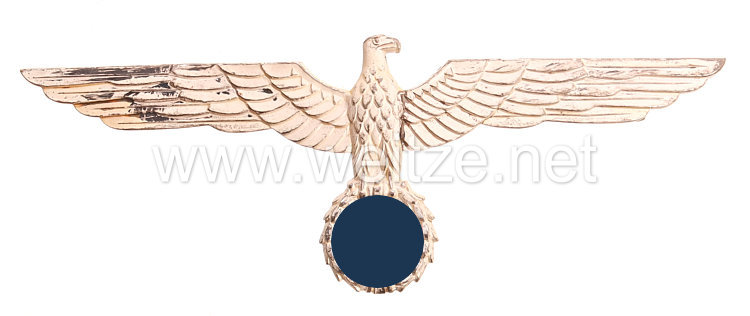
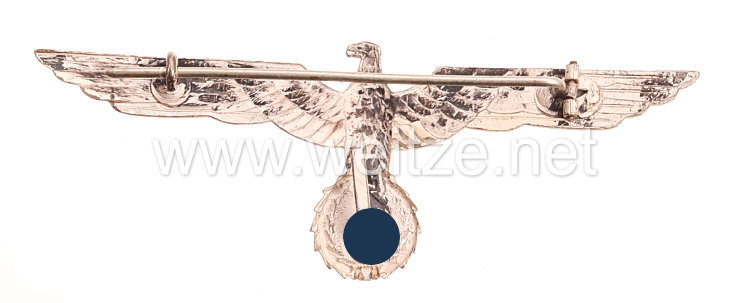
Kriegsmarine Metal Breast Eagle for Officer Summer Uniform (Officials)
The Kriegsmarine Metal Breast Eagle for Officers' Summer Uniforms represents a characteristic insignia element of the German Navy during World War II. This specific version of the breast eagle was worn by officers and officials of the Kriegsmarine on the light summer uniform and differed significantly in material and execution from the textile variants used on winter uniforms.
The Kriegsmarine, as the official designation of the German naval forces from 1935 to 1945, introduced a comprehensive system of uniforms and insignia following the reintroduction of conscription and the breach of the Treaty of Versailles. The eagle as the national emblem of the German Reich was worn on all uniform parts in various designs. According to the Dress Regulations for the Kriegsmarine of October 1, 1936, and its subsequent amendments, precise regulations were established for wearing the different eagle forms.
The present specimen consists of silver-plated non-ferrous metal, a material choice made for the summer uniform for both practical and aesthetic reasons. Unlike the cloth eagles in yellow or gold sewn onto dark uniform jackets, the white summer uniform required a metal eagle that would stand out in contrast. The non-ferrous metal, typically a zinc alloy or tombac, was silver-plated to achieve a noble, lustrous effect befitting the rank and dignity of officer status.
The summer uniform of Kriegsmarine officers consisted of a white cloth tunic or white jacket worn during warmer months or in tropical deployment areas. The metal breast eagle was attached centrally on the chest, above the pockets. Attachment typically occurred through rear prongs or soldered pins that were passed through the uniform fabric and bent over.
The iconography of the eagle followed national specifications: a stylized eagle with outstretched wings, holding a swastika within an oak wreath in its talons. The maritime version differed in details from the eagles of other Wehrmacht branches. The Kriegsmarine used a specific stylization distinguished from the army eagle by wing positioning and proportions.
Production of these metal breast eagles was carried out by various authorized manufacturers, including renowned firms such as Assmann & Söhne in Lüdenscheid, Friedrich Linden in Lüdenscheid, or C.E. Juncker in Berlin. Quality varied depending on the manufacturer and production period. Early wartime productions often showed higher detail accuracy and better material quality than later manufacture under wartime conditions.
The category “Officials” (Beamte) in the Kriegsmarine encompassed administrative officers, paymasters, engineers, doctors, and other specialists who held officer rank but did not belong to the military naval officer career path. These wore the same uniform variants as naval officers but were distinguished by specific sleeve insignia and career branch colors.
The described condition of “lightly worn” indicates actual use. The silver plating may show signs of wear such as slight abrasion, oxidation, or minimal scratches, which is normal for an object over 80 years old. Such wear marks provide the piece with historical authenticity and document its actual use during service time.
Following the collapse of the German Reich in 1945, the wearing of all military insignia with National Socialist symbols was prohibited. Many uniform parts and insignia were destroyed, hidden, or kept by soldiers as mementos. This makes preserved specimens important historical documents of a past era today.
From today's military-historical perspective, such objects are important witnesses to uniform studies and phalerists. They document craftsmanship, material usage, production techniques, and the complex system of military hierarchies and traditions. The scholarly engagement with such objects serves historical understanding and documentation, not glorification.