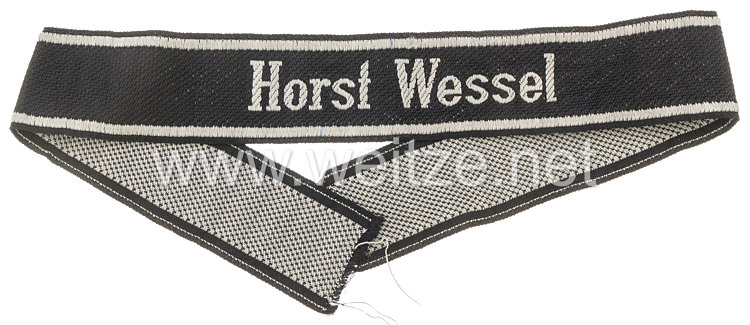
Waffen-SS Cuff Title for Enlisted Men of the 18. SS-Freiwilligen-Panzergrenadier-Division “Horst Wessel”
This cuff title of the 18. SS-Freiwilligen-Panzergrenadier-Division "Horst Wessel" represents a characteristic insignia of one of the latest Waffen-SS divisions formed during World War II. Worn as unit identification insignia on the lower left sleeve, this black band identified its wearer as a member of a formation established in January 1944 around a cadre from the 1st SS Infantry Brigade (mot.).
The division consisted primarily of Hungarian Volksdeutsche (ethnic Germans) from the Banat region. Originally designated as 18. SS-Panzergrenadier-Division in January 1944, it received the honorific name "Horst Wessel" before October 1944. This name honored Horst Wessel (1907-1930), an SA leader killed in 1930 who was glorified by the Nazi regime as a martyr. He was credited as the author of the Horst-Wessel-Lied, the Nazi Party anthem. The division was originally intended to recruit heavily from the SA, but by 1944 most physically fit SA men had already been drafted or volunteered.
The division's operational history extended across multiple theaters of war: during its training in spring 1944, it was employed for rear-security and anti-partisan duties in Croatia. Deployment to Hungary followed in June 1944, succeeded by combat operations in the Eastern Front central sector from July to October 1944. In August 1944, the division participated in operations against the Slovak National Uprising. Further engagements in Hungary and Czechoslovakia continued until the division was ultimately destroyed in May 1945. The division was commanded by SS-Brigadeführer Wilhelm Trabant (January 1944 - January 1945), SS-Gruppenführer Josef Fitzthum (January 1945), SS-Oberführer Georg Bochmann (January-March 1945), and SS-Standartenführer Heinrich Petersen (March-May 1945).
The cuff title itself was manufactured in Bevo-woven construction. The term "Bevo" refers to machine-woven production, particularly associated with Bandfabrik Ewald Vorsteher (BeVo) of Wuppertal, though various manufacturers produced similar machine-woven cuff titles during World War II. Machine-woven cuff titles became increasingly common from 1943 onward as a cost-efficient and faster production method compared to earlier RZM machine-embroidered versions.
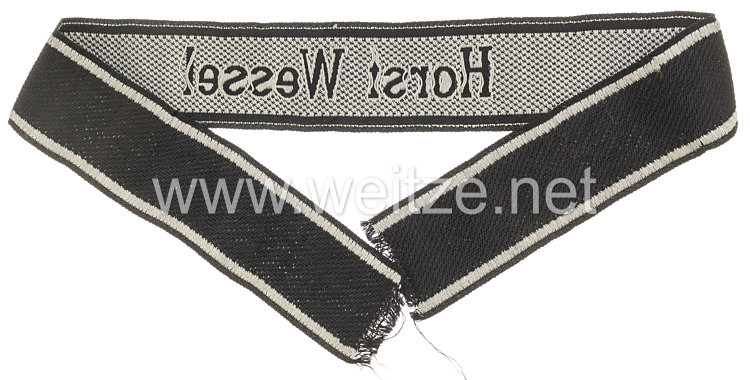
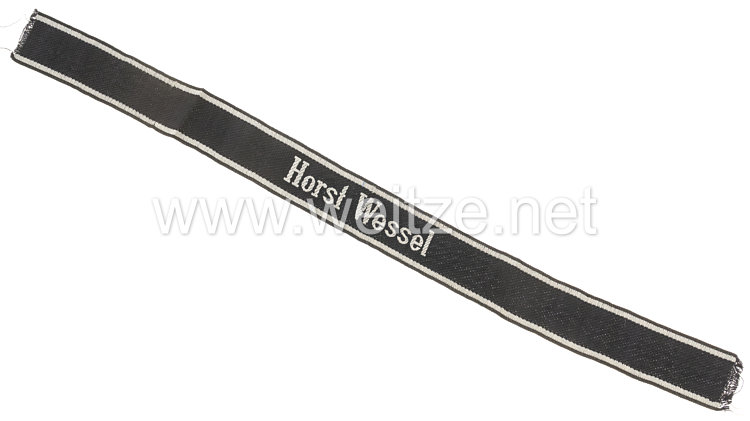
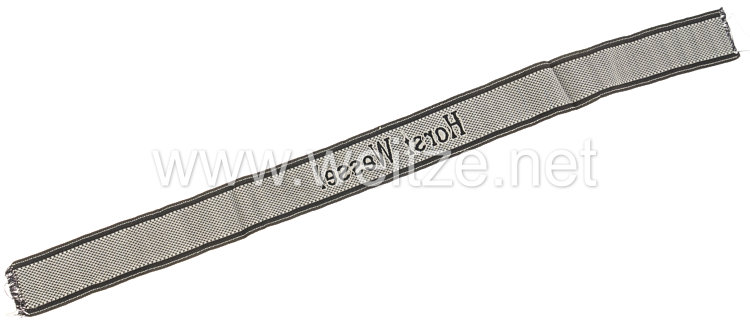
The band displays the machine-woven inscription "HORST WESSEL" in Latin script with silver-grey thread on black rayon. It is bordered at top and bottom with machine-woven silver-grey tresses. The reverse exhibits the characteristic "salt and pepper" pattern (black and white checkered), diagnostic of Bevo-weave production. With a length of 45 centimeters and a width of approximately 28-30 millimeters, it conforms to standard dimensions for Waffen-SS cuff titles. The unhemmed ends indicate late-war simplified production.
The cuff title was worn on the lower left sleeve of the field blouse and greatcoat by enlisted men and NCOs of the division. Regulations specified that cuff titles were not to be worn on shirts, camouflage garments, or drill uniforms. The bottom edge was generally placed at the top of the split seam of the jacket cuff, approximately 14.5-15 centimeters from the cuff edge. Cuff titles were considered a special honor and were to be worn only by active members of the designated unit—if transferred out, the cuff title was to be removed.
Multiple production variants existed for this cuff title: RZM machine-embroidered versions (early pattern), Bevo machine-woven versions with distinctive salt-and-pepper reverse, Bevo-like variants with different reverse patterns, and late-war simplified Bevo versions with unhemmed ends and no manufacturer markings. Enlisted men and NCOs wore cuff titles with white or silver-grey lettering, while officers wore versions with silver bullion thread lettering.
Following Germany's defeat in May 1945, all SS insignia and uniforms became prohibited. Many cuff titles were destroyed, hidden, or taken as war trophies by Allied soldiers. Original Waffen-SS cuff titles are now considered historical artifacts and are collected by military historians and museums. The sale and display of such items is regulated differently across countries, with some nations prohibiting their public display or sale, while others permit them for educational and historical purposes only.