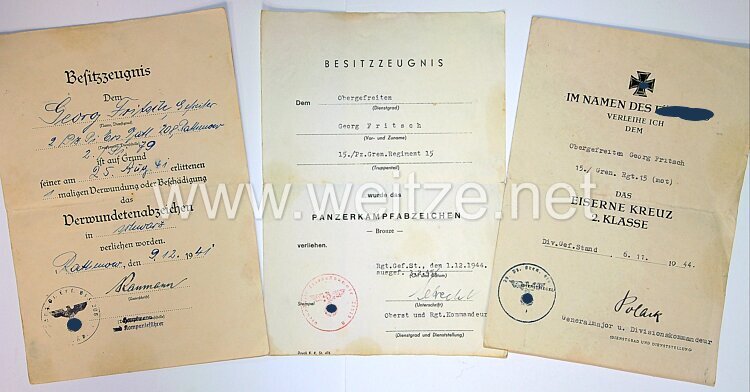
This document group chronicles the military career of an Obergefreiter (Senior Lance Corporal) serving with the 15th Company of Panzergrenadier Regiment 15 during World War II. The three preserved documents – certificates of possession for the Tank Battle Badge in Bronze and the Wound Badge in Black, along with an award certificate for the Iron Cross 2nd Class – provide authentic insight into the Wehrmacht's decoration system and the combat experiences of an ordinary soldier between 1941 and 1944.
Panzergrenadier Regiment 15 belonged to the 11th Panzer Division, one of the Wehrmacht's most mobile and combat-effective divisions. The division was established in August 1940 and fought on various theaters of war, including the Balkans, the Eastern Front, and later in Western Europe. The 15th Company was organized as a heavy infantry gun company, equipped with heavy weapons to support the motorized infantry.
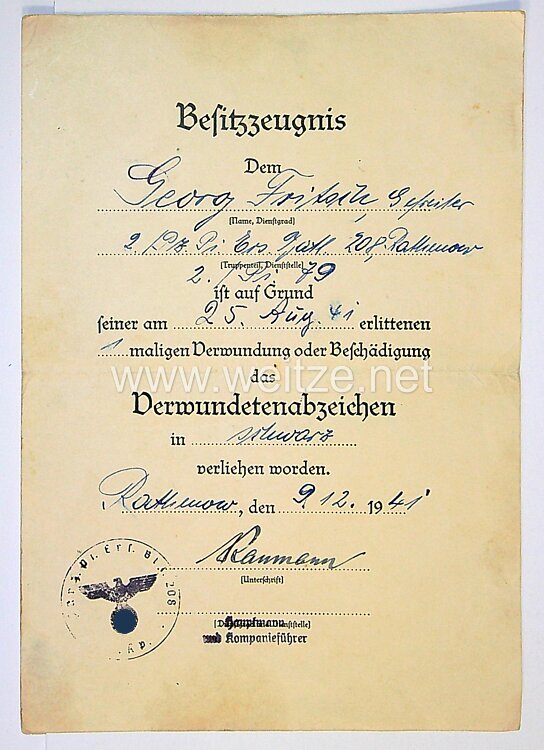
The Wound Badge in Black was awarded to the soldier for a wound sustained on August 25, 1941, as documented by the certificate issued on December 9, 1941. At this time, the 11th Panzer Division was engaged on the Eastern Front as part of Operation Barbarossa. The division participated in the Battle of Kiev and fought in heavy engagements in Ukraine. The Wound Badge was instituted by decree on September 1, 1939, and awarded in three grades: Black for one or two wounds, Silver for three or four wounds, and Gold for five or more wounds or permanent disability. The black grade thus marked the soldier's first combat wound.
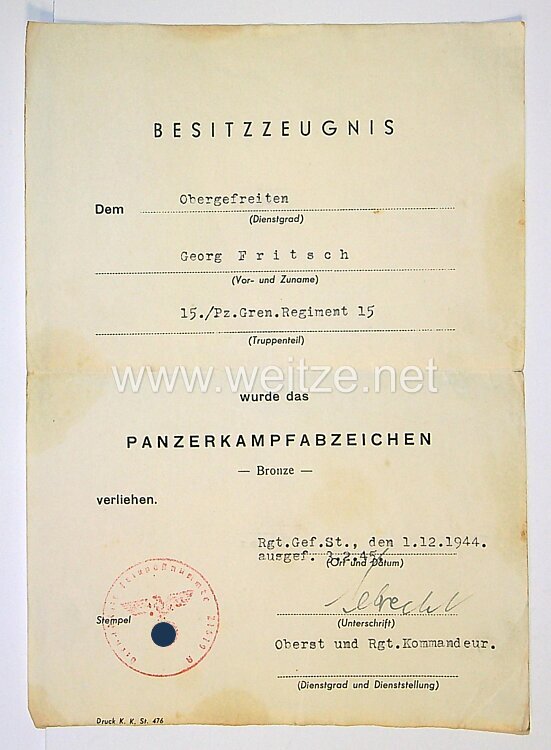
The Tank Battle Badge in Bronze was awarded on December 1, 1944, by the Colonel and Regiment Commander. This badge was originally instituted by decree on December 20, 1939, for crews of tanks and armored reconnaissance vehicles. However, the bronze grade was a later addition: on June 6, 1940, the badge was introduced for members of the Panzergrenadiers and other armored units who did not serve directly as tank crew. The award was made after participation in three combat days or after being wounded in armored combat. The late conferral in December 1944 suggests that the soldier was continuously in action and only at this point fulfilled the formal requirements or completed the bureaucratic processes.
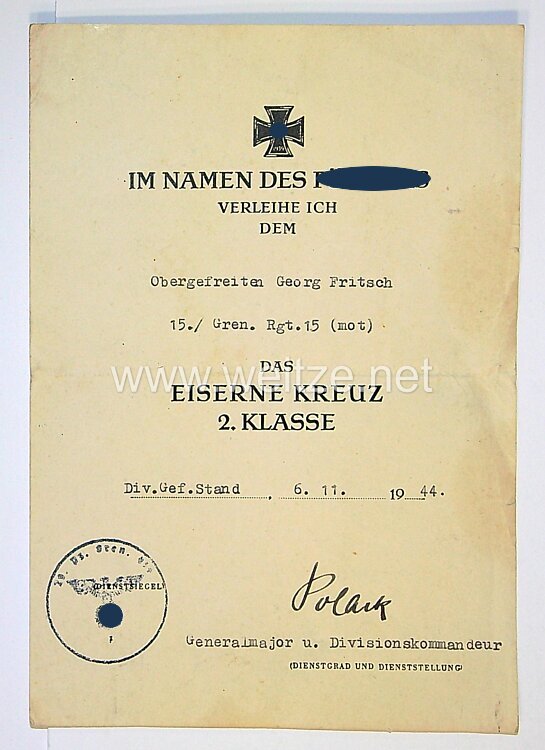
The most significant decoration in the group is the Iron Cross 2nd Class, awarded on November 6, 1944. The certificate bears the signature of Generalmajor Dr. Fritz Polack, commander of the 11th Panzer Division. Polack was an experienced tank commander who himself was decorated with the Knight's Cross of the Iron Cross on August 27, 1943, and the Oak Leaves on April 30, 1945. The Iron Cross, originally instituted in 1813 and renewed by Adolf Hitler in 1939, was Germany's most famous bravery decoration. The 2nd Class was awarded for special merit in combat and was a prerequisite for higher grades.
In November 1944, the 11th Panzer Division was in a critical phase of the war. After heavy fighting on the Eastern Front, the division was deployed in the West and participated in defensive battles in Lorraine and later in the Ardennes Offensive. The conferral of the Iron Cross at this late stage of the war underscores that despite the deteriorating military situation, the formal decoration system continued to function.
The rank of Obergefreiter was the highest enlisted rank before the non-commissioned officer grades. An Obergefreiter typically had several years of front-line experience and could be entrusted with leading small groups. The fact that this soldier was in action between August 1941 and November 1944 – over three years – and was wounded only once while receiving several decorations testifies to a remarkable combination of combat experience and luck.
Such document groups are important historical records that illuminate the individual fate of soldiers in the context of larger military events. They enable historians to understand the experiences of ordinary soldiers and the reality of war beyond strategic planning. The preserved documents with their fold marks and good condition suggest that they were of personal significance to the owner or his family and were carefully preserved.
The 11th Panzer Division earned a reputation as a reliable and effective fighting force throughout the war. From the invasion of Yugoslavia and Greece in 1941 through the vast expanses of the Soviet Union to the final battles in 1945, the division was continuously engaged. The survival of these documents, particularly through the chaotic final months of the war, is itself remarkable and speaks to the determination of those who preserved them as tangible memories of service and sacrifice.