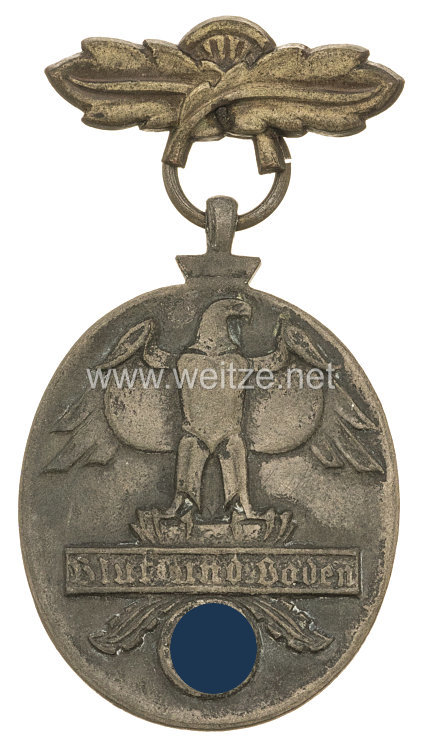
Reichsnährstand Landesbauernschaft Bayern - Honor Badge for 20 Years of Faithful Service for Men

Fine zinc, the clasp iron burnished.
419236
180,00

Reichsnährstand Landesbauernschaft Bayern - Honor Badge for 20 Years of Faithful Service for Men

The 20 Years Faithful Service Badge of the Bavarian Regional Farmers' Association (Landesbauernschaft Bayern) within the Reich Food Estate (Reichsnährstand) represents a fascinating example of the awards established during the National Socialist period in Germany to recognize agricultural service.

The Reichsnährstand was founded on September 13, 1933, through the Reich Food Estate Law under the leadership of Richard Walther Darré as Reich Farmers' Leader (Reichsbauernführer). This organization was a compulsory association of all persons and enterprises active in German agriculture, forestry, and the food industry. The Reichsnährstand followed the leadership principle (Führerprinzip) and was intended to implement the National Socialist “Blood and Soil” (Blut und Boden) ideology, which glorified the peasantry as the backbone of the German “racial community” (Volksgemeinschaft).

The Landesbauernschaft Bayern formed the regional organization of the Reichsnährstand for Bavaria. It was hierarchically subdivided into district farmers' associations (Kreisbauernschaften) and local farmers' associations (Ortsbauernschaften). These structures served not only the economic organization of agriculture but also the ideological penetration of rural areas and the control of agricultural production within the framework of National Socialist autarky policy.

This particular badge was specifically designed for men who had rendered 20 years of faithful service within the Reichsnährstand. The manufacture from fine zinc with a browned iron clasp was typical for awards of this period, particularly after material shortages during the war necessitated the conservation of more valuable metals for armaments production. The browning of the clasp served as corrosion protection and gave the iron a characteristic dark coloration.

Such service awards were part of a comprehensive system of honors and recognitions established by the National Socialist leadership to foster loyalty and emphasize the importance of various professional groups within the “Volksgemeinschaft.” Awards were granted according to established guidelines and were associated with certain privileges that elevated the wearer's social status within the agricultural community.

The existence of different versions for men and women reflects the gender-specific hierarchy of NS society. Women often received different, usually simpler versions of the same awards, reflecting the different roles assigned to men and women in the National Socialist worldview.

During its existence, the Reichsnährstand controlled all aspects of agricultural production and distribution. It set production quotas, regulated prices, and administered the distribution of agricultural products. This central control was intended to ensure Germany's food security, particularly during World War II when the supply situation became increasingly precarious.

After the end of World War II and the collapse of the NS regime, the Reichsnährstand was dissolved by the Allies in 1945. The organization was regarded as an integral component of the National Socialist system of rule. In the postwar period, new democratic agricultural organizations were founded, such as the German Farmers' Association (Deutscher Bauernverband) in the Federal Republic of Germany.

Today, awards such as this badge are important historical artifacts that provide insight into the organizational structure and ideology of the Third Reich. They document the penetration of all areas of society by the NS system and the instrumentalization of agriculture for political purposes. For historians and collectors of military and political antiques, they represent valuable sources for researching this dark period of German history.

The preservation and scholarly documentation of such objects is important for historical education and serves as a reminder of how totalitarian systems attempted to control and instrumentalize all areas of social life for their purposes.

r