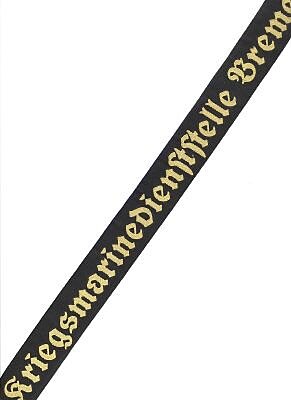
Kriegsmarine Cap Tally "Kriegsmarinedienststelle Bremen"

Cotton construction, worn condition, very well preserved. Condition 1.
33936
90,00

Kriegsmarine Cap Tally "Kriegsmarinedienststelle Bremen"

The Kriegsmarine cap tally bearing the inscription “Kriegsmarinedienststelle Bremen” represents a characteristic piece of equipment from the German Kriegsmarine during World War II. These cap tallies, worn on the peaked caps of enlisted ranks, served not only for uniformity but also for identification of affiliation to specific units, ships, or service stations.

Historical Context of the Kriegsmarine
The Kriegsmarine was officially established on June 1, 1935, as the successor organization to the Reichsmarine, after the German Reich unilaterally renounced the military restrictions of the Treaty of Versailles. Under the supreme command of Grand Admiral Erich Raeder and later Karl Dönitz, the Kriegsmarine developed into a significant naval force. The navy comprised not only warships and U-boats but also an extensive network of shore establishments, shipyards, training facilities, and administrative service stations.

Cap Tallies in the Kriegsmarine
The tradition of cap tallies in the German Navy dates back to the 19th century. According to the Kriegsmarine uniform regulations, sailors and petty officers without sword knots wore oval peaked caps with a black band made of cotton or artificial silk. This band was wrapped around the cap and bore the name of the ship, formation, or service station in golden-yellow lettering. The script design followed standardized guidelines, using either Gothic or Latin letters.

Kriegsmarine Service Stations
The term “Kriegsmarinedienststelle” (Naval Service Station) designated administrative and logistical establishments of the Kriegsmarine ashore. These service stations were responsible for various tasks, including recruitment, training, administration, material procurement, and welfare of naval personnel. In major port cities such as Bremen, several such facilities operated simultaneously.

Bremen as a Naval Base
Bremen played an important role for the Kriegsmarine during World War II. The city and its port of Bremerhaven were significant maritime centers on the Lower Weser. Shipyards such as AG Weser and Deschimag were located here, building U-boats, destroyers, and other warships. The Kriegsmarinedienststelle Bremen coordinated various administrative and logistical tasks in this important naval district. Naval personnel assigned to this service station wore the corresponding cap tally as an indicator of their affiliation.

Manufacture and Materials
The cotton construction of this example corresponds to Kriegsmarine material specifications. While higher-quality variants were made from artificial silk, cotton was particularly widespread in the later war years due to material shortages. The golden-yellow lettering was either embroidered or woven. Production was carried out by specialized textile companies that were Wehrmacht suppliers.

Wearing Method and Significance
The cap tally was threaded through two side openings at the rear of the cap and hung down in two ribbons. Upon assignment to a ship or new service station, enlisted ranks received the corresponding new tally. For naval personnel, the cap tally was an important identification feature and expression of esprit de corps. Affiliation with a particular unit was worn with pride.

Preservation and Collector Value
Kriegsmarine cap tallies today possess significant military historical value. Examples from shore service stations are rarer than those from famous warships, as they were produced in smaller quantities and received less attention. A tally in very good condition with clear, legible lettering is particularly valuable for collectors and museums. The worn condition testifies to authentic use during wartime.

Historical Classification
The cap tally documents the organizational complexity of the Kriegsmarine and the importance of the port city of Bremen for German naval warfare. It commemorates the thousands of naval personnel who served not at sea but in administrative and logistical functions ashore. Such objects are important witnesses to military history and provide insights into the structures and daily life of the Kriegsmarine during World War II.

r