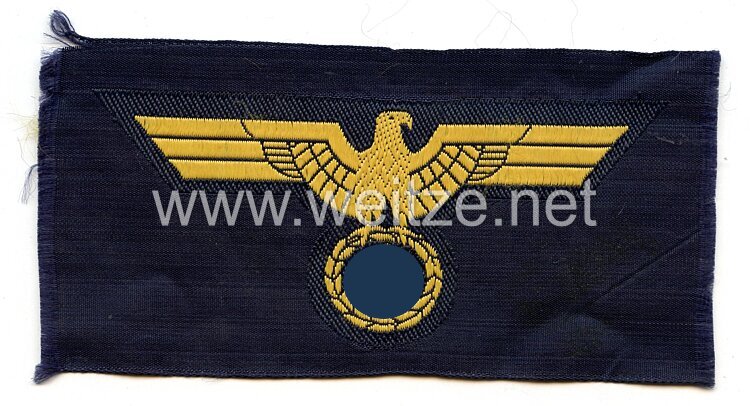
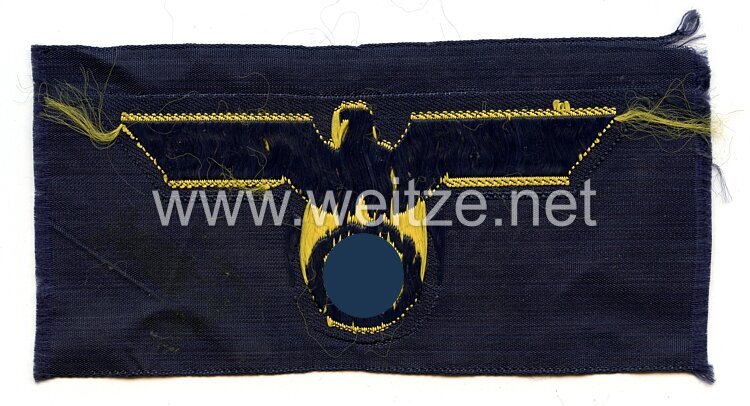
Kriegsmarine Breast Eagle for Enlisted Personnel

Bevo-woven version for the blue jumper. Unissued condition, grade 2.

Condition may vary.

Price per piece: 75 Euro.
453736
75,00

Kriegsmarine Breast Eagle for Enlisted Personnel

The Kriegsmarine breast eagle for enlisted men represents a significant element of German naval uniforms during World War II. These badges, manufactured using Bevo weaving technique, were characteristic of the service clothing worn by ordinary sailors and petty officers of the Kriegsmarine and differed markedly from the metal versions worn by higher ranks.

The Bevo weaving technique, named after the Barmer Bandweberei Ewald Vorsteher company, revolutionized the production of military insignia in the 1930s. This machine-weaving technique enabled the mass production of detailed emblems on a textile base that were both cost-effective and durable. The Bevo company was one of the main suppliers of textile insignia for the Wehrmacht and produced millions of these eagles during the war years.

The eagle for the blue blouse of the Kriegsmarine was manufactured on dark blue cloth, matching the base color of naval uniforms. The design featured the characteristic National Socialist national eagle with outstretched wings, clutching a swastika in its talons. The embroidery was typically executed in silver-gray or white thread to provide the necessary contrast against the dark blue background.

The introduction of these badges occurred as part of the Kriegsmarine uniform reform in the late 1930s. The Kriegsmarine dress regulations, defined in the Anzugordnung für die Kriegsmarine (A.O.K.), precisely specified the wearing method and position of the breast eagle. For enlisted men and petty officers, the eagle was to be attached to the right breast of the blue work and walking-out blouse, approximately at the level of the second row of buttons.

The rank groups within the Kriegsmarine differed in the type of their insignia. While enlisted men and petty officers wore textile eagles, officers used hand-embroidered or metal variants of higher quality. This differentiation reflected the strict hierarchy within the Navy and enabled immediate visual identification of rank.

The production of these badges was subject to strict quality controls and specifications. The Reichszeugmeisterei supervised manufacturing and ensured that all badges met prescribed standards. Nevertheless, there were various manufacturers, and slight variations in size, color tone, and weaving technique are detectable in specimens from different producers.

In the context of material shortages during the war, textile badges gained increasing importance. The Bevo weaving technique allowed the use of synthetic fibers and blended fabrics when natural materials became scarce. Towards the end of the war, however, even the quality of these badges noticeably deteriorated as substitute materials also became rare.

The breast eagle was worn on various uniform variants: the blue work blouse (drill blouse), the blue walking-out blouse, and occasionally on special uniforms. Proper attachment was achieved by sewing on all four sides to prevent slipping or detachment during service.

From a collecting-historical perspective, unworn specimens are of particular interest as they show the original condition without signs of wear. Such pieces often originate from depot stocks or were procured as replacement badges but never used. They document the manufacturing quality and original colors that could fade in worn specimens due to sunlight, washing, and mechanical stress.

The historical classification of these objects requires sensitivity. As components of National Socialist military uniforms, they are witnesses to a criminal dictatorship and a war of aggression. Their preservation in collections and museums serves exclusively for historical documentation and research. In Germany, the public display of swastikas and other NS symbols is subject to strict legal regulations, with exceptions for scientific and educational purposes.

For military-historical research, these badges provide valuable information about uniforming practices, manufacturing techniques, and the material culture of World War II. They complement written sources and photographic material and help reconstruct the everyday reality of naval personnel.

The technical execution of Bevo-woven eagles demonstrates remarkable craftsmanship. The weaving looms could produce intricate details including individual feather structures, the precise rendering of the swastika, and subtle shading effects through the use of different colored threads. This level of detail was achieved through specialized Jacquard-type looms that could handle complex patterns.

These insignia remain important historical artifacts that document a dark chapter of European history while simultaneously illustrating the technological and industrial capabilities of the period. Their study contributes to our understanding of military organization, supply systems, and the visual representation of totalitarian power.

r