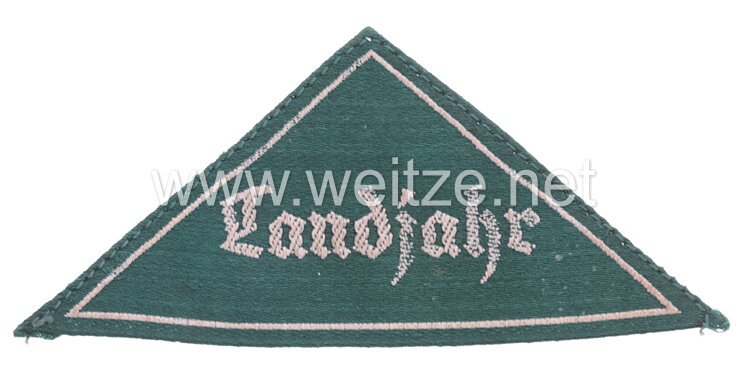
HJ Gebietsdreieck “Landjahr”
The HJ Gebietsdreieck "Landjahr" (Hitler Youth District Triangle "Land Year") represents a significant artifact of the National Socialist youth organization and its socio-political programs during the Third Reich era. This special badge was worn by members of the Hitler Youth (HJ) who participated in the Landjahr program, an initiative that obligated young people to work in rural areas.
The Landjahr was introduced in 1934 as part of National Socialist efforts to familiarize urban youth with rural life while simultaneously supporting agricultural production. The program required boys and girls aged 14 to 18 to spend one year working in rural areas before they could begin advanced education. This initiative was closely connected to the NS ideology of "Blood and Soil" (Blut und Boden), which romanticized the connection between the German people and the land.
The present district triangle is executed in white woven work on a green background. This color combination was characteristic of various HJ units and special programs. The green symbolized the connection to nature and agriculture, while the white lettering ensured readability and identifiability. Such badges were typically worn on the uniform, usually on the left upper arm, to indicate affiliation with a particular unit or program.
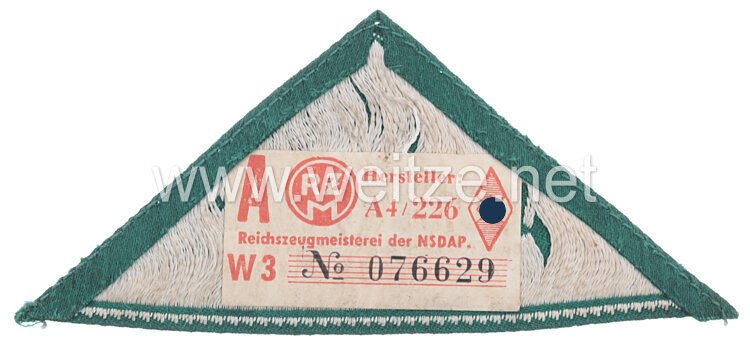
The presence of the RZM label is of particular significance for authenticating and dating the piece. The Reichszeugmeisterei (RZM) was the central testing and procurement office of the NSDAP, founded in 1929. From 1935 onward, RZM marking became mandatory for all uniform parts and badges of party organizations. The RZM system was intended to standardize quality, control production, and ensure that only authorized manufacturers produced these items. The label typically contained the RZM marking as well as a manufacturer's number identifying the specific producer.
The Gebietsdreiecke (district triangles) were part of a complex system of rank insignia and identifications within the Hitler Youth. The HJ was divided into various administrative units: Gebiete (the largest regional unit), Banne, Stämme, and Scharen. Each Gebiet often had its own characteristic badges identifying regional affiliation. However, the Landjahr badge was not a geographical but a functional identifier, indicating participation in this specific program.
The manufacture of such badges was carried out by various RZM-authorized companies. The weaving technique used in this specimen was a common production method that allowed for the creation of durable and washable badges. The white lettering was woven directly into the green base fabric, ensuring greater durability than embroidered or printed variants.
The Landjahr program itself evolved over the years. Initially conceived as a voluntary program, it became increasingly mandatory, especially for those who wished to attend higher schools or pursue certain professions. Participants were housed in Landjahr camps, where they were supervised by HJ leaders and performed both agricultural work and received ideological training.
From a historical perspective, such badges document the comprehensive organization and control that the NS regime exercised over youth. The Hitler Youth was not merely a recreational organization but an instrument for ideological indoctrination and preparation of youth for their future roles in the National Socialist state. The Landjahr program combined practical economic goals with ideological intentions.
For collectors and historians, such badges with RZM marking are particularly valuable as they represent authenticated original pieces. The indicated condition 2 suggests a well-preserved specimen that was likely worn but shows no significant damage. Such objects serve today as material testimonies of a dark period in German history and are important for historical research and education.
These artifacts remind us of the totalitarian control mechanisms employed by the Nazi regime, extending even to the most minute aspects of youth organization and identification. The systematic marking and categorization of youth through such badges reflects the broader Nazi tendency toward regimentation and control of all aspects of society. Today, these items are studied not to glorify this period but to understand the mechanisms of totalitarian control and to ensure that such dark chapters of history are neither forgotten nor repeated.