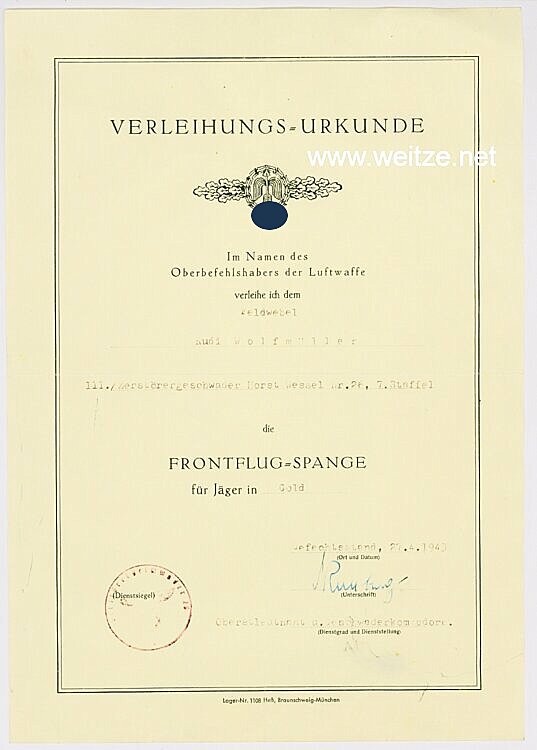
Front Flight Clasp for Fighters in Gold - Award Certificate

for a Feldwebel (Staff Sergeant) of 7. Staffel/III./Zerstörergeschwader Horst Wessel Nr. 26, issued on April 27, 1943. The DIN A4 pre-printed form is folded twice and somewhat creased.
219036
350,00

Front Flight Clasp for Fighters in Gold - Award Certificate

The Front Flying Clasp for Fighters in Gold represented one of the most significant decorations of the German Luftwaffe during World War II. This award certificate documents the honoring of a Feldwebel (sergeant) of the 7th Staffel of III. Gruppe of Zerstörergeschwader “Horst Wessel” No. 26, issued on April 27, 1943, at a time of intense aerial combat on all fronts.

The Front Flying Clasp was instituted by decree on January 30, 1941, and awarded in three grades: Bronze, Silver, and Gold. The gold grade for fighter and heavy fighter pilots required, according to regulations from June 26, 1942, proof of 500 operational points or alternatively 110 combat missions. These extraordinarily high requirements made the decoration one of the rarest and most prestigious in the Luftwaffe. Each combat mission was credited with one point, while special achievements such as aerial victories or successful attacks on ground targets earned additional points.

Zerstörergeschwader 26 “Horst Wessel” was established on May 1, 1939, and named after the National Socialist “martyr” Horst Wessel. The Geschwader was equipped with twin-engine heavy fighters, initially with the Messerschmitt Bf 110, later partially with the Messerschmitt Me 410. These Zerstörer (destroyers) were designed for combating enemy bombers and as escort protection. The III. Gruppe of the Geschwader was deployed at various theaters of war, including the Eastern Front, the Mediterranean, and in the defense of the Reich.

In April 1943, the time of the certificate's issuance, the German Luftwaffe found itself in an increasingly defensive position. Allied bombing raids on Reich territory were intensifying, and Luftwaffe losses were rising steadily. The Zerstörer units were increasingly deployed for Reich defense, where despite their original conception as an offensive weapon, they were used against the heavy four-engine bombers of the RAF and USAAF. The high number of operational points required for the gold clasp illustrates the extraordinary strain on crews during this phase of the war.

The award certificate itself followed a standardized form in A4 format, which was filled out and signed by the responsible commanders. These documents typically contained the name and rank of the recipient, his unit, the date of the award, as well as the signature and official seal of the awarding officer. The double folding and creased condition of such documents are characteristic of personal papers carried by soldiers - often as their most important possession and proof of their military achievements.

The rank of Feldwebel in the Luftwaffe corresponded to an experienced non-commissioned officer, frequently deployed as an aircraft pilot or gunner. In Zerstörer units, Feldwebels formed the backbone of operational strength, as they possessed extensive combat experience. The award of the gold Front Flying Clasp to a Feldwebel underscores his exceptional achievements over an extended period.

The preservation of such award certificates is of considerable historical significance. They document not only individual military careers but also enable the reconstruction of unit histories and the research of operational events. Many of these documents were lost in the chaos of the final months of the war, making preserved examples important primary sources for military-historical research today.

Zerstörergeschwader 26 suffered considerable losses during the course of the war. The heavy fighters proved increasingly vulnerable to Allied fighter aircraft, particularly when operating without their own escort protection. Nevertheless, the crews performed their duties under the most difficult conditions and achieved notable successes against Allied bomber formations.

The award of the gold Front Flying Clasp in April 1943 fell at a time when the Luftwaffe still possessed significant operational capabilities, but the first signs of later Allied superiority were already visible. For the crew members, the decoration meant recognition of their bravery and dedication under increasingly dangerous conditions.