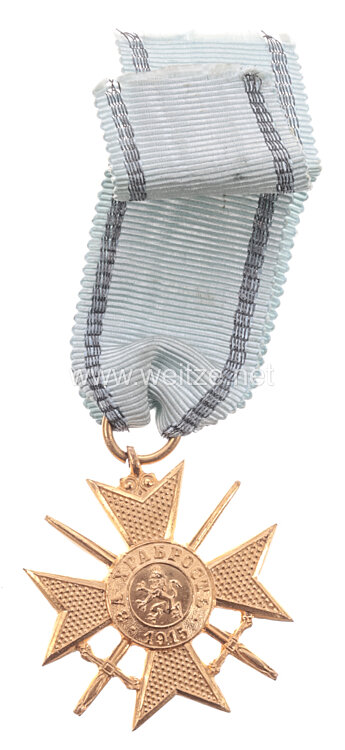
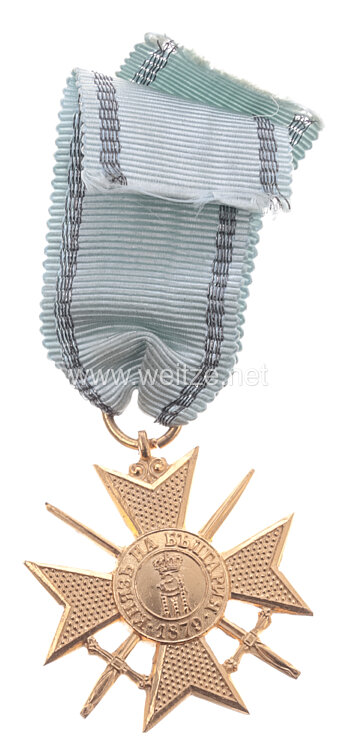
Bulgaria World War I Military Merit Cross with Swords in Gold 1915

Gilt bronze
465036
90,00

Bulgaria World War I Military Merit Cross with Swords in Gold 1915

The Bulgarian Military Merit Cross with Swords in Gold from 1915 represents a significant decoration of the Kingdom of Bulgaria during World War I. This decoration embodies the military honors culture of a state that entered the Great War on the side of the Central Powers, recognizing soldiers for exceptional bravery and distinguished service.

The Military Merit Cross (Bulgarian: Военен орден “За военна заслуга”) was originally established on December 20, 1879, by Prince Alexander I of Bulgaria, immediately following Bulgaria's independence from the Ottoman Empire. The decoration was intended to honor both military valor and outstanding service in war. The order system was awarded in several classes and distinguished between peacetime and wartime awards, with the wartime decorations featuring additional swords.

The gold version with swords represents one of the higher grades of this decoration and was awarded exclusively for extraordinary merit in active combat. The 1915 version is particularly significant in the context of World War I, when Bulgaria entered the war in October 1915 on the side of the Central Powers. This strategic decision under Tsar Ferdinand I was primarily motivated by territorial ambitions, especially the desire to reclaim territories lost in the Second Balkan War of 1913.

The material execution of this example in gold-plated base metal corresponds to the typical manufacturing method of this period. While peacetime versions were frequently manufactured in higher-quality materials, wartime resource scarcity from 1915 onwards necessitated the use of base metal alloys with gold plating. However, this in no way diminishes the historical significance or the value of the decoration for its recipients.

The design of the Military Merit Cross followed classical heraldic principles. The cross itself is typically fashioned as an enameled cross pattée, often in the Bulgarian national colors of white, green, and red. The swords, mounted between the arms of the cross, clearly symbolize the award for wartime merit. The obverse typically featured the Bulgarian state coat of arms or the tsar's monogram, while the reverse frequently bore inscriptions indicating the class of award.

The historical context of the 1915 awards is particularly significant. In this year, Bulgaria conducted its first major campaign against Serbia, which began in October. Bulgarian troops, operating alongside German and Austro-Hungarian forces, achieved significant military successes. Thousands of Bulgarian soldiers and officers were decorated for their bravery in these campaigns, with the Military Merit Cross being among the most frequently awarded decorations.

The award criteria were strictly regulated and required documented evidence of exceptional bravery, successful military leadership, or special strategic achievements. The gold version with swords was typically awarded to mid-ranking and senior officers, while enlisted soldiers more commonly received silver versions. The hierarchy of awards reflected the military rank structure and simultaneously served as a motivational instrument within the armed forces.

After the end of World War I and the defeat of the Central Powers in September 1918, Bulgaria was forced to accept significant territorial losses under the Treaty of Neuilly (1919). However, the Military Merit Cross remained as a symbol of Bulgarian military courage and national honor. Veterans wore their decorations with pride, even though the political objectives for which they had fought were not achieved.

Today, these decorations are important military-historical artifacts that provide insight into Bulgaria's complex history during World War I. They document not only individual heroism but also the broader geopolitical developments in the Balkans and Europe. Collectors and historians value these pieces both for their craftsmanship and for their historical significance as witnesses to a bygone era.

The study of Bulgarian military decorations from this period contributes to our understanding of the alliance systems, military campaigns, and national aspirations that characterized the First World War. The Military Merit Cross with Swords in Gold stands as a tangible reminder of the sacrifices made by Bulgarian servicemen and the tumultuous history of early 20th-century Southeastern Europe.