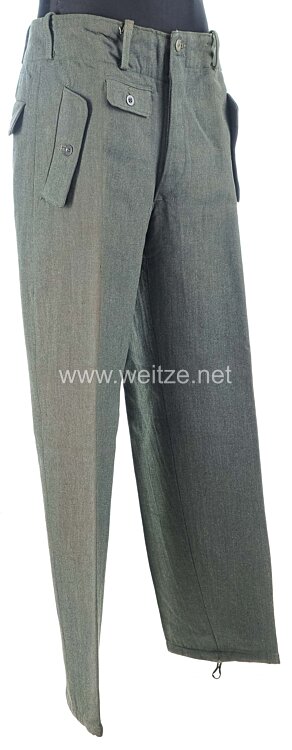
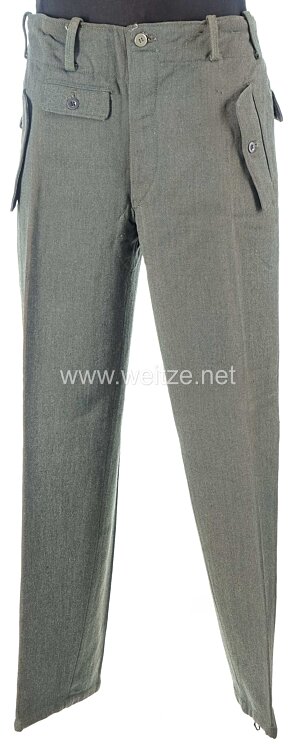
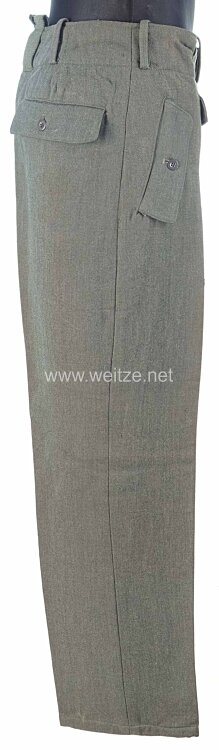
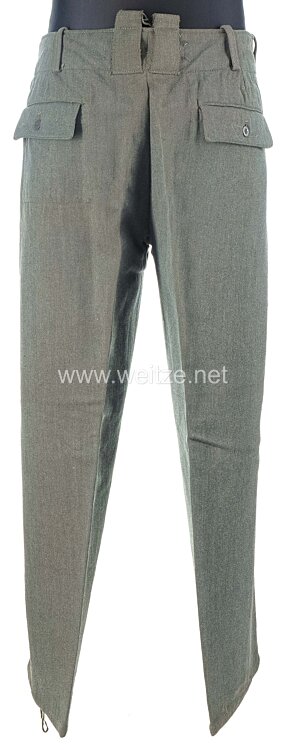
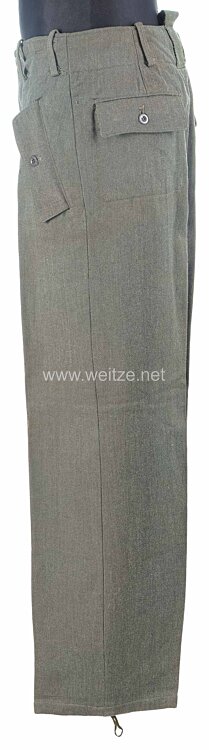
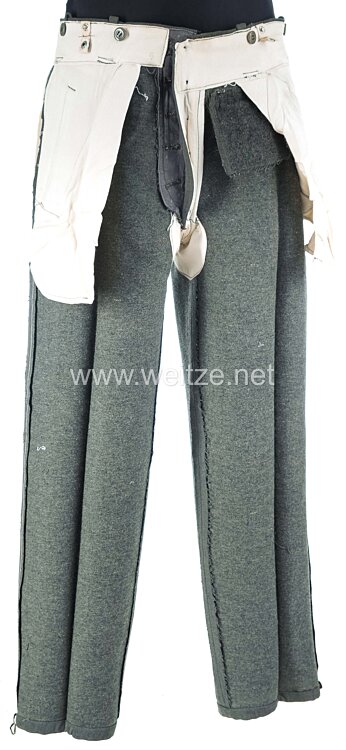
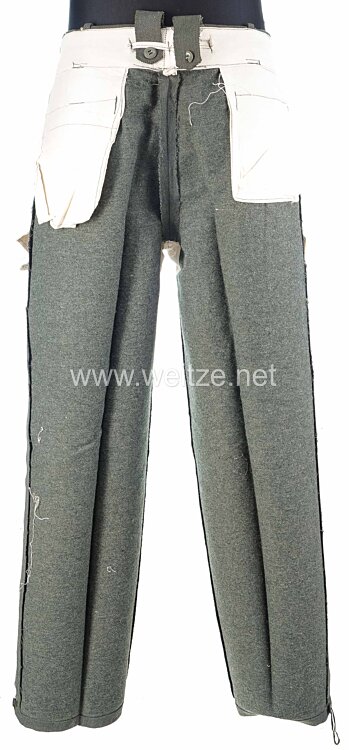
Waffen-SS Field-Gray Long Trousers M 44 for Enlisted Men
This field-grey uniform trousers represents a rare example of late-war Waffen-SS uniform production during the final years of World War II. The piece embodies the increasing material shortages and improvised production methods that characterized the German armaments industry from 1944 onwards.
The manufacture from Italian captured cloth is a clear indicator of the dramatic supply situation in the German Reich during this phase. After Italy's armistice with the Allies in September 1943 and the subsequent German occupation of large parts of Italy (Operation Achse), the Wehrmacht captured substantial quantities of military materials, including textiles and uniform fabrics. These captured stocks were systematically used for the production of German uniforms, as the domestic textile industry could no longer meet demand.
The M 44 model (Model 1944) represents one of the last simplifications in German uniform manufacture. The M 44 designation refers to simplified patterns and reduced processing standards that were introduced to accelerate production and conserve resources. Compared to earlier uniforms, less elaborate seams were used, and the overall workmanship was simpler.
The typical features of these trousers correspond to Waffen-SS guidelines for enlisted men's service trousers. The belt loops served to attach the belt, the central equipment belt to which numerous pieces of equipment were fastened. The watch pocket with flap was a characteristic feature of German military trousers and provided protection for the soldier's personal pocket watch. The trouser pockets with flaps served both practical purposes and protected the contents from weather conditions.
The absence of a depot stamp on the interior is not uncommon in late-war productions. While regular uniforms were usually marked with manufacturer stamps, size specifications, and acceptance stamps, the chaotic production situation from 1944 often meant that such administrative details were neglected. Manufacturing was increasingly distributed among smaller companies, suppliers, and even forced labor camps, leading to inconsistent marking practices.
The Waffen-SS as a military branch of the SS developed its own uniform standards during the war, which differed in details from those of the Wehrmacht. These differences were often subtle but concerned cut, pocket placement, and certain construction features. The trousers described here show the typical Waffen-SS design for enlisted ranks, that is, simple soldiers without officer rank.
The measurements of the trousers (waist circumference approximately 82 cm, total length approximately 103 cm) correspond to an average size for a soldier of that era. The German uniform administration used a complex size system that took various body measurements into account. The condition as a “worn piece in untouched original state” makes this object particularly valuable for historical research.
The rarity of such late-war uniforms is explained by several factors: many were destroyed in the chaos of war, disposed of after the war, or became unusable through wear and tear over the decades. Additionally, production numbers of M 44 variants were generally lower than those of earlier models, as industrial capacity was severely limited.
In historical context, these trousers represent the final phase of World War II, when the German Reich was already in military retreat and material shortages affected all areas of warfare. The use of captured material from Italy symbolizes the dependence on occupied territories and the increasing inability to meet military needs from domestic resources.
Such artifacts serve as tangible evidence of the economic and industrial collapse that accompanied Germany's military defeat. They document not only the evolution of military uniform design but also the broader story of wartime production, resource scarcity, and the desperate measures taken to maintain military forces in the face of overwhelming Allied superiority.