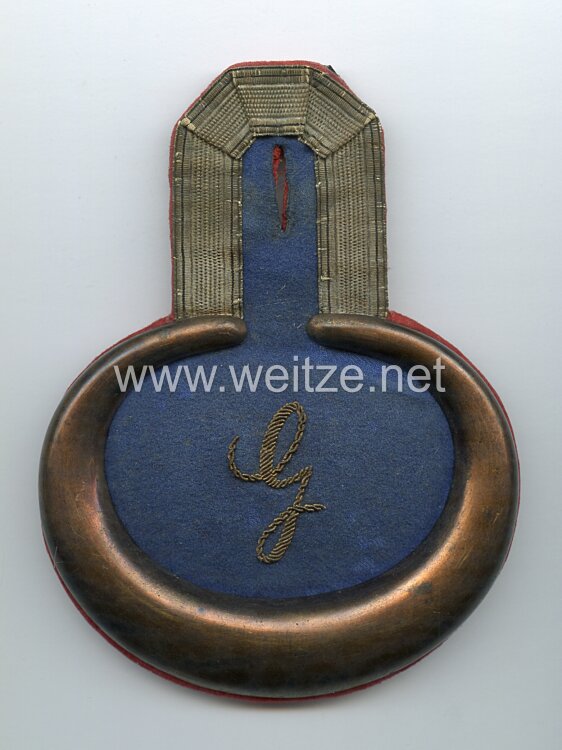
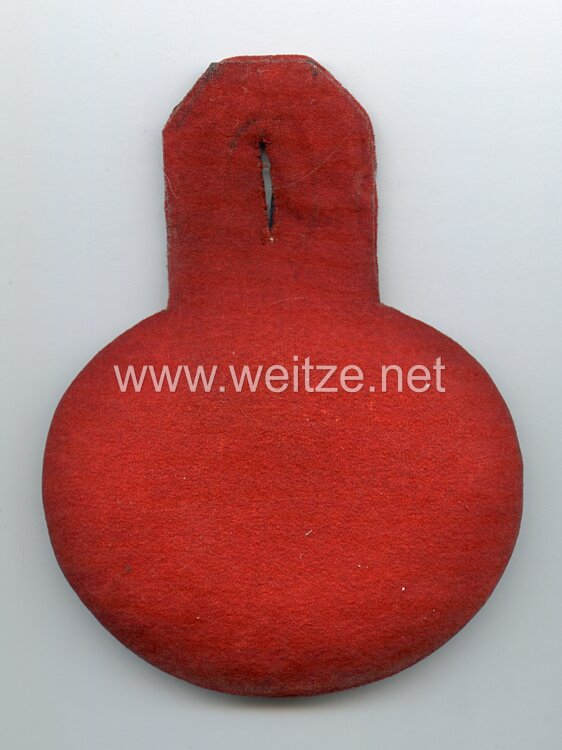
Prussia Single Epaulette for a Lieutenant of the Garde-Train-Abteilung

circa 1900. Blue field with gold embroidered “G”. Worn, condition 2. Very rare.
294735
300,00

Prussia Single Epaulette for a Lieutenant of the Garde-Train-Abteilung

This single epaulette of a Lieutenant of the Garde-Train-Abteilung (Guard Train Detachment) from around 1900 represents a rare and significant testimony to Prussian military history during the Wilhelmine era. Such rank insignia played a central role in the complex system of military hierarchy and identification in the German Empire.

The Garde-Train-Abteilung was a specialized unit within the Prussian Guard responsible for logistical tasks, material transport, and supply operations. The Train formed the backbone of military mobility and was indispensable for the smooth execution of maneuvers and campaigns. While Guard units were traditionally considered the elite of the Prussian army and directly subordinate to the Kaiser, the Train Detachment fulfilled vital support functions.

The characteristic blue field of the epaulette corresponds to the Waffenfarbe (branch color) of the Train, as stipulated by Prussian army uniform regulations. Branch colors served for rapid identification of different troop types: infantry wore white, cavalry various colors depending on regiment, artillery red, and the Train blue. This color coding had been systematically developed since the army reforms at the beginning of the 19th century.

The gold-embroidered "G" on the blue field indicates affiliation with the Guard. This simple yet significant initial distinguished Guard units from the regular line army. Gold embroidery was reserved for officers, while enlisted men and non-commissioned officers wore their rank insignia in wool. The craftsmanship of such embroidery required specialized skill, and renowned uniform accoutrement manufacturers in Berlin and other garrison cities competed for officers' patronage.

The fact that this is a single epaulette is noteworthy. Officers typically wore epaulettes in pairs or, in certain periods, a combination of epaulette and shoulder strap (Achselstück). A single epaulette could have various explanations: it might have been produced as a replacement, or its counterpart was lost over time. In some uniform configurations, only one epaulette was worn, for instance with certain walking-out or parade uniforms.

The rank of Lieutenant was the lowest officer rank in the Prussian army. Lieutenants were typically young men from the nobility or upper bourgeoisie beginning their military careers. Promotion to Lieutenant occurred after successful completion of war school or after proving oneself as an ensign. In the Guard, requirements were traditionally higher than in the line army, both regarding military qualification and social background.

Around 1900, the German Empire under Kaiser Wilhelm II was in a phase of intense military expansion and modernization. The army grew continuously, new technologies such as machine guns and modern artillery were introduced. Simultaneously, tradition and ceremonial remained of paramount importance, as evidenced by the elaborate design of uniforms and rank insignia.

The epaulette as a rank insignia has its roots in the 18th century, when it initially fulfilled practical functions – protecting the shoulder from the musket or saber strap. In the 19th century, it increasingly evolved into a purely decorative rank badge. The Prussian army adopted French influences but adapted them to its own system. By the late 19th century, epaulettes were increasingly replaced by more practical shoulder straps, especially for field service.

The rarity of this piece can be explained by several factors. The Garde-Train-Abteilung was a relatively small, specialized unit. Epaulettes for officers were produced in limited numbers, and many were lost over time or destroyed during the two World Wars and their aftermath. The turbulent years after 1918, when the monarchy collapsed and military insignia were often destroyed or hidden, significantly decimated the stock of preserved uniform parts.

For collectors and historians, such an object offers valuable insights into the material culture of Wilhelmine Germany. The workmanship, materials used, and craftsmanship document not only military hierarchies but also social structures, economic conditions, and aesthetic concepts of a bygone era. The epaulette is thus far more than a mere rank badge – it is a cultural object of considerable historical significance.

The condition of the piece, described as worn but well-preserved, adds to its authenticity. Unlike mint, unused examples that may have been warehouse stock, this epaulette was actually worn by an officer, making it a genuine artifact of military service. The traces of use connect us directly to the individual who once wore this insignia, though his identity remains unknown. Such personal connections to history make military collectibles particularly fascinating and valuable as teaching objects.

r