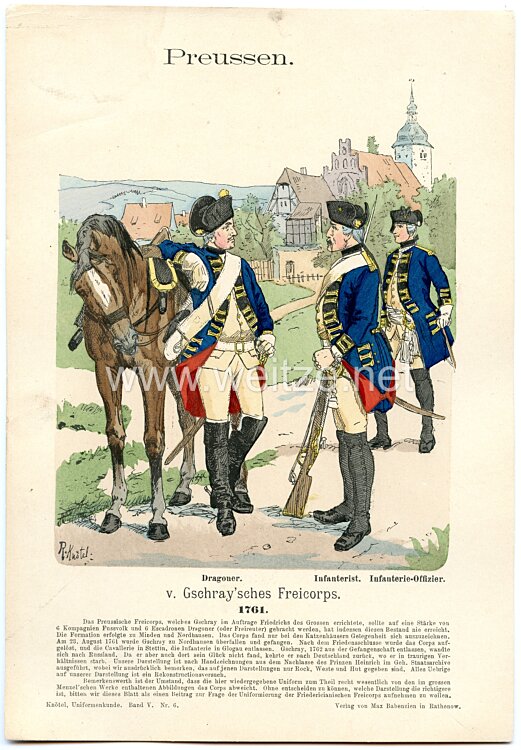
Knötel Uniform Plate “v. Gschray's Freikorps” 1761
The Knötel uniform plate depicting v. Gschray's Freicorps from 1761 represents a significant document of Prussian military history during the Seven Years' War (1756-1763). This type of uniform illustration belongs to the extensive body of work created by the Knötel family, who contributed to the scientific documentation of military dress over several generations.
Richard Knötel (1857-1914) was the most renowned representative of this artistic dynasty. His works, later continued by his son Herbert Knötel, created an invaluable collection of uniform illustrations that remain reference works for military historians and collectors to this day. The Knötel plates are distinguished by their meticulous accuracy and detailed depiction of uniforms, equipment, and weaponry.
The Freicorps von Gschray was one of numerous Freikorps formations that fought on the Prussian side during the Seven Years' War. Freikorps were irregular military units that stood outside the regular line infantry and cavalry. They were frequently raised by noble officers at their own expense and served primarily for reconnaissance, small war operations, raids, and security tasks. These formations were more flexible and mobile than regular troops and played an important role in the warfare of that era.
The Seven Years' War represented an existential threat to Prussia under Frederick II (Frederick the Great). Fighting against an overwhelming coalition of Austria, France, Russia, Sweden, and the Holy Roman Empire, Prussia had to mobilize all available military resources. In this situation, the Freikorps gained particular importance as they supplemented the regular forces and often undertook difficult tasks requiring greater tactical flexibility.
The uniforms of the Freikorps frequently differed from those of the regular Prussian army. While the line infantry wore strictly regulated uniforms in Prussian blue, the Freikorps often displayed more individualized uniforming. This was partly due to the independent organization of these units and the fact that their commanders had greater freedom in matters of equipment. Nevertheless, they remained part of the Prussian armed forces and ultimately fell under royal supreme command.
Uniform plates as military-historical sources are of inestimable value. In an era before photography, detailed drawings and watercolors were the only means of recording the appearance of soldiers from various epochs for posterity. Although the Knötel plates were largely created in the 19th and early 20th centuries, they were based on intensive archival studies, contemporary sources, and preserved uniform pieces. They became the standard reference work for German uniform studies.
The year 1761 marks a critical phase of the Seven Years' War. After the devastating battles of previous years, Prussia was at the end of its military and economic resources. Nevertheless, Frederick the Great continued the fight, and formations like the Gschray Freicorps made their contribution to Prussia's struggle for survival. The Freikorps often operated in occupied or contested territories and had to supply themselves through requisitions.
For collectors and militaria enthusiasts, original Knötel plates represent coveted objects. The stated condition 2 indicates a well-preserved example without serious damage. Such plates were produced in various formats and versions, from simple prints to hand-colored individual pieces. They served not only scientific purposes but also the training of military personnel and the entertainment of a historically interested public.
The systematic recording and depiction of historical uniforms gained importance in the 19th century as interest in national history and military traditions increased. The works of the Knötel family were part of this movement and contributed significantly to the professionalization of military history research. Their plates were used in numerous publications and inspired generations of uniform scholars.
Today, such uniform plates serve not only as collector's items but also as important sources for historical research, museum practice, and living history presentations. They enable the development of a visual understanding of past military cultures and contribute to the preservation of cultural heritage.