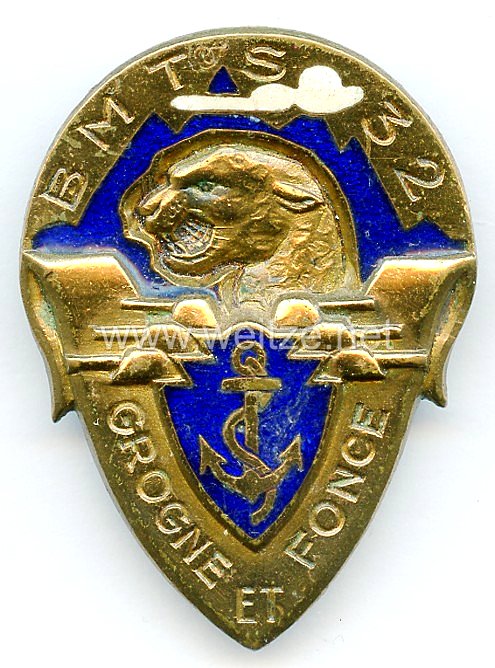
French Indochina Badge "32e Bataillon de Marche de Tirailleurs Sénégalais en Extreme Orient"

Maker "Arthus Bertrand Paris", Condition 2-
396835
55,00

French Indochina Badge "32e Bataillon de Marche de Tirailleurs Sénégalais en Extreme Orient"

The badge of the 32nd March Battalion of Senegalese Riflemen in the Far East (32e Bataillon de Marche de Tirailleurs Sénégalais en Extrême Orient) represents a significant military artifact from French colonial history, particularly from the era of the First Indochina War (1946-1954).

The Tirailleurs Sénégalais were colonial infantry units originally established in 1857 under the government of Napoleon III. Despite their name, these units were not recruited exclusively from Senegal, but from across French West Africa, including Mali, Burkina Faso, Benin, Guinea, and Ivory Coast. These soldiers played a crucial role in nearly all of France's military conflicts from the late 19th century through decolonization in the 1960s.

This badge was manufactured by Arthus Bertrand Paris, one of the most prestigious French makers of military insignia and decorations. The company, founded in 1803, quickly gained an excellent reputation for the quality of its products and became the official supplier for numerous French military units and state institutions. The signature “Arthus Bertrand Paris” on a badge guarantees its authenticity and high craftsmanship quality.

The Bataillons de Marche (March Battalions) were temporary formations assembled for specific campaigns or operations. In the context of Indochina, these units were frequently formed to meet the need for reinforcement troops in Southeast Asia. The 32nd Battalion was one such formation that mobilized African colonial soldiers for deployment in the Far East.

The Indochina War began in December 1946 when tensions between the French colonial power and the Viet Minh movement under Ho Chi Minh escalated into open conflict. France deployed a variety of troops, including units of the French Foreign Legion, French metropolitan units, North African troops, and the Tirailleurs Sénégalais. These African soldiers fought in the difficult tropical conditions of Indochina, terrain and climate completely different from their home regions.

The Tirailleurs Sénégalais distinguished themselves through their bravery and discipline, but suffered high casualty rates due to the intense guerrilla warfare conducted by the Viet Minh, tropical diseases, and extreme climatic conditions. Between 1946 and 1954, an estimated more than 60,000 West African soldiers served in Indochina, of whom thousands lost their lives or were wounded.

Regimental badges like this one fulfilled several important functions: they promoted esprit de corps and unity within the formation, served for identification purposes, and became important symbols of military honor and tradition. Soldiers wore these badges with pride, often on their uniform or headgear, and they became treasured mementos of military service.

After the end of the Indochina War with the devastating French defeat at Dien Bien Phu in May 1954, many of these temporary battalions were dissolved. The surviving soldiers returned to Africa, often without adequate recognition for their service. The history of the Tirailleurs Sénégalais and their contribution to French military campaigns was long neglected in official French historiography, but has received increasing attention in recent decades.

Today, badges like this are important historical artifacts that document not only military history but also bear witness to the complex history of French colonialism, the courage and sacrifice of African soldiers in distant conflicts, and the far-reaching effects of decolonization. They are valuable objects for collectors of military antiques and serve as material connections to a significant, though often forgotten, epoch of history.