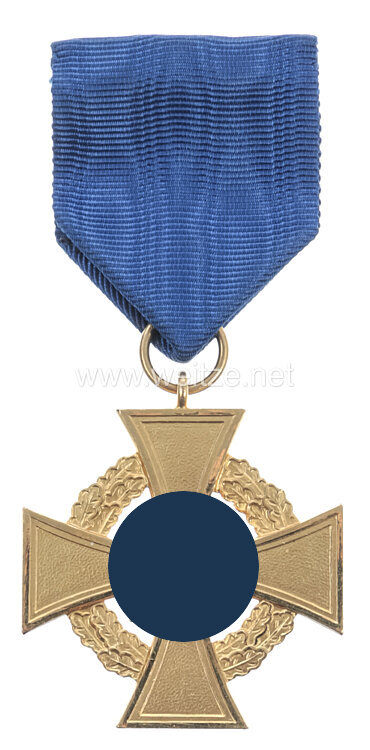
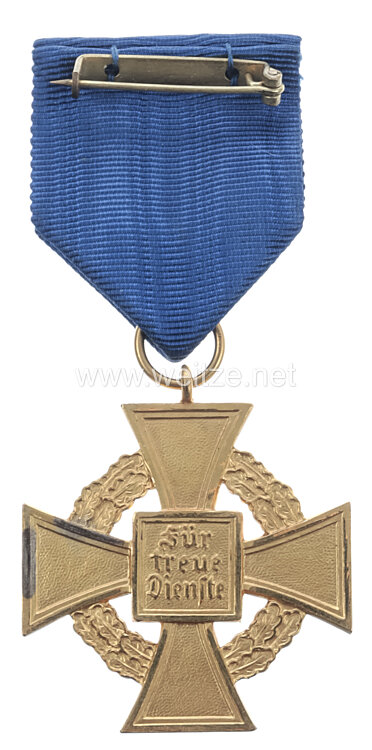
Faithful Service Decoration 1st Class for 40 Years

Gilt bronze, on ribbon with pin-back attachment.
466834
120,00

Faithful Service Decoration 1st Class for 40 Years

The Faithful Service Award 1st Class for 40 Years (Treudienst-Ehrenzeichen 1. Stufe für 40 Jahre) represents one of the highest decorations awarded in the German Reich for exceptionally long and faithful service in the public sector. This award was instituted through a decree of February 16, 1936 by Adolf Hitler and was part of a tiered system of honors designed to recognize the loyal service of civil servants, employees, and workers in public service.

The establishment of the Faithful Service Award occurred during a period when the National Socialist regime sought to promote and publicly recognize the loyalty and sense of duty among state employees. The award existed in four grades: for 25 years, 40 years, and 50 years of faithful service, with the 1st Class paradoxically representing 40 years of service, as the numbering system was arranged in reverse order to the length of service.

The present example consists of gilt base metal and is attached to the original ribbon with a pin. The design followed the official specifications of the founding charter: the award displays on the obverse the national emblem of the German Reich (eagle with swastika) surrounded by an oak leaf wreath, traditionally symbolizing strength, constancy, and honor. The reverse typically bears the inscription “Für treue Dienste” (For Faithful Service) along with the indication of years of service.

The award criteria were strictly regulated: eligibility for the award extended to Reich, state, and municipal civil servants, as well as employees and workers in public service who had completed the corresponding period of service without significant interruption or disciplinary violations. Forty years of service was a remarkable achievement that only a few state servants attained, making this class a particularly rare and valued decoration.

The ribbon of the award was designed in the German national colors: black-white-red, symbolizing the connection to German tradition and the Reich. The gilding of the award for 40 years of service emphasized the significance of this achievement compared to lower grades, which were made in silver or other materials.

The presentation was made in the name of the Führer and Reich Chancellor and was documented with an official certificate of award. The ceremony often took place in a formal setting and was considered an important element of National Socialist personnel policy, aimed at rewarding and promoting loyalty to the state and the regime.

From a historical perspective, the Faithful Service Award stands in the tradition of German service decorations dating back to the 19th century. Similar awards for long and faithful service were already being conferred in the individual German states and during the Imperial period. The National Socialist regime deliberately connected to these traditions to suggest continuity while simultaneously imbuing the awards with their own symbolism and ideology.

After the end of World War II in 1945 and the collapse of the German Reich, all National Socialist decorations were banned by the Allies. Control Council Law No. 1 of September 20, 1945, explicitly prohibited the wearing of orders and decorations bearing National Socialist symbols. In the Federal Republic of Germany, this regulation was maintained, with subsequent laws criminalizing the display of swastikas and other Nazi symbols.

Today, such awards are subjects of historical research and military-historical collections. They document a dark chapter of German history and serve as sobering testimony to the instrumentalization of loyalty and duty by a totalitarian regime. Collectors and historians value these objects as authentic witnesses of their time, whereby the scientific and educational context should always remain paramount.

The craftsmanship quality of the awards varied considerably depending on the period of manufacture. Early examples from the years 1936 to approximately 1942 typically display high-quality workmanship with careful gilding. Toward the end of the war, when material shortages prevailed, quality often declined and substitute materials were employed.

The Faithful Service Award represents not only a piece of material culture from the Nazi period but also reflects the regime's systematic attempt to bind civil servants and public employees to the state through symbolic recognition. The 40-year service requirement meant that recipients had often begun their careers during the Imperial or Weimar periods, making them witnesses to profound political transformations in German history.